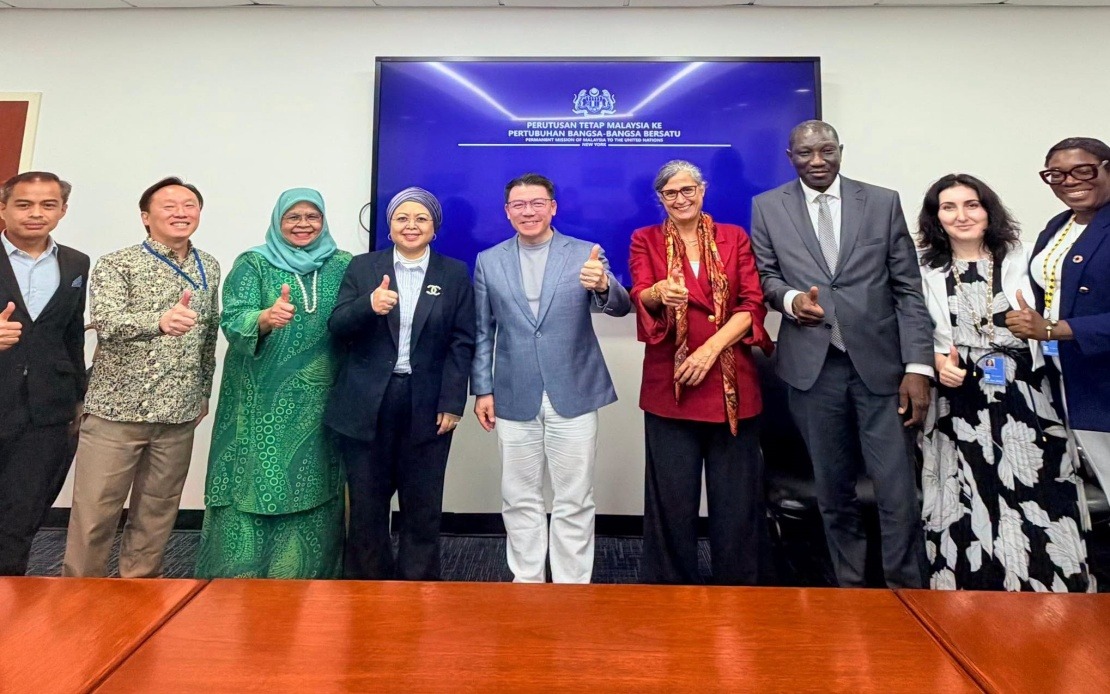
Housing and Local Government Minister Nga Kor Ming has delivered a stark message to the global community at the United Nations: words alone will not solve the world's mounting urban challenges. Speaking at the High-Level Meeting on the Midterm Review of the New Urban Agenda at UN Headquarters in New York, Nga stressed that as President of the UN-Habitat Assembly, Malaysia views this year's review as a critical juncture where nations must shift from merely documenting failures to implementing tangible solutions that improve the lives of billions of urban dwellers worldwide.
The minister's intervention highlights growing frustration among developing nations with the slow pace of progress on sustainable urbanisation goals. With only four years remaining until 2030, Nga's argument that a midterm review becomes meaningless if it only catalogs shortcomings resonates with countries struggling to balance rapid urban growth against resource constraints and competing development priorities. His call for an "inflection point" suggests Malaysia believes the current trajectory of implementation falls dangerously short of what the world's exploding cities actually require.
Central to Malaysia's position are three interconnected crises afflicting urban areas globally. The housing shortage remains perhaps the most visible problem, with inadequate affordable accommodation fueling slum expansion and homelessness across the developing world. Simultaneously, the digital divide persists in marginalizing lower-income urban populations from economic opportunities and essential services. Climate resilience represents the third pillar of Nga's framework, acknowledging that cities in vulnerable regions face intensifying risks from extreme weather events that existing infrastructure often cannot withstand. These three challenges demand simultaneous, coordinated responses rather than piecemeal initiatives.
Malaysia has positioned itself as a practical demonstrator of what inclusive urban development can achieve. The country's promotion of the Asia-Pacific Urban Action Platform with regional partners offers a model of how larger nations can facilitate knowledge exchange and financial cooperation among developing economies without imposing external prescriptions. By emphasizing locally driven solutions and political commitment from governments, rather than top-down international mandates, Malaysia presents an alternative approach that may resonate with nations wary of colonialism echoes in global governance structures.
The green building sector exemplifies Malaysia's commitment to translating policy into measurable outcomes. With over 500 million square feet of green index buildings already constructed and more planned before 2030, Malaysia demonstrates that sustainable infrastructure expansion is technically feasible and economically viable when political will exists. This concrete achievement strengthens Nga's credibility when he exhorts other nations to invest substantially in climate-resilient infrastructure rather than merely endorsing aspirational declarations.
The MADANI Economy framework that Malaysia invokes as its overarching development philosophy reflects a deliberate effort to integrate sustainable urbanisation into broader national economic strategy. By naming and consistently referencing this framework, Nga signals that Malaysia does not compartmentalize urban development as a separate policy domain but rather weaves it through all economic decision-making. This holistic approach, he implicitly argues, produces better outcomes than treating urbanisation as an isolated concern addressed by local government ministers alone.
Regional cooperation emerges as essential to Malaysia's vision for accelerated progress. The Asia-Pacific Urban Action Platform specifically targets the Sustainable Development Goals, acknowledging that the 2030 Agenda's 17 interconnected objectives cannot be achieved through isolated sectoral efforts. Cross-border knowledge sharing becomes particularly valuable in a region where nations face remarkably similar urbanisation challenges—rapid metropolitan expansion, aging housing stocks in developed areas, environmental degradation, and insufficient financing for infrastructure upgrading. By facilitating such exchange, Malaysia positions itself as a regional leader without wielding coercive power.
Nga's repeated emphasis on ensuring that "no community is left behind" addresses a fundamental anxiety underlying urban development debates in Southeast Asia and beyond. Rapid urbanisation frequently benefits elites and middle classes while marginalizing the poor, indigenous populations, and other vulnerable groups. Malaysia's insistence that equity must be central to sustainable city-building reflects both moral principle and pragmatic recognition that cities built on exclusion breed social tension, political instability, and ultimately unsustainable development patterns. This framing appeals to civil society organizations and grassroots communities whose participation Nga explicitly acknowledges as essential.
The minister's recognition of contributions from UN General Assembly President Annalena Baerbock, Secretary-General António Guterres, UN-Habitat Executive Director Anacláudia Rossbach, and various stakeholder groups reflects the diplomatic delicacy required in multilateral forums. Yet beneath courteous acknowledgments lies a fundamental challenge: how to mobilize genuine commitment from governments often struggling with immediate domestic fiscal pressures. The two-day meeting's theme, "Delivering Sustainable Urbanisation for All: Accelerating and Scaling Implementation of the New Urban Agenda to 2036 Together," extends the timeline to 2036 while maintaining 2030 targets—suggesting either ambitious optimism or acknowledgment that current trajectory falls short.
For Malaysia and other Southeast Asian nations, the stakes extend beyond abstract developmental goals. Rapid urbanisation represents perhaps the defining transformation reshaping the region's future. Cities like Kuala Lumpur, Bangkok, Jakarta, Manila, and Ho Chi Minh City face mounting congestion, environmental degradation, housing shortages, and service delivery challenges that demand sustained, serious investment. Nga's intervention at the UN signals Malaysia's determination to position itself not merely as a problem-solver but as a solutions-exporter, offering Southeast Asia's accumulated experience to the broader developing world.

