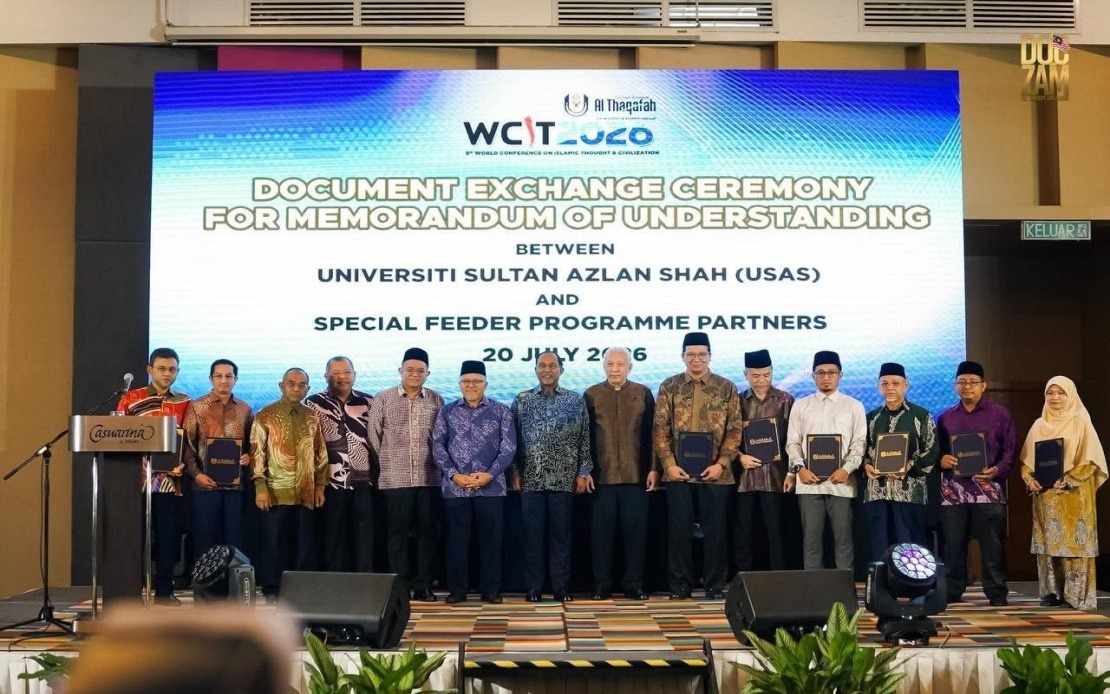
Malaysia is reasserting its ambition to serve as a nexus for intellectual discourse and a global hub for advanced learning, positioning the nation as a strategic partner in constructing a knowledge-driven ecosystem that transcends parochial boundaries. Higher Education Minister Datuk Seri Dr Zambry Abdul Kadir articulated this vision in recent remarks, underscoring that the country's higher education sector must continue cultivating spaces where diverse intellectual traditions converge and strengthen one another. The minister's statement arrives as the country prepares to host the 8th World Conference on Islamic Thought and Civilisation (WCIT2026), an event designed to convene scholars, researchers, and intellectual leaders from across the globe in sustained conversation about contemporary challenges facing both Islamic societies and the international community at large.
The upcoming conference represents more than a ceremonial gathering of academics. It functions as a deliberate platform for generating actionable insights and collaborative solutions that can address pressing problems confronting both the Muslim world and humanity broadly. By hosting such a forum, Malaysia demonstrates its readiness to facilitate cross-border scholarly networks and foster the kind of institutional cooperation that produces substantive intellectual progress. The three-day event, which commenced this week, aims to yield concrete resolutions and innovative frameworks capable of advancing the Islamic world while simultaneously contributing to global welfare and mutual understanding.
Central to the minister's vision is a fundamental assertion that knowledge transcends the narrow confines of national interest or civilisational boundaries. Zambry stressed that education must operate as a domain insulated from the corrosive effects of political rivalry, armed conflict, and technological determinism. This framing challenges the troubling contemporary trend of weaponising educational institutions and treating intellectual heritage as the possession of particular nations or religious traditions rather than as humanity's collective treasure. Such rhetoric carries particular resonance in Southeast Asia, where Malaysia's multicultural composition demands careful stewardship of inclusive educational values.
The minister's address drew pointed historical lessons from instances where the destruction of universities and libraries has signalled civilisational collapse. References to the fall of Baghdad, the loss of Granada, the siege of Sarajevo, and the ongoing Palestinian conflict serve as sobering reminders that when centres of learning are deliberately obliterated, societies lose not merely physical infrastructure but the intellectual foundations necessary for future advancement. These examples underscore why Malaysia's commitment to protecting and promoting higher education institutions—whether through domestic policy or international partnership—carries profound moral weight. The implication for policymakers across the region is clear: educational institutions represent irreplaceable assets requiring urgent protection during periods of geopolitical turbulence.
Datuk Seri Dr Zambry's emphasis on integrity-driven leadership and competitive academic institutions reflects a sophisticated understanding of why the Islamic world must modernise its educational ecosystem. Rather than indulging nostalgia for past intellectual achievement, he contends that Muslim-majority societies must invest in contemporary research capacity, innovation infrastructure, and institutional excellence. This position potentially influences higher education policy across Southeast Asia, where Malaysia functions as a model and influence centre. By coupling this ambition with explicit commitment to values-based knowledge frameworks, the minister attempts to reconcile modernisation imperatives with ethical and religious considerations—a balancing act that resonates with policymakers throughout the region.
The conference itself demonstrates Malaysia's practical commitment to these principles. The inaugural gathering in Ipoh, attended by more than 180 international delegates, assembled scholars and thinkers from multiple countries united by a shared conviction that rigorous intellectual engagement remains essential for confronting global crises. This assembly of expertise creates conditions for generating ideas that might otherwise remain siloed within national or institutional boundaries. For Malaysia, hosting such gatherings burnishes its reputation as a destination for serious intellectual work while simultaneously positioning Southeast Asia as a region capable of contributing meaningfully to global conversations about civilisational futures.
The emphasis on inclusive, progressive, and values-based knowledge frameworks also reflects Malaysia's unique position within the Islamic world and within Southeast Asia more broadly. As a Muslim-majority nation with significant non-Muslim populations and with deep historical roots in regional maritime networks, Malaysia can credibly champion approaches to knowledge creation that respect religious perspectives while remaining open to secular scholarship and cross-cultural learning. This middle-ground positioning, if executed authentically, could make Malaysia genuinely influential in shaping how Islamic societies approach higher education reform and international academic collaboration.
Yet the minister's aspirations must confront real constraints. Malaysian higher education institutions, while respected regionally, remain marginal players in global research rankings and international knowledge production. Successfully positioning Malaysia as a true centre of excellence demands sustained investment in research infrastructure, competitive faculty recruitment, and institutional autonomy protections that allow academic communities to pursue truth wherever intellectual inquiry leads. The government's role in facilitating dialogue and creating institutional space for international collaboration must be balanced against the pressing need to enhance domestic research capacity and global visibility.
The WCIT2026 conference ultimately serves as both a practical gathering and a symbolic statement about Malaysia's role in the contemporary world. By hosting international scholarly discourse and emphasising knowledge's universal character, the country signals its rejection of zero-sum civilisational competition in favour of collaborative problem-solving. Whether these aspirations translate into measurable advances in Malaysia's higher education standing and regional intellectual influence will depend on translating rhetorical commitments into concrete policy innovations, sustained funding, and institutional reforms that empower Malaysian universities to compete globally while remaining grounded in local values and regional responsibilities.

