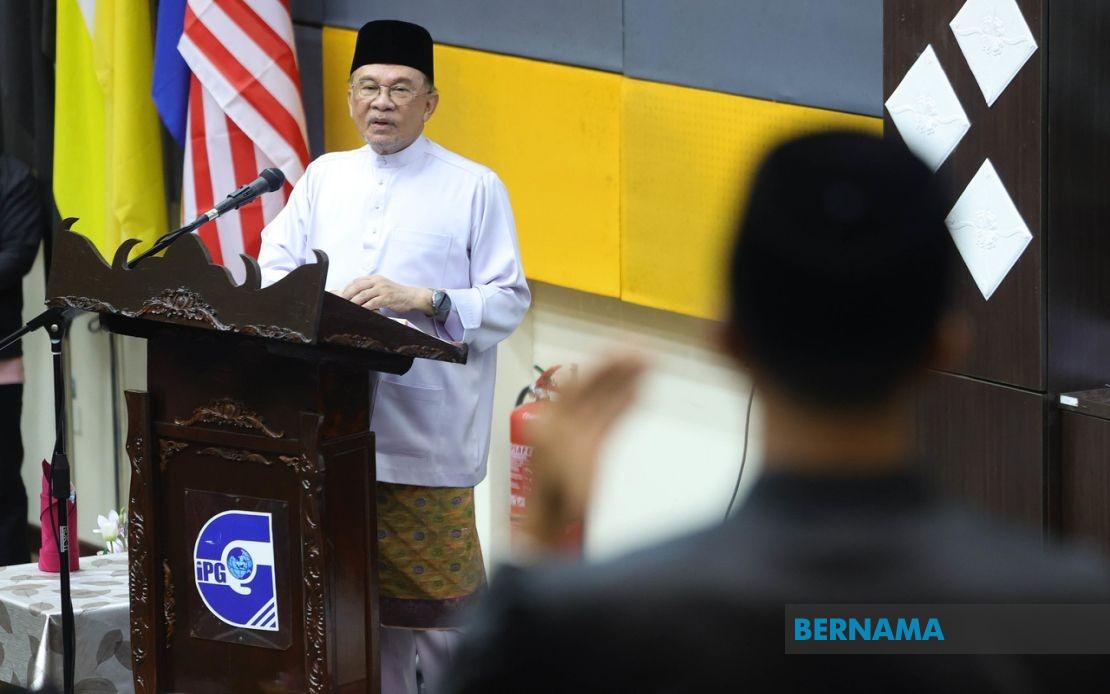
Malaysia's education system stands at a crossroads, requiring educators who can navigate both cutting-edge technology and timeless moral principles, according to Prime Minister Datuk Seri Anwar Ibrahim. Speaking at an event in Nilai attended by Education Minister Fadhlina Sidek and IPGKPT director Dr Kartini Abdul Mutalib, Anwar outlined a vision for pedagogical advancement that transcends the conventional debate between technical competence and humanistic education.
The Prime Minister articulated a concern increasingly voiced across Southeast Asia: that rapid technological change demands curriculum innovation and teacher development in Science, Technology, Engineering and Mathematics fields, particularly artificial intelligence and related disciplines. Without such adaptation, Malaysia risks falling behind in the global digital economy and witnessing its competitive advantage erode. Yet Anwar's framing goes beyond the typical technocratic approach often favoured by policymakers focused solely on workforce readiness and economic metrics.
Central to his message is the conviction that technological prowess divorced from ethical grounding creates a hollow education system. The phrase he invoked—"reach for the skies while keeping our roots on the ground"—encapsulates a philosophy that rejects the false choice between modernity and tradition. For Malaysian educators, this carries particular weight given the nation's multicultural fabric and constitutional commitment to preserving religious and cultural diversity. Teachers equipped only with data science skills but lacking understanding of character development and moral reasoning would be ill-equipped to address the ethical dilemmas their students will face in an AI-driven world.
Anwar's emphasis on character and values assumes heightened significance when viewed through the lens of social cohesion. He explicitly cautioned that education becomes counterproductive when it fosters divisive sentiments rooted in racial or religious prejudice. This warning reflects genuine concerns within multiracial societies about how technological platforms and algorithmic systems can amplify existing biases and deepen communal fractures. Teachers who understand both the capabilities and pitfalls of technology, combined with commitment to inclusive values, become crucial gatekeepers against such degradation.
The Prime Minister's insistence that diversity should strengthen rather than weaken national bonds presents an alternative to more insular educational philosophies. In a region where tensions periodically surface along sectarian and ethnic lines, education systems that deliberately cultivate tolerance and mutual respect operate as stabilising forces. Malaysian teachers tasked with this mission require not only pedagogical training in new technologies but also professional development grounded in intercommunal understanding and conflict prevention.
What Anwar proposed implicitly challenges the compartmentalisation often seen in Malaysian education policy, where technical training and values-based education operate in separate silos. The integration he advocates demands more sophisticated teacher preparation programmes that weave together computational thinking with ethical reasoning, artificial intelligence literacy with cultural sensitivity. This represents a significant departure from conventional international development frameworks that frequently prioritise STEM expansion without corresponding investment in the humanistic dimensions of pedagogy.
For policymakers tasked with implementing such vision, practical questions emerge. How should teacher training institutions like IPGKPT restructure curricula to ensure that every graduate—whether specialising in mathematics, science, or technology—demonstrates competency in ethical reasoning and cultural awareness? What institutional mechanisms might prevent technological training from becoming purely instrumental, disconnected from broader questions of purpose and value? The Prime Minister's vision requires sustained, coordinated effort across education departments, professional bodies, and institutions responsible for educator development.
Regional comparisons prove instructive. Several Southeast Asian nations have begun experimenting with integrated curricula that blend technical and humanistic education, yet systematic implementation remains inconsistent. Malaysia, with its established institutional infrastructure and relatively advanced technological ecosystem, possesses advantages that could position it as a regional model if implementation proves effective. However, rhetoric alone, however eloquent, cannot bridge the gap between aspirational vision and classroom reality without sustained commitment to resource allocation and professional support.
The economic implications are also notable. Employers increasingly report that while technical skills remain essential, they value graduates demonstrating emotional intelligence, ethical judgment, and collaborative capacity—precisely the human-centred qualities Anwar highlighted. Teachers cultivating such attributes in students contribute directly to workforce development aligned with contemporary labour market demands. Yet this pragmatic benefit should not overshadow the deeper point: that education serves purposes transcending economic utility.
Anwar's framework also acknowledges that technology itself is not neutral—the systems educators teach and the values embedded within them reflect choices. Teachers understanding this non-neutrality can guide students toward conscious, critical engagement with technological tools rather than uncritical adoption. This capacity for critical technological citizenship becomes increasingly vital as artificial intelligence systems influence more consequential domains of Malaysian life, from healthcare to criminal justice.
Implementing the vision requires sustained political will and institutional change extending well beyond rhetorical commitment. Professional development programmes must be redesigned, teacher compensation structures adjusted to attract talent capable of bridging technical and humanistic domains, and examination systems reformed to assess character and values alongside technical competence. Educational institutions require autonomy and resources to experiment with innovative pedagogical approaches without excessive bureaucratic constraint.
For Malaysia and other developing economies navigating rapid technological transformation, the challenge is neither choosing between tradition and modernity nor treating them as incongruous domains requiring compartmentalised expertise. Instead, the path forward demands educators—and education systems—that integrate these dimensions seamlessly. The Prime Minister's call represents an important articulation of this integrated vision, one that recognises teachers as architects not merely of technical competence but of character, conscience, and national cohesion.

