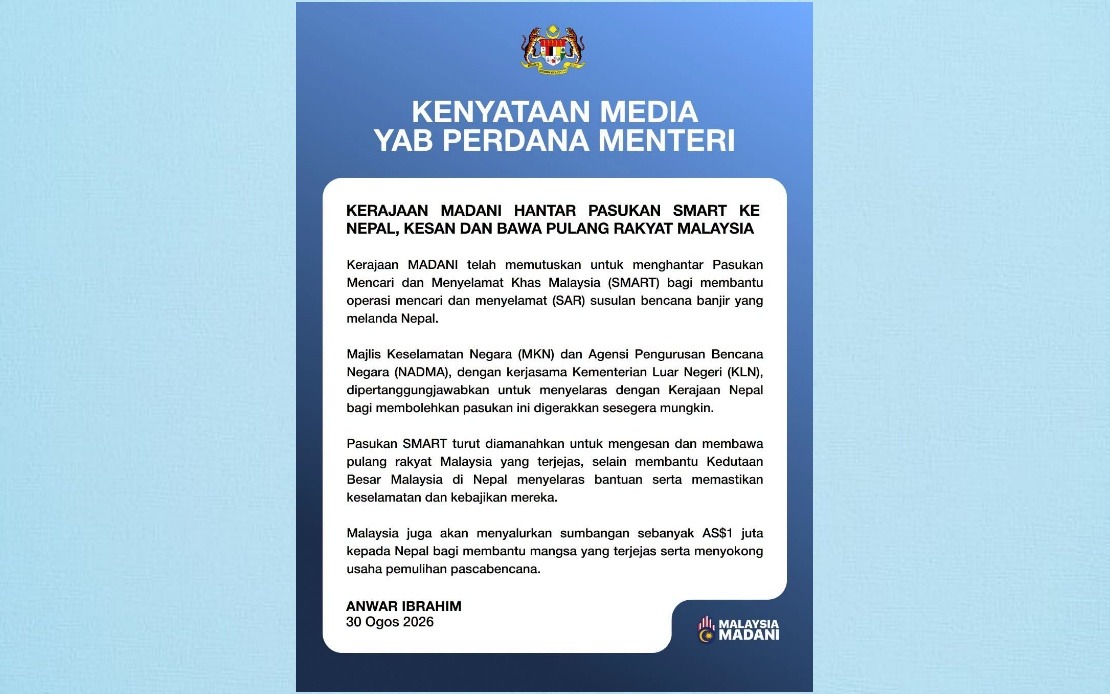
Malaysia has activated its international disaster response capability in the wake of catastrophic flooding that ravaged Nepal's Rasuwa district on August 26, dispatching its specialist SMART team and pledging substantial financial support to one of South Asia's most vulnerable nations. Prime Minister Datuk Seri Anwar Ibrahim announced the dual commitment to address both the immediate humanitarian crisis and the specific concerns of Malaysian nationals caught in the disaster zone.
The decision to deploy the Special Malaysian Disaster Assistance and Rescue Team represents a significant international engagement, reflecting Malaysia's role as a responsible member of the broader Asian community and its capacity to contribute technical expertise during emergencies. The SMART team brings trained personnel and equipment specifically configured for search and rescue operations in challenging terrain—a critical asset given that the flooding and subsequent landslides have created extremely hazardous conditions across mountainous regions of Nepal.
Coordination of the response falls to several key Malaysian institutions working in concert. The National Security Council and the National Disaster Management Agency, partnering with the Foreign Ministry, have been given responsibility for liaising with Nepal's government to ensure smooth deployment and operational integration with local authorities. This multi-agency approach reflects the complexity of mounting an effective international rescue operation, which demands not only technical capability but also diplomatic finesse and administrative coordination.
Beyond search and rescue operations, the SMART team has been assigned an equally critical humanitarian function: locating and assisting Malaysians who have been affected by the flooding. The Malaysian Embassy in Nepal will work alongside the rescue team to ensure that affected citizens receive proper support, medical attention, and logistical assistance for evacuation if necessary. This dual mandate—providing general disaster relief while prioritising the welfare of nationals—is a standard feature of Malaysian international assistance efforts.
The scale of concern regarding Malaysian citizens became apparent when the Foreign Ministry disclosed that 55 Malaysians remained uncontactable following the August 26 disaster. Many of these individuals are likely tourists or temporary visitors caught unexpectedly in the flooded region, though some may be longer-term residents or business people. The inability to establish contact with this number of nationals underscores both the severity of the disaster's impact on communications infrastructure and the genuine peril faced by those in affected areas.
The US$1 million financial contribution that Malaysia is providing represents a meaningful commitment to Nepal's immediate response and longer-term recovery. This assistance will support emergency relief operations, medical interventions, and the restoration of critical infrastructure—roads, bridges, water systems, and electricity networks—that have been severely compromised by the flooding and landslides. For a country of Nepal's economic capacity, foreign donations constitute essential resources that accelerate recovery and reduce the humanitarian burden on already stretched local authorities.
Nepal's geography makes it particularly vulnerable to such disasters. The country's mountainous terrain, with valleys carved by numerous rivers, creates conditions where intense rainfall generates devastating flash floods and triggers cascading landslides. The Rasuwa district, located in the central Himalayan region north of Kathmandu, is especially prone to such events during the monsoon season. August's flooding follows a pattern of increasing disaster frequency that climate scientists attribute partly to shifting weather patterns affecting the broader South Asian region.
For Malaysia, this engagement with Nepal's crisis illustrates the interconnectedness of modern Asia and the expectation that wealthier, better-resourced nations will mobilise assistance when their neighbours face catastrophe. SMART team deployments, though not routine, have become a recognised component of Malaysian foreign policy during major regional emergencies. These operations serve multiple purposes: providing genuine humanitarian aid, protecting Malaysian interests and nationals abroad, and enhancing Malaysia's standing within the regional diplomatic community.
The decision also carries implications for regional cooperation mechanisms. Malaysia's response demonstrates the value of maintaining operational readiness in disaster response capabilities, a capacity increasingly important as climate change drives more frequent extreme weather events across Southeast Asia and South Asia. The experience gained through SMART deployments contributes to broader knowledge-sharing within regional frameworks such as ASEAN, which has developed cooperative protocols for disaster management and mutual assistance.
For Malaysians with family or business connections in Nepal, the deployment of SMART and the government's explicit commitment to locating and assisting affected nationals provides some reassurance during a frightening situation. The establishment of dedicated coordination through the Malaysian Embassy ensures that consular assistance, which might otherwise be overwhelmed, receives dedicated attention to the specific needs of Malaysian citizens.
The flooding in Nepal also serves as a sobering reminder of natural disaster risks that extend across borders and affect both wealthy and developing nations. Malaysia itself remains vulnerable to floods, landslides, and other hazards, making international cooperation and knowledge exchange in disaster management a matter of enlightened self-interest as well as humanitarian principle.

