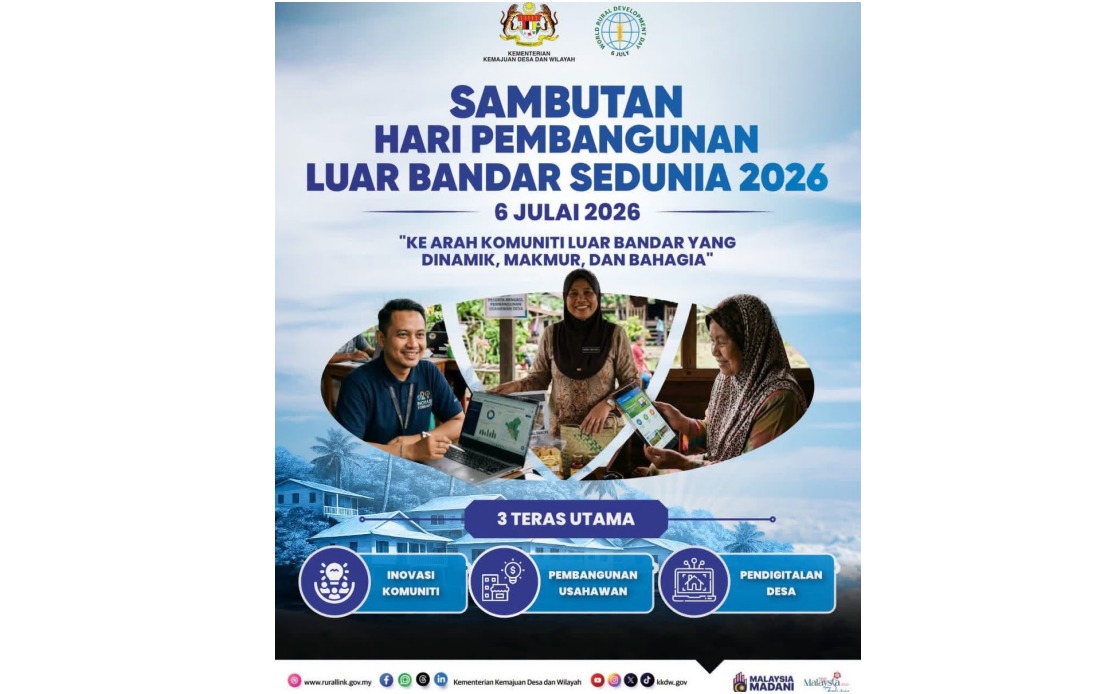
Malaysia will host its inaugural World Rural Development Day (WRDD) celebration at Tun Abdul Razak Stadium in Jengka, near Maran, marking a significant milestone in the nation's commitment to recognising and supporting rural communities. The event, scheduled for July 6, represents Malaysia's formal participation in a globally established observance that gained official status just last year. Deputy Prime Minister and Minister of Rural and Regional Development Datuk Seri Dr Ahmad Zahid Hamidi will preside over the ceremony, underscoring the federal government's prioritisation of rural development as a cornerstone of national advancement.
The celebration carries the thematic banner "Toward Vibrant, Prosperous and Happy Rural Communities," reflecting a comprehensive vision that extends beyond mere economic metrics to encompass quality of life improvements across Malaysia's rural regions. This framing acknowledges that rural development encompasses multiple dimensions—social cohesion, economic opportunity, technological access, and individual dignity—rather than focusing narrowly on agricultural productivity or infrastructure alone. The Ministry of Rural and Regional Development (KKDW) conceptualised the event to honour the often-overlooked contributions of rural populations to national progress and to underscore the government's role in facilitating their advancement toward the broader Sustainable Development Goals (SDGs) framework adopted internationally.
The organisers have structured the celebration around three interconnected strategic pillars that address contemporary challenges facing Malaysian rural areas. Community innovation represents the first thrust, recognising that rural populations possess unique capacity for creative problem-solving adapted to local contexts and resources. Rural digitization forms the second pillar, acknowledging the digital divide that has traditionally disadvantaged communities beyond urban centres in accessing information, markets, and services essential for economic participation in the modern economy. The third thrust—rural entrepreneur development—targets capacity-building initiatives designed to cultivate business acumen and competitive advantage among individuals seeking to establish viable enterprises within their communities.
These three pillars translate into concrete programmatic initiatives implemented by KKDW and partner agencies to expand the economic possibilities available to rural dwellers. By deliberately expanding avenues for income generation beyond traditional agricultural and resource-based activities, the government signals recognition that rural economies require diversification to sustain prosperity. Simultaneously, strengthening technological connectivity addresses a fundamental infrastructure gap that has historically constrained rural access to educational resources, market information, and professional services. Empowering communities to adopt progressive mindsets and develop competitive capabilities represents an investment in human capital development that should yield long-term returns as rural Malaysia's workforce becomes increasingly sophisticated and adaptive.
The inaugural celebration will feature several high-visibility components designed to recognise achievement and announce new initiatives. The Rural Aspiration Award MADANI will honour individuals and organisations exemplifying rural excellence, providing visibility and incentive for continued advancement. The Felda Plan Excellence Award recognises outstanding performance within the Federal Land Development Authority framework, a historically significant institution in Malaysian rural development. The launch of My Rural Insight Journal signals the government's commitment to documenting rural narratives and facilitating knowledge-sharing among communities. Additionally, the announcement of Felcra Bhd's interim distributable profit distribution for the 2026 financial year demonstrates tangible economic returns being channelled to beneficiaries of the Federal Land Consolidation and Rehabilitation Authority schemes.
The broader context underlying Malaysia's decision to formally observe WRDD reflects global recognition that rural development deserves dedicated international attention. The United Nations General Assembly (UNGA) formally declared World Rural Development Day on September 6, 2024, designating July 6 as the annual observance date. This timing aligns with the commemorative date of the Centre on Integrated Development for Asia and the Pacific (CIRDAP), the Asia-Pacific regional institution focused on development challenges specific to the region. The inaugural global WRDD celebration occurred on July 6, 2025, establishing the observance as a new element within the international development calendar. Malaysia's adoption of this celebration in 2026 positions the nation among early-implementing member countries, demonstrating proactive alignment with United Nations development priorities.
For Malaysian audiences, the establishment of WRDD carries particular significance given the nation's substantial rural population and the enduring gaps between urban and rural development indicators. Rural Malaysia encompasses diverse geographies and economies—from peninsular agricultural zones and eastern Sabah and Sarawak communities to fishing-dependent coastal settlements—each facing distinct development challenges requiring contextualised solutions. The dedicated annual observance provides an institutional framework for prioritising rural policy discussions, mobilising resources, and publicly recognising rural contributions that might otherwise receive limited attention amid competing national priorities. The government's hosting of the first-ever Malaysian WRDD celebration signals that rural development merits prominent placement on the national agenda.
The event's inclusive design, inviting public participation and featuring exhibition booths from KKDW and partner agencies, reflects an intent to extend engagement beyond government officials and rural elites. By creating accessible forums where rural community members can learn about available programmes, networks, and opportunities, the celebration functions as both ceremony and practical outreach mechanism. The exhibition component allows multiple government agencies and rural development entities to present their initiatives directly to prospective beneficiaries and interested stakeholders, potentially reducing information asymmetries that sometimes prevent rural populations from accessing available support.
The selection of Jengka as the hosting location carries symbolic weight. Located in Pahang, within the Maran district, Jengka has been a focal point for rural development initiatives, particularly through FELDA schemes that transformed vast tracts of previously forested land into coordinated agricultural settlements. This location history makes Jengka an appropriate venue for celebrating rural development aspirations and demonstrating tangible examples of how systematic rural programmes can reshape communities and livelihoods over time. The Tun Abdul Razak Stadium provides suitable infrastructure for a major public celebration while honouring the former Prime Minister whose tenure witnessed significant expansion of Malaysian rural development frameworks.
Looking forward, Malaysia's formal participation in the annual World Rural Development Day observance creates opportunity for sustained policy attention and resource allocation toward rural advancement. The inaugural celebration establishes a precedent for annual commemorations that could catalyse continuing dialogue, programme refinement, and stakeholder mobilisation around rural development priorities. As Southeast Asian nations grapple with urbanisation pressures, climate vulnerabilities, and economic transformation, Malaysia's commitment to recognising and supporting rural communities through dedicated international observances contributes to regional discourse emphasising that balanced national development requires deliberate investment in all geographic communities, not merely metropolitan centres.

