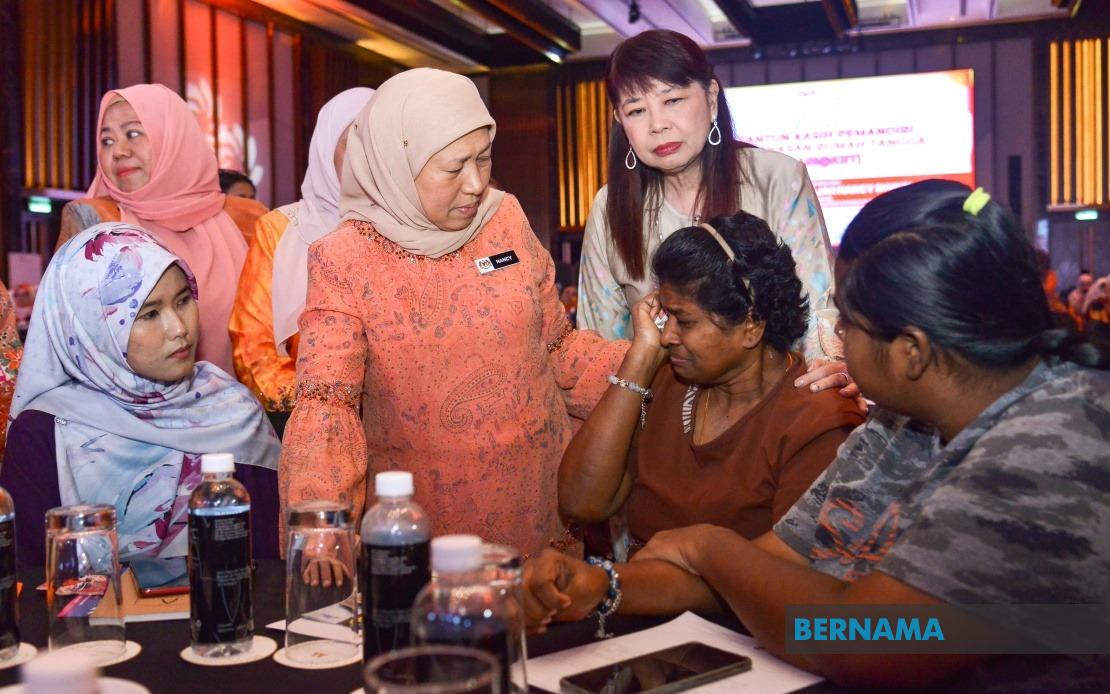
The Ministry of Women, Family and Community Development has launched a comprehensive nationwide initiative aimed at reaching 1,400 survivors of domestic violence, marking a significant escalation in the government's commitment to addressing one of Malaysia's most persistent social challenges. The SARI@KRT: Road to Eliminate Violence Against Women (EVAW) 2026 programme was officially unveiled by Minister Datuk Seri Nancy Shukri, who emphasised that the intervention goes well beyond conventional awareness campaigns to deliver tangible, multi-faceted support that can genuinely transform survivors' lives.
The programme adopts an ambitious scaling strategy, targeting a minimum of 100 participants in each state across Malaysia's thirteen states and three federal territories. This geographic distribution reflects an understanding that domestic violence cuts across urban and rural communities alike, and that survivors in less densely populated areas often face particular obstacles in accessing specialist services. By establishing a presence in every state, the initiative acknowledges regional variations in support infrastructure and aims to bridge critical gaps where victims previously had limited recourse.
Psychological reconstruction forms a cornerstone of SARI@KRT's approach. Beyond simply identifying survivors, the programme prioritises strengthening psychosocial support networks that address the profound emotional and mental health consequences of domestic abuse. This recognition that trauma requires sustained, professional intervention represents an evolution in how Malaysia's government addresses violence—moving away from a purely law-enforcement framework toward one that integrates therapeutic care. Survivors often remain trapped not merely by physical circumstances but by psychological dependencies and fractured self-worth; the programme's explicit focus on rebuilding confidence directly confronts these deeper barriers to escape and recovery.
Legal empowerment constitutes the second pillar of support. The ministry recognised that while domestic violence survivors may understand they need help, navigating Malaysia's complex legal system presents formidable obstacles. By embedding legal assistance within SARI@KRT, women can access guidance on protection orders, divorce proceedings, child custody arrangements, and financial settlements without bearing prohibitive costs. This integration of legal support with psychological care acknowledges that victims often face critical junctures—such as court appearances—where emotional vulnerability intersects with high-stakes decisions affecting their and their children's futures.
Economic empowerment represents the third dimension, recognising that financial independence remains fundamental to lasting escape from abusive situations. Women trapped in domestic violence frequently lack the economic resources to establish independent households, pursue education or skills training, or achieve the self-sufficiency necessary to resist returning to abusive partners. By incorporating economic empowerment components, SARI@KRT addresses a root cause of continued victimisation: the economic vulnerability that forces many women to tolerate abuse as the price of shelter and sustenance.
Recent statistics underscore the urgency of such interventions. The Royal Malaysia Police reported 4,014 domestic violence cases during the first half of this year, representing a concerning nine percent increase compared to 3,678 cases during the equivalent period in 2023. Johor recorded the highest incidence with 721 cases, followed by Selangor with 614 and Perak with 405, indicating that the problem concentrates in Malaysia's most populous states but manifests nationwide. Misunderstandings and communication failures account for the largest category of incidents, responsible for 1,967 cases, though drug abuse contributed 444 cases and financial stress accounted for 378 cases.
Minister Shukri offered a nuanced interpretation of the rising case numbers, suggesting that increases may partly reflect greater public awareness and increased willingness among survivors to report abuse rather than suffering silently. This perspective carries important implications: while the raw figures appear alarming, they potentially indicate that victims feel sufficiently emboldened to seek official intervention, suggesting that previous public education campaigns and anti-violence messaging have created conditions where reporting becomes more culturally acceptable. Nonetheless, the absolute numbers remain deeply troubling and demand sustained, well-resourced responses.
Financial abuse emerged as a particular concern in the minister's remarks, highlighting a form of domestic violence that remains underrecognised in Malaysia's social consciousness. When spouses with adequate means deliberately withhold financial provision, forcing partners to shoulder all household expenses alone, this constitutes psychological control and economic coercion—yet many victims and even some legal authorities may not categorise such behaviour as abuse. By explicitly naming and addressing financial abuse, SARI@KRT expands the definition of domestic violence beyond physical harm to encompass the economic strangulation that keeps victims dependent and powerless. The minister emphasised that family financial responsibility must represent a shared commitment between partners, challenging traditional household dynamics where men monopolise financial control.
The ministry has introduced a special allowance enabling survivors to attend court proceedings related to child maintenance claims, removing a significant practical barrier. Many victims lack the financial flexibility to take time away from employment or childcare to appear in court, and court fees can consume scarce resources; this provision acknowledges such realities and removes a structural obstacle to pursuing legal remedies. Combined with broader legal assistance, this allowance signals the government's recognition that accessing justice requires removing not merely legal barriers but practical, economic ones.
For Malaysian society, SARI@KRT represents a paradigm shift in how government addresses domestic violence—from reactive law-enforcement to proactive, holistic rehabilitation. The programme's integrated approach reflects international best practices demonstrating that survivors require simultaneous interventions addressing psychological trauma, legal empowerment, and economic self-sufficiency. Without addressing all three dimensions, survivors risk cycling through crisis intervention without achieving lasting recovery.
Regional implications extend beyond Malaysia's borders. Southeast Asian governments increasingly recognise that domestic violence represents a public health crisis demanding public investment, yet many programs remain underfunded, fragmented, or focused narrowly on criminal justice responses. Malaysia's decision to target 1,400 survivors with comprehensive, multi-sectoral support may influence regional policy conversations, particularly as neighbouring countries develop or refine their own anti-violence initiatives. The explicit incorporation of economic empowerment within a domestic violence programme also offers lessons for gender-equity advocates throughout the region.
Moving forward, the success of SARI@KRT depends on adequate resourcing, trained personnel, cultural acceptance among communities where shame and stigma remain powerful deterrents to help-seeking, and sustained political commitment beyond current electoral cycles. The programme's reach of 1,400 survivors, while substantial, represents only a fraction of the estimated total experiencing domestic violence in Malaysia—suggesting that parallel efforts to strengthen prevention, increase awareness among potential perpetrators, and transform cultural attitudes regarding gender and family violence must accompany direct service provision to affected women.

