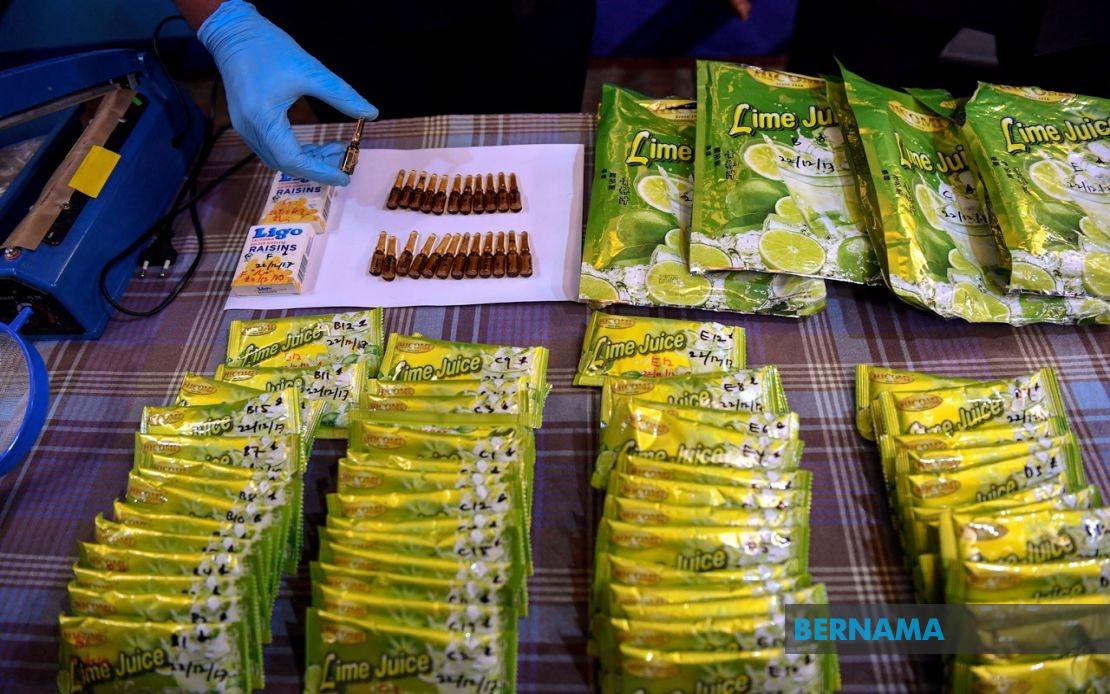
Malaysia's Home Ministry is mounting an increasingly aggressive campaign against the proliferation of synthetic drugs, responding to what officials characterise as an urgent and escalating public health emergency. Home Minister Datuk Seri Saifuddin Nasution Ismail has flagged methamphetamine, psychoactive tablets colloquially known as "piu-piu," and fentanyl as particular threats that have taken root in Malaysia's drug market, each posing severe risks of addiction, fatal overdoses, and broader social destabilisation through links to criminal activity and community disorder.
The scale of the enforcement response underscores the gravity officials attach to the issue. Since 2023 through June 2026, the Royal Malaysia Police (PDRM) have executed 238,704 arrests spanning various synthetic drug offences across the nation. This figure, disclosed in Saifuddin Nasution's parliamentary reply to GPS assemblyman Mohamad Shafizan Kepli, represents a sustained mobilisation of law enforcement resources to combat what has become a defining challenge for Malaysia's drug control apparatus. The question originated from concerns about Sarawak specifically, where rural and remote communities face particular vulnerability to traffickers exploiting geographic isolation and limited policing presence.
To intensify interdiction efforts, PDRM has rolled out dedicated operations including Op Tapis and Op Tapis Khas, extending across densely populated urban zones as well as isolated rural and remote territories. These operations function as coordinated efforts involving multiple government agencies: the National Anti-Drugs Agency (AADK) and the Royal Malaysian Customs Department (JKDM) work alongside police to create overlapping layers of detection and enforcement. This inter-agency architecture reflects recognition that synthetic drug trafficking demands coordinated action across multiple enforcement domains, combining police street-level operations with customs intelligence and dedicated anti-narcotics expertise.
Technological advancement has become central to the ministry's enforcement strategy. Authorities are deploying modern surveillance infrastructure including drones and surveillance camera networks to monitor suspected trafficking corridors and distribution points. These tools enable detection capabilities that transcend traditional policing boundaries, particularly valuable in Sarawak where vast distances and challenging terrain have historically hindered conventional patrols. The integration of technology alongside boots-on-ground operations reflects a modernised approach to drug law enforcement that acknowledges both the scale and sophistication of trafficking networks.
Legislative action complements enforcement muscle. The government is actively considering amendments to the Dangerous Drugs Act 1952, with particular focus on expanding the Act's drug schedules to explicitly encompass newly emerging synthetic drugs classified as New Psychoactive Substances (NPS). This proactive legislative posture recognises that synthetic drug chemistry evolves rapidly, with traffickers synthesising novel compounds designed to evade existing legal prohibitions. By amending the Act rather than waiting for Parliament to respond to each new chemical variant, Malaysia seeks to create regulatory flexibility that keeps pace with clandestine pharmaceutical innovation. Such amendments would streamline enforcement by eliminating legal ambiguity surrounding previously unknown substances.
Sarawak's drug situation presents a microcosm of Malaysia's broader challenge. In the first half of 2026, authorities in the state arrested 7,097 individuals involved in drug offences, comprising 342 commercial traffickers, 1,314 individuals apprehended with drugs in their possession, and 5,441 individuals identified as drug users. These figures indicate that Sarawak's drug problem spans the entire supply chain, from high-level trafficking operations down to street-level consumption. Beyond arrests, enforcement has generated significant asset seizures: authorities confiscated drugs weighing 418.01 kilogrammes valued at RM53.73 million, alongside criminal syndicate assets worth RM1.95 million. Additionally, thirteen individuals faced detention under the Dangerous Drugs (Special Preventive Measures) Act 1985, while enforcement action under Section 39C of the Dangerous Drugs Act 1952 targeted 131 hardcore drug addicts, reflecting efforts to address both supply and demand dimensions.
The ministry has recognised that enforcement alone cannot resolve what is fundamentally a public health and social challenge. Between 2023 and June 2026, authorities conducted 1,144 drug prevention programmes nationwide, designed to elevate public awareness of synthetic drug hazards. This community-oriented prevention approach complements coercive enforcement, addressing the demand side through education and outreach. Such preventive initiatives acquire particular significance in Sarawak and other remote areas where access to drug treatment services may be limited and where community awareness of emerging synthetic drugs remains underdeveloped compared to urban centres.
Capacity building within Malaysia's forensic and analytical infrastructure has accelerated to maintain law enforcement's technological edge. Laboratory capabilities for profiling emerging drug trends are being continuously enhanced, enabling authorities to rapidly identify new synthetic drugs including fentanyl analogues and novel synthetic opioids. This forensic sophistication permits faster detection and more targeted enforcement action, reducing the time interval between a new drug's emergence and law enforcement's ability to identify and prosecute traffickers. For a nation grappling with dynamically evolving drug chemistry, such laboratory modernisation constitutes a critical competitive advantage against traffickers.
The legislative and operational initiatives announced by Saifuddin Nasution reflect Malaysia's positioning of drug control as a paramount national security issue, one requiring sustained resource commitment and cross-agency coordination. For Malaysian readers and policymakers, these measures signal that synthetic drug trafficking will remain a major enforcement priority, with consequences extending beyond criminal justice into public health, family welfare, and community safety. The particular emphasis on Sarawak acknowledges geographic realities that create enforcement asymmetries, where remote areas require specially tailored approaches distinct from urban enforcement models that dominate in Peninsular Malaysia.

