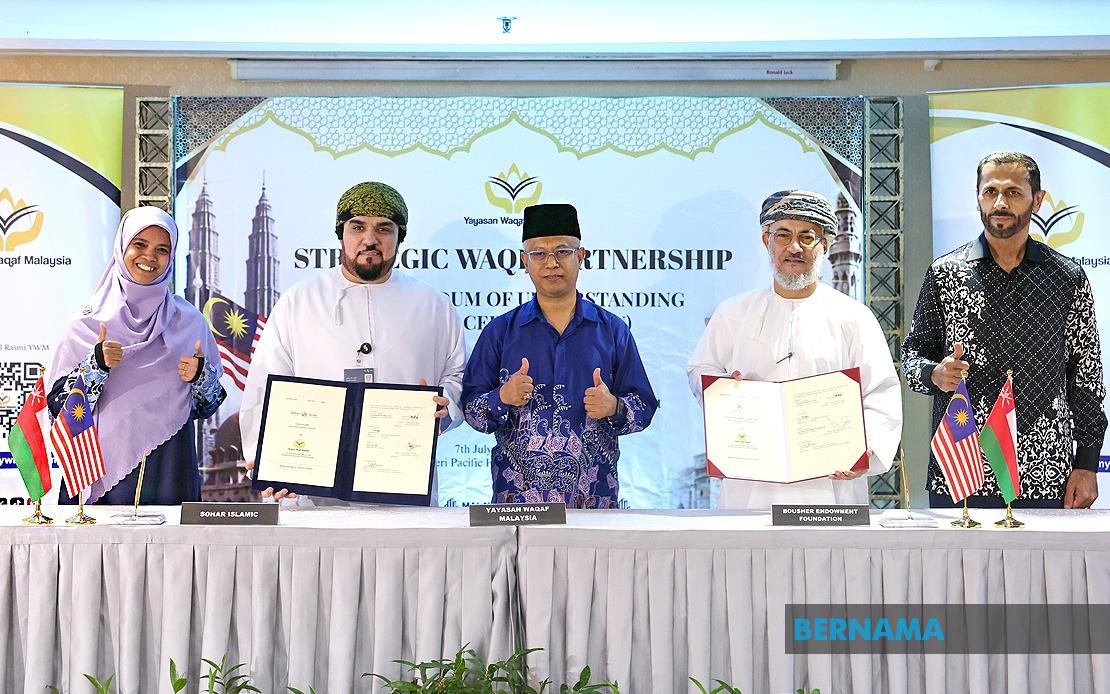
Malaysia has taken a significant step in expanding its influence within global Islamic finance circles by establishing a formal partnership with two major Omani financial institutions. The Malaysian Waqf Foundation (YWM) signed a memorandum of understanding with Sohar Islamic and the Boushar Endowment Foundation in Kuala Lumpur on July 7, marking a collaborative effort aimed at advancing waqf asset development and exploring new frontiers in Islamic social finance. The agreement represents not merely a bilateral arrangement but rather a validation of Malaysia's technical prowess in structuring waqf systems that have proven both innovative and sustainable across different economic contexts.
The collaboration framework encompasses a comprehensive exchange of professional knowledge, technological capabilities and institutional best practices centred on waqf governance and asset management. This depth of cooperation signals that both Omani partners view Malaysia's experience as directly applicable to their own developing waqf ecosystems. For Malaysian observers, the arrangement underscores a notable shift in regional dynamics: rather than importing expertise from established Islamic finance centres, Malaysia now serves as an originating source of sophisticated financial knowledge for other Muslim-majority nations.
Deputy Minister in the Prime Minister's Department (Religious Affairs) Marhamah Rosli characterised the partnership as a defining moment for Malaysia's international standing. She emphasised that the collaboration transcends simple commercial dealings by contributing to broader development of the Muslim ummah through structured Islamic philanthropy. The timing of such a partnership is particularly significant given Malaysia's longstanding efforts to position Kuala Lumpur as a credible alternative to traditional Islamic finance hubs, a goal that requires consistent demonstration of technical leadership and institutional reliability.
A particularly notable dimension of this arrangement involves the appointment of YWM Chief Executive Officer Dr Ridzwan Bakar as Waqf Adviser to the Sultanate of Oman. This personal designation reflects Omani confidence in Malaysian expertise at the highest levels and provides YWM with direct influence over waqf policy development in a Gulf state. Dr Ridzwan's advisory role carries significance beyond ceremonial recognition; it positions Malaysian thinking about waqf structures at the centre of Omani financial policy deliberations, creating opportunities for knowledge transfer that could eventually benefit Malaysian investors and institutions seeking to expand into Gulf markets.
Dr Ridzwan revealed that the Malaysian foundation has been actively cultivating international partnerships across multiple jurisdictions, with ongoing engagement in Kuwait, Qatar and the United Arab Emirates alongside the newly formalised Oman collaboration. This broader network-building strategy suggests that YWM views waqf development as a sector where Malaysia possesses comparative advantages that transcend regional boundaries. The foundation's proactive approach—characterised by Dr Ridzwan as actively approaching potential partners rather than waiting for solicitation—demonstrates confidence in Malaysia's institutional capacity and market positioning.
The genesis of the Oman partnership traces to exploratory visits undertaken in 2023 and 2024, during which YWM representatives identified genuine receptiveness to Malaysian methodologies and governance approaches. This measured timeline reflects professional due diligence; rather than rushing into formal commitments, Malaysian officials tested the waters to ensure genuine compatibility and mutual benefit. The eventual formalisation of the partnership validates this careful approach and suggests that future collaborations in other jurisdictions may follow similar trajectories of relationship-building before institutional commitment.
From an economic development perspective, Dr Ridzwan articulated a compelling vision of waqf assets functioning as magnets for strategic investment capital flowing from Arab Gulf states into Malaysia. By demonstrating that Malaysian waqf management can generate reliable returns while advancing social objectives, YWM aims to tap into substantial pools of Islamic capital seeking vehicles that align with both profit motives and religious obligations. This positioning of Malaysia as a credible repository for Gulf waqf investments carries implications for broader economic growth, particularly in sectors historically aligned with Islamic finance such as real estate, infrastructure and social enterprises.
YWM currently operates three investment products through Kenanga Investors that are specifically designed to channel international investment funds into Malaysian assets. These vehicles represent institutional infrastructure through which the benefits of international waqf collaborations can be directly materialised into capital inflows. The existence of such conduits makes Malaysia's partnerships with Omani and other Gulf institutions substantially more than ceremonial arrangements; they constitute genuine economic corridors through which transnational Islamic capital can flow into Malaysian enterprises and development projects.
The broader development model that Dr Ridzwan articulated emphasises gradual asset accumulation as a foundation for expanded social benefit. Rather than viewing waqf primarily as immediate charity mechanisms, this approach prioritises the strategic growth of waqf portfolios to generate increasingly substantial returns that can eventually support wider beneficiary populations. This methodology carries particular relevance for Malaysia, where demographic shifts and economic pressures have expanded the population experiencing financial vulnerability beyond traditional categories of waqf beneficiaries (asnaf) to encompass portions of the B40 and M40 income groups.
The partnership with Oman also reflects Malaysia's strategic calculation regarding competition within Islamic finance. As traditional centres such as London and Singapore strengthen their offerings in Islamic banking and capital markets, Malaysia has identified waqf development as a distinctive niche where it can establish uncontested leadership. Waqf governance is less saturated than conventional Islamic banking sectors, allowing Malaysia to shape international standards and practices rather than merely adopting frameworks established elsewhere. This standard-setting capacity carries long-term competitive value beyond immediate financial returns.
For Southeast Asian countries observing Malaysia's international positioning, the Oman partnership exemplifies how a Muslim-majority nation can leverage institutional expertise into broader geopolitical influence within the Islamic world. Malaysia's elevation to trusted adviser status in Oman's waqf sector represents soft power that extends beyond commercial relationships into areas of fundamental governance and financial policy. This influence may eventually translate into broader diplomatic advantage and deeper integration within Gulf Cooperation Council economic structures.
The collaboration also carries implications for Malaysia's positioning within evolving Islamic finance governance frameworks. As international bodies increasingly develop standards for waqf management and Islamic social finance, Malaysia's expanding network of partnerships provides platforms from which Malaysian perspectives can influence regulatory discussions. The personal appointment of Dr Ridzwan as adviser ensures that Malaysian institutional thinking remains at the forefront of Gulf policymaking conversations regarding Islamic finance evolution.
Looking forward, the Oman partnership appears positioned as a foundation rather than a culmination. Both Malaysian officials and Omani counterparts have signalled openness to deepening collaboration, suggesting that additional joint ventures and expanded knowledge exchanges may emerge as the initial relationship matures. For Malaysia's broader economic strategy, such partnerships represent tangible progress toward the articulated objective of establishing Kuala Lumpur as a globally recognised centre of Islamic finance innovation and expertise.

