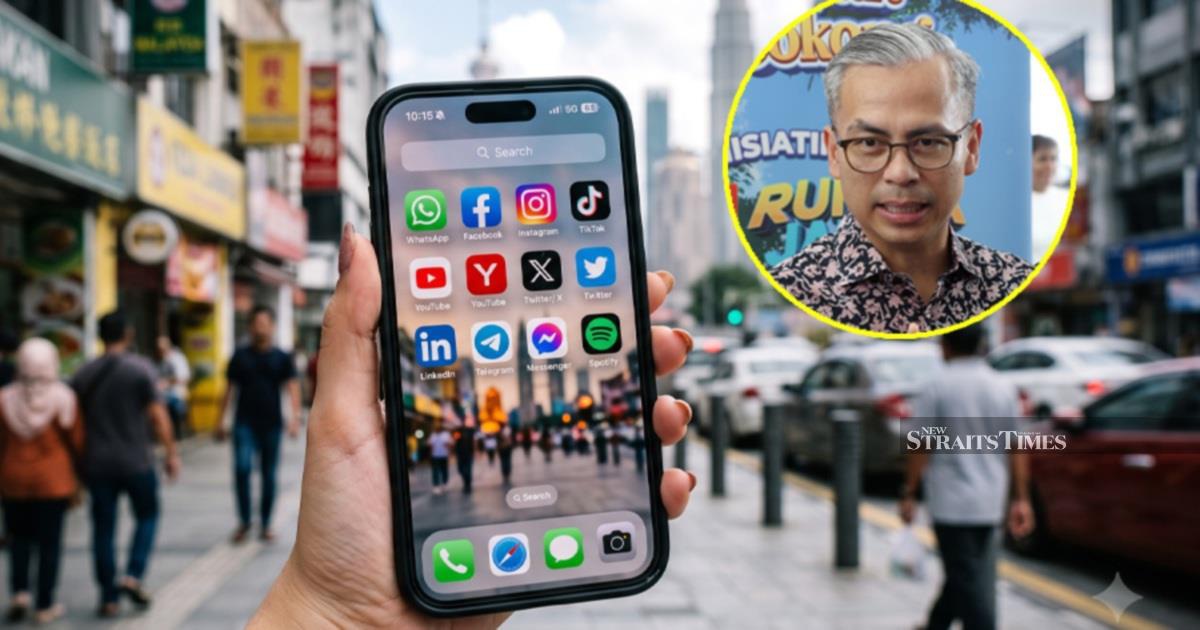
The Malaysian government has identified over 1,800 inauthentic social media accounts operating across platforms, with a significant portion strategically deployed to amplify sensitive and divisive content centred on race, religion, and royalty (3R) issues, Communications Minister Datuk Seri Fahmi Fadzil has disclosed. The discovery underscores the mounting sophistication of coordinated disinformation campaigns targeting Malaysia's plural society and the vulnerability of the nation's digital ecosystem to organised manipulation.
Fake accounts represent a particularly insidious form of online manipulation because they obscure the true origin and intent of messaging, allowing bad actors to simulate grassroots sentiment and artificially inflate the reach of inflammatory narratives. By operating under false identities, these accounts can circumvent platform moderation more effectively and create the illusion of widespread community support for divisive positions. The concentration of such accounts on 3R-related content is especially concerning given Malaysia's delicate social fabric, where these topics carry profound historical, cultural, and constitutional significance.
The 3R framework—race, religion, and royalty—forms the foundation of Malaysia's constitutional compact and social boundaries. Article 153 of the Federal Constitution provides special protections and privileges to Bumiputeras, while Article 3 enshrines Islam as the federation's religion, and Articles 181-184 define the position of the Yang di-Pertuan Agong and Rulers. These pillars are widely understood as non-negotiable components of Malaysia's social contract, particularly among the Malay-Muslim majority. When weaponised through coordinated inauthentic behaviour online, messaging around these topics carries heightened capacity to mobilise sentiment and undermine social cohesion.
The timing of this disclosure reflects broader concerns within Southeast Asia about the weaponisation of social media during politically sensitive periods. Neighbouring countries including Thailand, Indonesia, and the Philippines have similarly grappled with networks of coordinated inauthentic accounts deployed to destabilise public discourse around elections, constitutional matters, and inter-community relations. The transnational nature of digital platforms means that disinformation campaigns often originate from actors operating outside national borders, making detection and accountability particularly challenging for individual governments.
Fahmi's announcement suggests that Malaysian authorities have invested in enhanced capacity to detect and monitor inauthentic account networks, likely through collaboration with social media platforms themselves. Tech companies including Meta, Google, and Twitter have increasingly acknowledged responsibility for removing coordinated inauthentic behaviour from their platforms and publishing transparency reports documenting their efforts. However, the scale of detection—1,800 accounts—raises questions about how many additional fraudulent accounts may continue operating undetected, particularly on platforms with weaker moderation infrastructure or in regional languages where monitoring is less robust.
The prevalence of fake accounts amplifying 3R narratives reflects a broader strategy of leveraging existing social tensions to achieve political or commercial objectives. Adversaries of Malaysia's stability, whether foreign actors seeking to undermine regional security or domestic elements with sectarian agendas, can efficiently mobilise inauthentic networks to polarise discourse around these constitutionally sensitive matters. The accounts may be deployed strategically around key political moments, such as elections, court decisions affecting minority rights, or royal events, when public attention is already heightened and discourse more volatile.
From a regional perspective, the detection of such networks highlights the importance of developing collective frameworks for addressing cross-border disinformation. The Association of Southeast Asian Nations (ASEAN) has initiated discussions around digital governance and online safety, but coordination on combating inauthentic accounts remains fragmented. If these fake accounts are operating across borders or are connected to actors outside Southeast Asia, then Malaysian authorities' ability to address the problem unilaterally is limited. Bilateral or multilateral intelligence-sharing and platform cooperation become essential tools.
The public disclosure of the detection itself serves multiple purposes within Malaysia's information environment. It warns potential creators and operators of such accounts that they face identification and potential legal consequences, potentially raising the perceived cost of engagement. It also signals to ordinary Malaysians that authorities are actively monitoring the digital landscape, which can encourage greater vigilance and critical consumption of content. However, it may simultaneously amplify anxiety about online threats and require careful communication to avoid suggesting that the situation is spiralling out of control.
The government's next steps will be critical in determining whether this disclosure translates into sustained action against inauthentic behaviour. This might include pursuing criminal charges against account operators under the Communications and Multimedia Act or other legislation, deepening collaboration with international social media platforms on enforcement, enhancing media literacy programmes, and strengthening institutional capacity for ongoing monitoring. Malaysian citizens, particularly those active in online spaces, also bear responsibility for practising digital hygiene—verifying sources, questioning unusually coordinated amplification of divisive content, and reporting suspicious accounts to platforms.
Ultimately, the detection of 1,800 fake accounts represents both a success in Malaysian cyber-security awareness and a sobering reminder of persistent vulnerabilities. Social media platforms remain contested spaces where authenticity is difficult to verify and malicious actors operate with relative impunity. For Malaysia, a nation navigating complex multi-ethnic, multi-religious, and multi-cultural dynamics, protecting the integrity of public discourse against coordinated disinformation has become not merely a matter of platform governance but a fundamental component of national stability and social cohesion.

