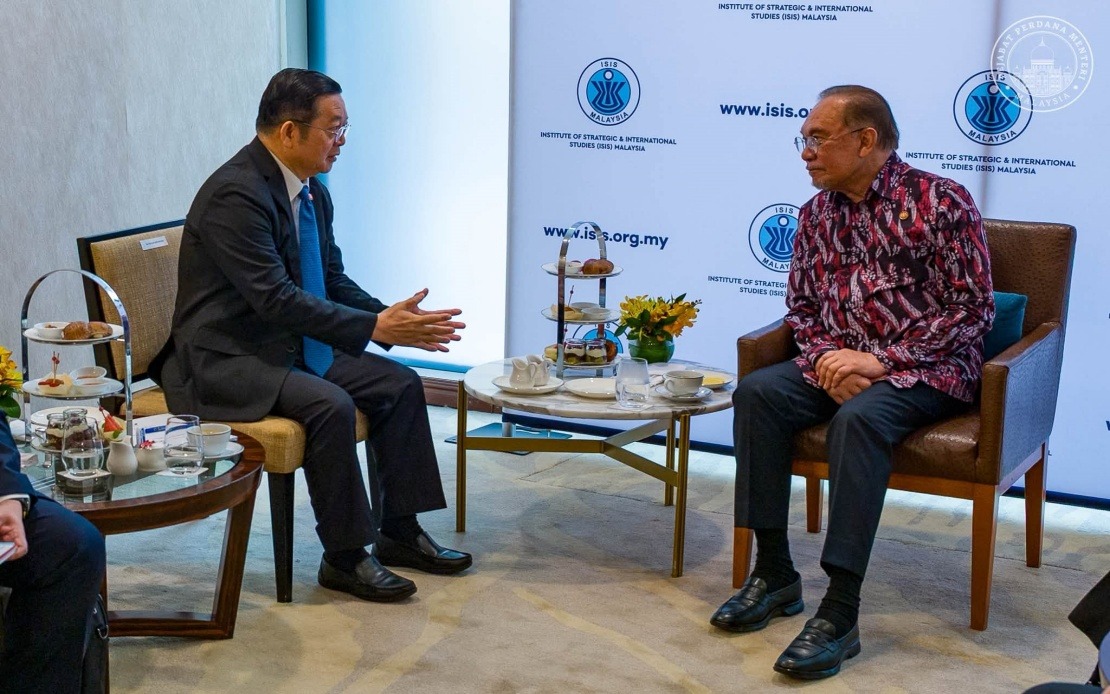
Prime Minister Datuk Seri Anwar Ibrahim has reinforced Malaysia's pledge to play an active and constructive part in bolstering ASEAN as a unified, inclusive regional organisation equipped to fulfil the expectations and ambitions of its constituent populations. The commitment was articulated following a high-level engagement with ASEAN Secretary-General Dr Kao Kim Hourn on the sidelines of the 39th Asia-Pacific Roundtable in Kuala Lumpur, where Anwar delivered the keynote address and participated in extensive deliberations on pressing regional matters.
The courtesy call between Anwar, who simultaneously holds the portfolio of Finance Minister, and the ASEAN Secretary-General served as a forum for substantive discussion on contemporary issues confronting the bloc and its broader strategic priorities. Against a backdrop of intensifying geopolitical rivalry, volatile economic conditions, and evolving security challenges across the Indo-Pacific, the two officials identified key areas requiring heightened ASEAN coordination and consensus-building efforts to preserve regional equilibrium.
Myanser's ongoing internal instability emerged as a central point of discussion, reflecting ASEAN's continued concern over the trajectory of one of its members. The situation in Myanmar, which has been characterised by political upheaval and humanitarian concerns since 2021, remains a sensitive issue within ASEAN's consensus-based framework, with member states attempting to maintain engagement while respecting the principle of non-interference. Malaysia, as a significant regional player and fellow ASEAN member, maintains particular interest in developments that could have spillover effects affecting its own stability and that of neighbouring nations.
The South China Sea tensions also featured prominently in the discussions, underscoring the persistent challenges posed by competing territorial and maritime claims in waters through which trillions of dollars in global trade transit annually. For Malaysia, which maintains its own claims within the disputed waters, the issue remains strategically vital to national interests and regional prosperity. The conversation likely touched upon mechanisms for maintaining dialogue, reducing escalation risks, and ensuring freedom of navigation—concerns that resonate deeply across Southeast Asia.
Advancements in artificial intelligence represented a novel dimension of their exchange, signalling ASEAN's recognition that technological transformation demands collective thought on governance, ethics, and equitable benefit-sharing across member states. As AI capabilities accelerate globally, Southeast Asian nations face the challenge of harnessing these tools for development whilst managing risks of job displacement and digital divides that could exacerbate existing inequalities within and between societies.
The integration of Timor-Leste as ASEAN's newest full member following its accession was another substantive topic, as the bloc navigates questions about post-accession support, institutional capacity, and harmonisation of policies across an increasingly diverse membership spanning various development levels and political systems. This expansion reshapes ASEAN's strategic calculus and requires careful management to maintain coherence whilst accommodating new perspectives and interests.
Implementation of the ASEAN Community Vision 2045 also commanded attention, as member states assess progress toward deeper economic integration, improved connectivity, and enhanced people-to-people linkages envisioned under this long-term strategic framework. The vision represents an ambitious blueprint for the region's future, yet translating aspirations into concrete results requires sustained commitment and resource allocation amid competing domestic priorities and budgetary constraints across diverse national economies.
Possible ramifications of the West Asia conflict on Southeast Asian interests and security formed part of the strategic calculus, as ongoing tensions and potential escalation in the Middle East influence regional security architectures, economic flows, and alignment patterns. Malaysia, as a Muslim-majority nation with historical ties to West Asian countries and home to significant expatriate communities, carries particular sensitivity to developments in that theatre and their potential consequences for its own citizens and regional stability.
Anwar emphasised that ASEAN's enduring strength depends upon unwavering adherence to foundational principles including unity among disparate members, the bloc's central and indispensable role in regional architecture, and commitment to collaborative problem-solving mechanisms. These three pillars—unity, centrality, and cooperation—form the philosophical bedrock distinguishing ASEAN's approach from great-power competition that increasingly characterises the broader Indo-Pacific. Malaysia's reaffirmation of these principles carries particular significance given its demonstrated commitment to multilateral engagement and its position as a bridge-builder across diverse regional interests and perspectives. The sustained emphasis on these fundamentals suggests recognition that ASEAN's relevance and effectiveness ultimately depend upon member states' willingness to prioritise collective interests and maintain solidarity even when facing pressures to align exclusively with individual great-power sponsors or pursue narrowly nationalist agendas that could fragment the organisation.

