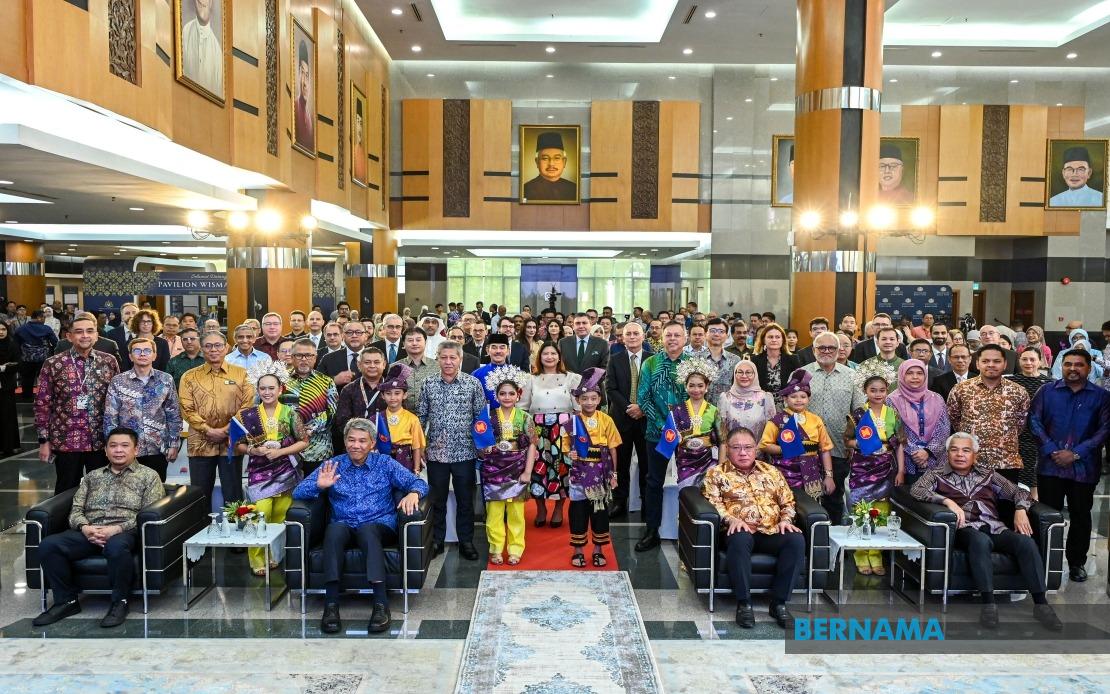
Malaysia marked its nearly six-decade journey within ASEAN during a commemorative event in Putrajaya on Monday, bringing together approximately 300 dignitaries, diplomats and officials to reflect on the regional organisation's enduring significance. The gathering, held at the Foreign Ministry under the banner "59 Years of Navigating Together", provided a platform to underscore Malaysia's foundational role in an alliance that has evolved from five Southeast Asian nations into a dynamic bloc of eleven members spanning the full breadth of the region.
When Indonesia, Malaysia, the Philippines, Singapore and Thailand signed the Bangkok Declaration on August 8, 1967, they created an institutional framework designed to foster peace, stability and prosperity across one of the world's most strategically important regions. For nearly three-fifths of a century, this framework has survived Cold War tensions, financial crises, geopolitical shifts and pandemic disruptions. Malaysia's presence at the table from day one positions it uniquely within ASEAN's institutional memory and decision-making architecture, lending the nation particular influence over the bloc's strategic direction.
The expanding membership of ASEAN reflects both the organisation's appeal and the shifting regional landscape. Brunei's accession in 1984 added a small but resource-rich sultanate to the fold. Vietnam's entry in 1995 represented a watershed moment, bringing into the regional family a major power that had been isolated for decades following the Cold War. The near-simultaneous admission of Laos and Myanmar in 1997 extended ASEAN's reach into mainland Southeast Asia, while Cambodia's entry in 1999 completed the circle of continental territories. Most recently, Timor-Leste joined during the 47th ASEAN Summit in October of the previous year, making it the eleventh and youngest member state. This gradual expansion has transformed ASEAN from a Cold War-era diplomatic arrangement into a genuinely pan-Southeast Asian institution encompassing over 650 million people and substantial economic weight.
Foreign Minister Datuk Seri Mohamad Hasan officiated the Putrajaya celebration, underscoring the government's commitment to the regional agenda at the ministerial level. His presence, alongside Tourism, Arts and Culture Minister Datuk Seri Tiong King Sing and Deputy Foreign Minister Datuk Lukanisman Awang Sauni, reflected the multifaceted nature of contemporary ASEAN engagement. Beyond diplomatic and security considerations, cultural exchange, tourism flows and people-to-people connections now constitute vital pillars of regional integration. This diversification of ASEAN cooperation acknowledges that sustainable regional stability depends not merely on governments maintaining dialogue, but on societies developing deeper mutual understanding and economic interdependence.
The event's thematic framework—anchored to ASEAN's three foundational pillars of political-security, economic and socio-cultural cooperation—demonstrates how the organisation has institutionalised a holistic approach to regional development. The political-security dimension ensures conflict prevention and peaceful dispute resolution through mechanisms like the ASEAN Regional Forum and the East Asia Summit. The economic pillar, materialised through the ASEAN Free Trade Area and subsequent integration initiatives, has progressively eliminated tariff barriers and harmonised standards, enabling businesses and consumers across member states to benefit from integrated markets. The socio-cultural dimension, often the least visible yet profoundly important, facilitates educational exchanges, cultural festivals and civil society engagement that humanise regional relationships beyond government-to-government contacts.
For Malaysia specifically, ASEAN membership has been foundational to national foreign policy for nearly six decades. The organisation provided an early venue for Malaysia to establish itself as a constructive regional player despite the nation's own internal complexities during the post-independence period. Through ASEAN, Malaysia participated in shaping regional responses to major challenges from the Vietnam War era through the Cold War, the Asian financial crisis, terrorism and maritime security concerns. The country has also leveraged ASEAN platforms to amplify its voice in broader Asian and global affairs, ensuring that Southeast Asian perspectives inform international discourse on everything from trade to environmental stewardship to human rights.
The screening of "ASEAN Journey: Navigating Our Future, Together - 59 Years of Malaysia in ASEAN" during the Putrajaya event served both commemorative and educational functions. Such visual documentation helps younger generations of Malaysians understand their country's pivotal role in regional institution-building and appreciate how ASEAN frameworks have contributed to decades of relative peace and economic progress in Southeast Asia. The symbolic cake-cutting ceremony reinforced the celebratory character of the occasion, marking not merely the passage of years but the ongoing relevance and vitality of the regional partnership.
The gathering's emphasis on "navigating together" carries particular resonance in the contemporary regional context. Southeast Asia faces mounting pressures from great power competition, climate change, pandemic preparedness and transnational challenges that individual nations cannot address in isolation. ASEAN's centrality to regional architecture—through mechanisms like the ASEAN Plus Three, the East Asia Summit and the ASEAN Regional Forum—positions it as the indispensable convening body for constructive dialogue among major powers competing for influence in the region. Malaysia's steadfast commitment to ASEAN reflects an understanding that the organisation's strength and cohesion directly serve national interests by preventing bilateral disputes from escalating and ensuring that regional development priorities remain set by Southeast Asian nations themselves rather than imposed externally.
As ASEAN enters its seventh decade, member states including Malaysia confront fundamental questions about adaptation and relevance. The bloc must balance its cherished principles of non-interference and consensus decision-making against pressure from major powers demanding clearer stances on geopolitical issues. Economic integration, while substantial, remains incomplete in key sectors. Climate change threatens coastal economies while demanding coordinated regional responses. Digital transformation and artificial intelligence present both opportunities and governance challenges that ASEAN mechanisms have yet to fully address. Malaysia's continued investment in ASEAN forums and celebrations signals recognition that these challenges are best confronted through strengthened regional solidarity rather than fragmented national responses.
The participation of international organisation representatives alongside ASEAN's governmental leadership underscores how deeply embedded ASEAN has become within global governance frameworks. From the United Nations to regional development banks to specialised agencies addressing everything from disaster management to heritage preservation, international institutions now coordinate extensively with ASEAN structures. This integration has expanded ASEAN's capacity to mobilise resources and expertise for regional development while ensuring that Southeast Asian voices shape the design of international responses to transnational challenges affecting the region.

