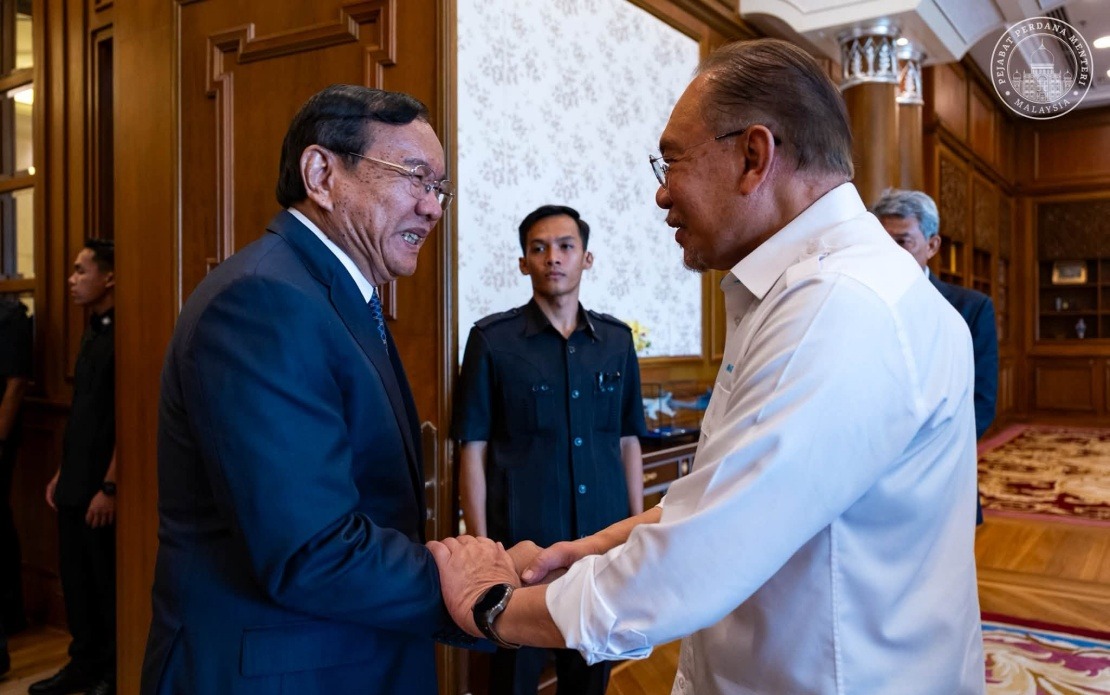
Malaysia and Cambodia have pledged to expand their strategic partnership across multiple economic and security domains, according to Prime Minister Datuk Seri Anwar Ibrahim. The commitment encompasses collaboration in the digital economy, artificial intelligence, the halal industry, food security and human capital development, alongside joint efforts to tackle cross-border crime. The declaration follows discussions between Anwar and Cambodian Deputy Prime Minister and Minister of Foreign Affairs and International Cooperation Prak Sokhonn, who arrived in Malaysia for an official two-day visit beginning August 3.
The bilateral engagement carries particular significance as it precedes the Third Malaysia-Cambodia Joint Commission for Bilateral Cooperation meeting scheduled for August 4. This institutional platform serves as a formal mechanism for the two nations to coordinate policy initiatives and evaluate the progress of ongoing collaborative projects. Such structured dialogue demonstrates the maturity of the Malaysia-Cambodia relationship and the both governments' commitment to translating political goodwill into concrete implementation frameworks.
Looking further ahead, the two countries are positioning their relationship as a cornerstone partnership ahead of a historic milestone. Malaysia and Cambodia will commemorate the 70th anniversary of their diplomatic relations in 2027, a landmark moment that both nations view as an opportunity to reflect on their shared history and chart an ambitious course for the coming decades. This forward-looking approach reflects how modern bilateral relations increasingly function as multi-decade projects requiring sustained institutional investment and strategic vision.
The focus on the digital economy and artificial intelligence reveals both nations' recognition that technological advancement and digital transformation are non-negotiable priorities in the 21st century. As Southeast Asian economies compete for investment and talent in the technology sector, Malaysia and Cambodia recognise that collaborative efforts in AI development, digital infrastructure and innovation ecosystems can amplify their individual capacities. Pooling expertise and resources allows both countries to participate more effectively in global tech markets while building complementary capabilities that serve regional interests.
Cooperation on halal industry standards and practices addresses a distinctive competitive advantage within the region. Malaysia, as an established halal hub and the home of the Global Halal Industry Centre, can share certification expertise, supply chain management practices and market access knowledge with Cambodia. This dimension of bilateral cooperation demonstrates how strategic partnerships can leverage existing comparative advantages while helping partners develop new economic capabilities. For Cambodia, strengthening halal credentials opens access to the substantial Muslim consumer market across Southeast Asia and the Islamic world.
Food security has emerged as a critical concern for Southeast Asian policymakers, particularly given climate vulnerabilities, demographic pressures and supply chain disruptions experienced in recent years. Malaysia and Cambodia, both agricultural producers, stand to benefit from collaborative research into crop resilience, sustainable farming techniques and regional food production planning. Such cooperation acknowledges that transnational challenges like food system stability cannot be adequately addressed through purely national approaches and require coordinated regional responses.
The commitment to enhanced cooperation in combating cross-border crime reflects the practical security dimensions underlying the bilateral relationship. Malaysia and Cambodia share porous land and maritime borders where criminal networks exploit jurisdictional gaps for human trafficking, drug smuggling and weapons trafficking. Deepening law enforcement cooperation through intelligence sharing, joint operations and capacity building addresses a fundamental challenge to regional stability and citizen safety. This security dimension underscores that strategic partnerships must address both opportunity creation and threat mitigation.
As fellow ASEAN member states, Malaysia and Cambodia carry shared institutional responsibilities that extend beyond their bilateral relationship. Prime Minister Anwar emphasised that both nations are custodians of regional peace, stability and the ASEAN Community Vision 2045. This framing positions the Malaysia-Cambodia partnership as a microcosm of broader ASEAN aspirations toward regional integration, economic prosperity and collective resilience. The bilateral cooperation agenda thus contributes to the larger project of building a cohesive, prosperous and rules-based ASEAN community.
The human capital development dimension of the cooperation framework recognises that long-term economic competitiveness ultimately depends on developing skilled, educated workforces. Malaysia and Cambodia can collaborate through education exchanges, professional training programmes and capacity building initiatives that transfer knowledge across borders. Such people-to-people engagement also builds the social foundations for sustained political cooperation, creating networks of mutual understanding among officials, academics, business leaders and civil society actors.
Beyond the formal sector cooperation agenda, Anwar's public affirmation of Malaysia-Cambodia relations carries diplomatic weight in a region where strategic partnerships are occasionally contested or misunderstood. By prominently highlighting the comprehensiveness of bilateral cooperation and the warmth of personal relations between leaders, Malaysia signals its commitment to Southeast Asian stability and inclusive regional diplomacy. This approach contrasts with zero-sum competition frameworks and demonstrates confidence in mutual benefit approaches to international relations.

