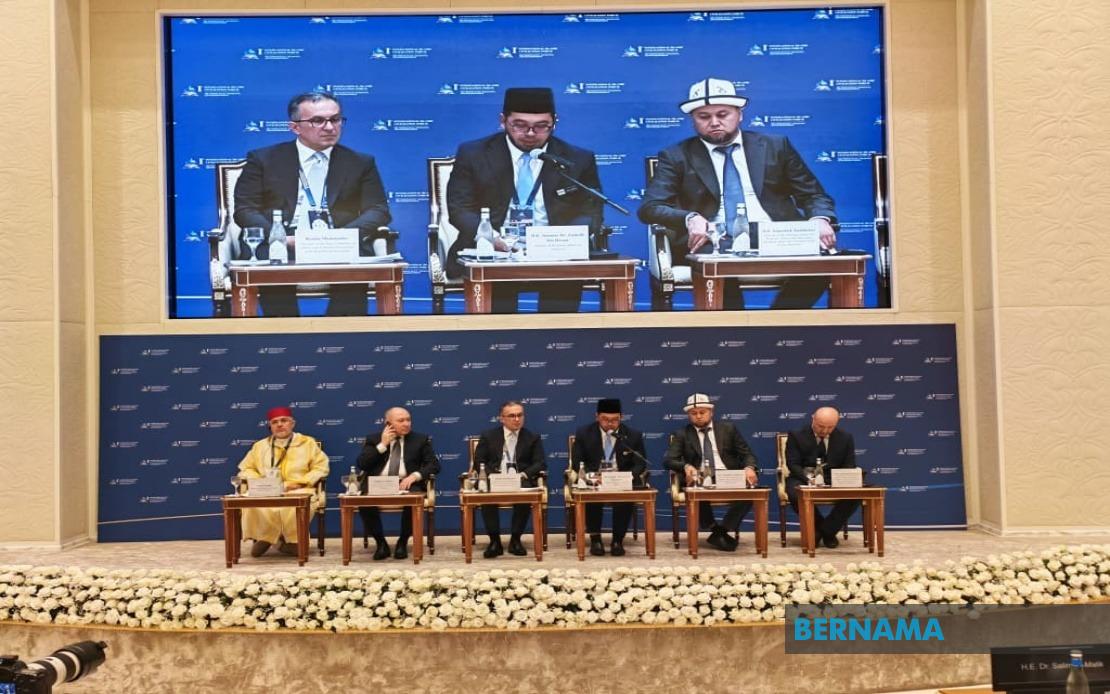
Malaysia has appealed to the broader Muslim world to harness the tragedy unfolding in Gaza as an opportunity to reaffirm core Islamic values while charting a renewed path toward meaningful global contribution. Delivering remarks at the International Islamic Civilisation Forum in Tashkent, Uzbekistan, Datuk Dr Zulkifli Hasan, Minister in the Prime Minister's Department (Religious Affairs), positioned the Gaza humanitarian catastrophe not merely as a regional crisis but as a moment demanding civilisational introspection and repositioning on the world stage.
Zulkifli framed the civilian suffering in Gaza as a watershed moment that has tested international law and challenged the consistency with which principles of justice are applied globally. The scale of the humanitarian toll, he suggested, extends beyond immediate geopolitical implications—it raises fundamental questions about the architecture of global governance and whether established international norms operate equitably across different regions and populations. This framing represents a deliberate attempt to shift the conversation from immediate conflict dynamics toward systemic examination of how the international order functions and whose interests it genuinely serves.
Central to the minister's message was a call for Islamic civilisation to undergo genuine intellectual and spiritual renewal rather than merely reacting to external pressures and developments. Zulkifli challenged the Muslim world to move beyond a reactive posture, one defined primarily by responding to geopolitical shifts initiated by other powers, and instead assume a proactive role in defining the terms of global discourse. This represents a significant repositioning—one that emphasises agency and leadership capacity rather than victimhood or grievance, though the latter clearly inform the underlying sentiment.
In articulating this vision, Zulkifli posed a pointed question to assembled delegates: rather than dwelling on whether Islamic civilisation once achieved greatness—a historical fact requiring no further validation—the pertinent inquiry concerns what role contemporary Islamic societies should play in constructing the future. This rhetorical pivot deflects from nostalgic retrospection toward forward-looking responsibility, suggesting that the Islamic world possesses resources and wisdom necessary for contemporary global challenges rather than remaining confined to historical memory.
The minister identified specific domains where Islamic civilisation could exercise transformative influence. He highlighted the growing global appetite for not merely technological innovation and economic growth, but also moral clarity, principled governance, and enduring value systems—all purported strengths of Islamic tradition. This positioning attempts to reframe Islamic contribution beyond economic or security metrics, instead emphasising the spiritual and ethical dimensions that market-driven societies increasingly seek but struggle to articulate or sustain.
Zulkifli drew on Islamic historical precedent to support this argument, noting that classical Islamic scholarship deliberately absorbed knowledge from diverse civilisations including Greek, Persian, Indian, and Chinese traditions. He proposed that contemporary Muslim societies replicate this intellectual openness by engaging actively with emerging technological frontiers such as artificial intelligence, biotechnology, and quantum computing. Rather than resisting these domains as externally imposed or morally suspect, the minister suggested Muslims should participate in establishing ethical frameworks ensuring that technological advancement serves human dignity and wellbeing rather than undermining them.
Environmental stewardship emerged as another key pillar of this proposed civilisational renewal. Drawing on Islamic theological concepts regarding humanity's custodial relationship with creation, Zulkifli advocated for stronger Muslim engagement with sustainability challenges. This connects Gaza's immediate crisis—where environmental degradation compounds humanitarian suffering—to broader questions about how Islamic societies conceptualise and discharge their responsibilities toward the natural world and future generations.
Crucially, Zulkifli framed Islamic civilisational revival not as competitive rivalry with other world systems but as a complementary contribution emphasising dialogue, partnership, and mutual respect. This measured approach distinguishes Malaysia's diplomatic positioning from more confrontational Islamic narratives that frame geopolitical developments as zero-sum contests. The minister stressed that Malaysia simultaneously builds alliances with Muslim nations while maintaining constructive engagement with diverse partners to tackle shared global challenges—a careful balancing act reflecting Southeast Asia's strategic necessity to navigate between multiple powers.
The bilateral relationship between Malaysia and Uzbekistan provided concrete expression of these principles. Zulkifli highlighted complementarities between Uzbekistan's distinguished Islamic scholarly heritage and Malaysia's track record in Islamic governance, Islamic finance, and peaceful multicultural coexistence. This framing positions both nations as bridges between their respective regions, capable of synthesising Central Asian and Southeast Asian approaches to Islamic modernisation.
Under this proposed framework, Malaysia and Uzbekistan could jointly advance knowledge-sharing, ethical innovation, and sustainable development benefiting the wider Muslim world. This bilateral emphasis transforms abstract civilisational aspirations into practical institutional cooperation, suggesting that meaningful Islamic renewal proceeds through concrete partnership and shared projects rather than rhetorical pronouncements alone. For Malaysian readers, this signals Kuala Lumpur's continued commitment to leveraging its Islamic credentials and governance experience as soft power assets in regional and global diplomacy.
The minister's remarks ultimately reflect Malaysia's strategic interest in positioning the Muslim world as a constructive force in global affairs rather than a reactive bloc defined primarily by grievance against external powers. By connecting Gaza's humanitarian tragedy to broader questions about Islamic civilisation's future role and contribution, Zulkifli attempts to transform immediate suffering into impetus for systematic renewal and positive engagement with global challenges. This approach acknowledges legitimate concerns about justice and international law while channeling them toward civilisational repositioning rather than escalatory responses.

