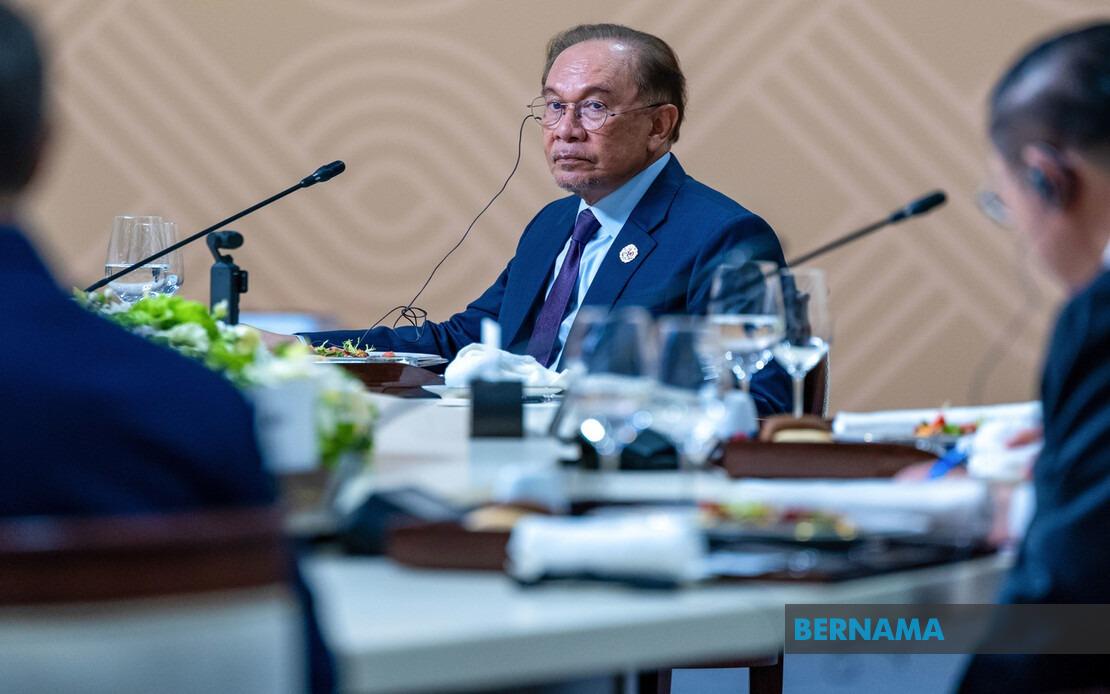
Prime Minister Datuk Seri Anwar Ibrahim's four-day journey through Tashkent, Kazan, and Ashgabat represents far more than a routine diplomatic circuit. The condensed schedule achieved multiple strategic objectives simultaneously, reflecting Malaysia's calculated response to one of the most consequential periods of global economic transformation since the Cold War ended. As major powers intensify their strategic competition and weaponise trade policy through restrictions, sanctions, and export controls, smaller nations like Malaysia face a narrowing window to secure their economic futures and preserve their autonomy.
For Malaysia, the stakes in this shifting international order extend well beyond maintaining growth within an open global trading system. The nation must now simultaneously protect critical supply chains, safeguard economic opportunities, and build the resilience necessary to navigate an increasingly fragmented world. The diplomatic visits underscore a fundamental recognition: survival in this environment demands expanding the network of partners and relationships rather than concentrating bets on traditional allies.
The stopover in Tashkent, initially conceived as a brief courtesy call on President Shavkat Mirziyoyev, evolved into substantive economic discussions building on groundwork laid during a 2024 official visit. Malaysia and Uzbekistan identified multiple cooperation areas requiring detailed follow-up, demonstrating how diplomatic engagement increasingly operates on multiple tracks simultaneously. What might appear as peripheral stops on an itinerary often contain the seeds of significant future partnerships.
Kazan represented Malaysia's participation in the broader ASEAN-Russia Commemorative Summit, positioning Southeast Asia within the wider Eurasian economic ecosystem. While Russia remains a relatively modest trade and investment partner compared to established relationships, both ASEAN and Moscow acknowledge substantial untapped potential across diverse sectors including energy, agriculture, digital technology, advanced manufacturing, and food security. The ASEAN-Russia Strategic Programme on Trade and Investment Cooperation 2026-2035 formalises this recognition that future competitiveness increasingly hinges on innovation, technological capability, and economic adaptability.
Beyond Moscow's traditional influence, Malaysia engaged with Tatarstan, one of Russia's most dynamic industrial and technological centres. Discussions spanning biotechnology, halal industries, maritime capabilities, Islamic finance, and industrial cooperation reveal a sophisticated understanding of contemporary economic diplomacy. National governments no longer serve as exclusive gateways to economic opportunity; increasingly, regional authorities, industrial clusters, and innovation hubs function as independent actors in international economic networks. Building these sub-national relationships often generates practical commercial opportunities that complement traditional state-to-state engagement.
Turkmenistan, the final destination, highlighted Malaysia's commitment to energy diversification through Petronas. The national oil company has maintained substantial operations there for three decades, evolving beyond simple foreign investment into a genuine partnership contributing to infrastructure development, technological advancement, and human capital formation. The estimated USD12 billion in cumulative investment reflects patience and long-term commitment rather than opportunistic capital flows. Recent landmark agreements position Petronas to expand significantly its stake in one of the world's largest gas fields, securing long-term hydrocarbon development rights and expanded exploration activities.
This energy partnership carries implications extending far beyond commercial metrics. Recent global crises demonstrated how quickly disruptions in one region can cascade through international energy markets, shipping networks, and production costs worldwide. Diversified energy partnerships have become essential components of national economic resilience and strategic flexibility. For a nation dependent on stable energy supplies, deepening relationships with reliable producers in geopolitically complex regions provides insurance against supply disruptions and price volatility.
Crucially, these engagements cannot be reduced to trade and investment statistics alone. The Prime Minister emphasised across all bilateral discussions that contemporary economic diplomacy operates simultaneously across multiple interconnected domains. Food security intersects with technological advancement; energy cooperation overlaps with industrial development and infrastructure investment; digitalisation creates innovation opportunities while raising governance and technological dependence concerns. Building what Anwar characterised as "brotherly relations" has become integral to economic diplomacy, establishing mutual trust and confidence essential for navigating complex negotiations.
Malaysia's approach reflects a broader challenge confronting many middle powers navigating an intensifying multipolar world. As traditional blocs fragment and strategic competition sharpens, resilience increasingly depends on the breadth and diversity of external relationships rather than reliance on a narrow group of established partners. ASEAN's traditional emphasis on centrality and maintaining open channels across competing centres of power gains fresh relevance in this environment. Rather than choosing exclusive alignments, the region positions itself to benefit from multiple partnerships.
Diversification strategy does not imply diminishing existing relationships; instead, it represents an effort to expand Malaysia's economic options and negotiating leverage in an increasingly challenging world. A trading nation whose prosperity depends fundamentally on openness and connectivity requires maximum flexibility to adapt as circumstances shift. Countries successfully positioning themselves within broader economic networks enjoy substantially greater resilience than those whose options remain narrowly concentrated among a handful of partners.
The halal ecosystem featured prominently in discussions across all three destinations, reflecting Malaysia's competitive advantage in this rapidly expanding global sector. As Muslim-majority populations continue expanding and consumer consciousness regarding halal certification grows, Malaysia possesses expertise and credentials valuable across diverse markets. Collaborations in education and research alongside Islamic finance create additional vectors for deepening relationships beyond conventional trade.
PM Anwar's diplomatic tour ultimately demonstrates that economic statecraft for middle powers increasingly requires sophisticated engagement across multiple geographic regions, economic sectors, and relationship types. The four-day circuit achieved tangible commercial outcomes whilst simultaneously signalling Malaysia's determination to remain centrally positioned within evolving global economic networks. As the international order continues fragmenting, nations that successfully diversify their partnerships whilst maintaining principled engagement across competing blocs will best protect their strategic interests and economic prosperity.
For Malaysia specifically, these initiatives signal readiness to move beyond historical trade dependencies and establish genuine partnerships in regions often overlooked by Southeast Asian policymakers. The investments in political relationship-building through high-level visits create diplomatic capital that can be converted into commercial advantage when opportunities arise. In an era when traditional multilateral frameworks appear increasingly strained, bilateral and regional networks become crucial channels through which nations pursue their interests and manage uncertainty.
%22%2F%3E%3C%2Fpattern%3E%3C%2Fdefs%3E%3Crect%20width%3D%22100%25%22%20height%3D%22100%25%22%20fill%3D%22url(%23ph1qbo1g)%22%2F%3E%3Crect%20width%3D%22100%25%22%20height%3D%22100%25%22%20fill%3D%22url(%23ph1qbo1p)%22%2F%3E%3Ctext%20x%3D%2250%25%22%20y%3D%2250%25%22%20text-anchor%3D%22middle%22%20dominant-baseline%3D%22central%22%20fill%3D%22rgba(255%2C255%2C255%2C0.95)%22%20font-family%3D%22Georgia%2C%20'Times%20New%20Roman'%2C%20serif%22%20font-weight%3D%22700%22%20font-size%3D%22136%22%20letter-spacing%3D%22-0.02em%22%3ETerengganu%3C%2Ftext%3E%3C%2Fsvg%3E)