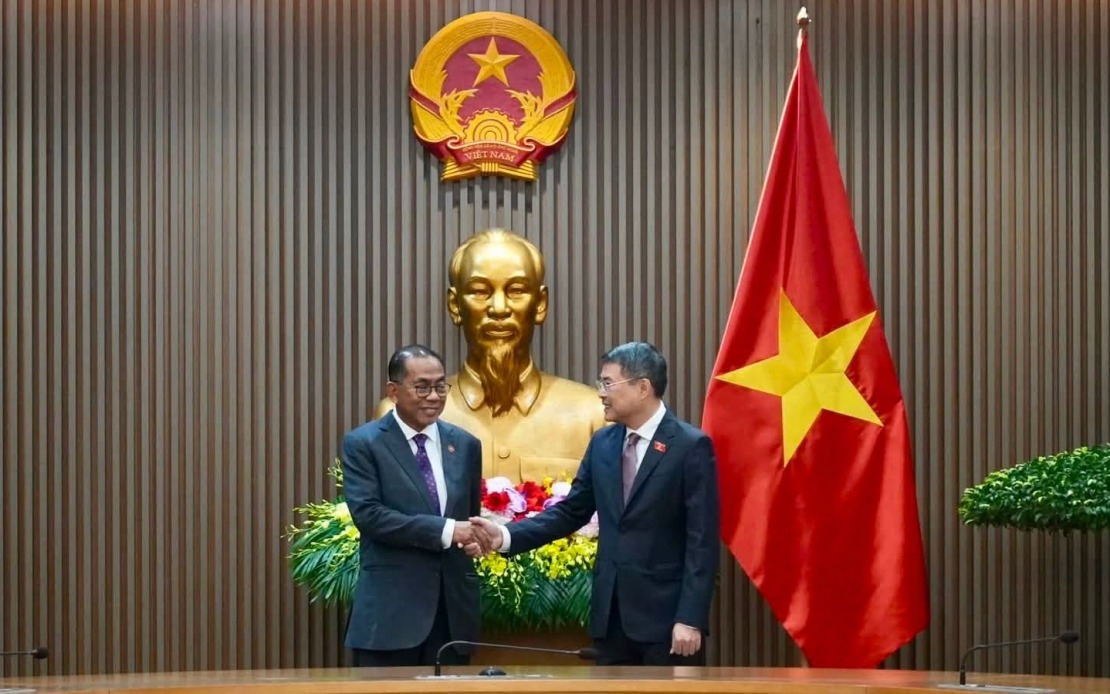
Malaysia and Vietnam are moving to deepen their defence relationship through expanded cooperation across maritime security, technological advancement and defence industrial capacity, Defence Minister Datuk Seri Mohamed Khaled Nordin said following high-level talks in Hanoi. The Malaysian minister held discussions with Vietnamese Prime Minister Lê Minh Hưng during an official visit, exploring avenues to transform bilateral defence ties into a more strategically aligned partnership suited to the complexities of the contemporary regional environment.
The two nations regard each other as trusted and dependable strategic partners, a relationship grounded in shared commitment to ASEAN principles and a mutual preference for dialogue and diplomacy as mechanisms for preserving regional peace. This foundation has enabled Malaysia and Vietnam to align their thinking on fundamental security matters and develop a practical framework for collaboration that benefits both governments and the broader Southeast Asian community.
A central anchor for the deepening partnership is the 2023 Memorandum of Understanding on Defence Cooperation, which both capitals have designated as a roadmap for advancing their military and security relationship. Rather than serving as a static document, the MoU is being treated as a living instrument capable of adaptation to emerging needs and opportunities. This flexible approach allows Malaysia and Vietnam to respond nimbly to evolving challenges without requiring renegotiation of foundational terms.
Maritime security emerged as a priority area during the ministerial discussions, reflecting shared geographical and strategic interests in the waters of Southeast Asia. As both nations maintain coastlines vulnerable to transnational security challenges—including piracy, smuggling and unauthorised fishing—coordinated approaches to maritime domain awareness and joint operations offer clear mutual benefits. Enhanced information sharing and coordinated patrols in relevant zones could significantly improve security outcomes for both countries and contribute to freedom of navigation in contested waters.
Capability development and technology transfer represent another pillar of the expanding partnership. By collaborating on military training programmes, equipment standardisation and technological innovation, Malaysia and Vietnam can accelerate modernisation efforts while reducing duplicative expenditure. This is particularly relevant given the defence budgetary pressures faced by most Southeast Asian nations and the premium placed on acquiring sophisticated capabilities in an arms-competitive region.
The defence industrial dimension adds an economic layer to the security cooperation. Malaysian and Vietnamese defence manufacturers and technology firms can explore joint ventures, licensing arrangements and supply chain partnerships that create competitive advantages in regional and global markets. Such industrial collaboration strengthens the economic foundation of the security relationship and creates private sector constituencies invested in maintaining stable bilateral ties.
Both nations recognised the intensifying security challenges that now define the regional strategic environment. Great power competition, particularly the structural rivalry between the United States and China, creates pressure points throughout Southeast Asia and forces smaller nations to calibrate their positions carefully. Grey zone activities—military actions that fall below the threshold of conventional war—pose particular challenges to countries lacking sophisticated early-warning systems or advanced defensive capabilities.
Cyber threats have become an existential concern for both Malaysia and Vietnam as their digital infrastructure expands and digitalisation deepens across government and commercial sectors. The emergence of AI-enabled cyber warfare and cognitive warfare—campaigns designed to manipulate public opinion and political perceptions—represents a threat envelope that traditional military structures are only beginning to address comprehensively. Supply chain disruptions, vividly demonstrated during the pandemic and ongoing geopolitical tensions, threaten defence procurement and industrial capacity.
In this complex landscape, Malaysian and Vietnamese defence officials have concluded that ASEAN cannot effectively address these challenges through individual national responses alone. Strengthening collective regional resilience requires closer coordination among member states, pooling of intelligence and analytical resources, and development of shared protocols for responding to emerging threats. Malaysia and Vietnam see themselves as catalysts for encouraging this broader regional integration.
The strategic partnership between Malaysia and Vietnam is also informed by their respective geopolitical positions. Vietnam, with its lengthier coastline and more direct exposure to great power competition in the South China Sea, brings particular expertise in managing complex maritime security environments. Malaysia, positioned at one of the world's most critical maritime choke points, brings different but complementary security perspectives and interests. Their collaboration can serve as a model for ASEAN states seeking to build stronger partnerships without compromising non-alignment or ASEAN solidarity.
The timing of this defence engagement carries significance within the broader ASEAN context. As the bloc confronts challenges to its unity and coherence, bilateral partnerships that reinforce shared ASEAN principles and demonstrate commitment to dialogue-based problem solving help sustain the organisation's relevance. Malaysia and Vietnam's emphasis on maintaining regional peace and prosperity through strengthened defence cooperation sends a message that ASEAN members remain committed to managing their differences through established frameworks rather than confrontation.
Looking forward, the expansion of Malaysia-Vietnam defence cooperation will likely extend beyond traditional military domains into areas such as humanitarian assistance and disaster relief, where both nations face shared vulnerabilities. Joint training exercises, officer exchange programmes and technical working groups will operationalise the commitments announced, transforming political declarations into practical security improvements. The success of this partnership may also encourage other ASEAN pairings to deepen their defence relationships, gradually strengthening the security architecture that underpins regional stability.

