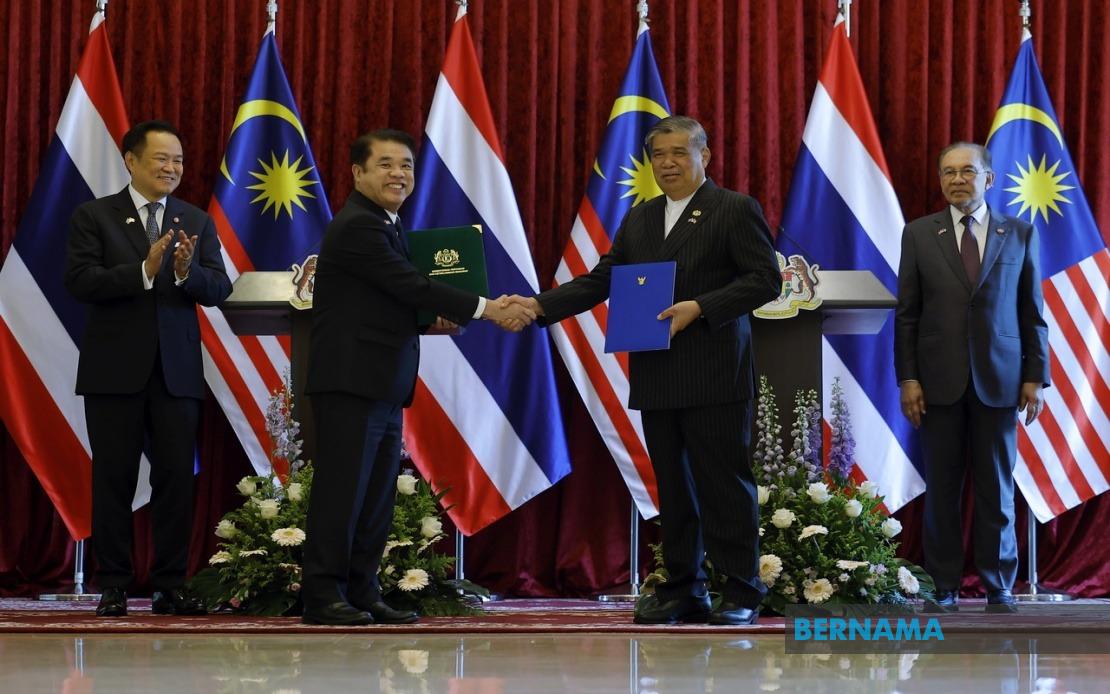
Malaysia and Thailand have cleared a significant hurdle in their agricultural relationship by resolving contested fisheries market access issues and accelerating implementation of a comprehensive agricultural cooperation framework. The breakthrough emerged during Thai Prime Minister Anutin Charnvirakul's maiden official visit to Malaysia, where the two nations' leaders oversaw the signing of a memorandum of understanding designed to deepen food security collaboration and expand bilateral trade in agricultural commodities. Prime Minister Datuk Seri Anwar Ibrahim and Anutin witnessed the formal exchange of the MoU between Malaysia's Agriculture and Food Security Minister Datuk Seri Mohamad Sabu and Thailand's Agriculture Minister Suriya Juangroongruangkit at a signing ceremony in Putrajaya on July 9.
The pace of implementation represents a notable diplomatic acceleration. Thai officials had initially sought a one-and-a-half-month timeline before the MoU could take legal effect, but Malaysian negotiators successfully compressed that window to just seven days. This expedited approach signals both countries' desire to move swiftly from paper agreements to practical cooperation, reflecting heightened regional urgency around food supply stability. The rapid deployment of the framework underscores how agricultural resilience has become a critical policy lever in Southeast Asian diplomacy, particularly as global supply chain vulnerabilities persist and populations face mounting food price pressures.
At the joint press conference following the signing, Anwar framed the agreement as evidence of shared commitment to fortifying food security across the region while simultaneously strengthening commercial ties. He specifically highlighted the resolution of fisheries-related market access obstacles, which had created friction between the two countries' agricultural sectors. The disputed access issues had threatened to derail broader cooperation plans, but coordinated efforts by both agriculture ministers produced what officials described as mutually agreeable solutions to previously intractable cases. This diplomatic success required both sides to make concessions and demonstrates that even entrenched trade disagreements can yield to structured negotiation when political leadership prioritizes outcomes.
Thailand's prime minister reciprocated the optimistic tone, characterizing food security as a cornerstone of bilateral engagement. Anutin acknowledged the agricultural ministers' role in brokering solutions to contentious matters surrounding fishery and agricultural product market access, suggesting that technical-level expertise had paved the way for political-level breakthroughs. His emphasis on amicable resolution rather than zero-sum outcomes reflects a Southeast Asian approach to trade disputes that seeks to preserve longer-term relationships rather than declare winners and losers. This collaborative posture carries implications for how ASEAN member states might address similar disputes within the broader regional economic framework.
The memorandum itself provides an expansive template for agricultural cooperation spanning multiple domains. Beyond the headline fisheries resolution, the framework encompasses crop production coordination, livestock development initiatives, and structured trade facilitation mechanisms. The agreement also establishes protocols for research and development collaboration, technical capacity building programs, and alignment on biosecurity standards. Critically, the MoU addresses sanitary and phytosanitary measures—the technical regulations that often obscure protectionist intent behind health and safety justifications. By pre-emptively establishing shared standards and transparent procedures in these areas, Malaysia and Thailand aim to prevent future disputes from germinating in regulatory grey zones.
The bilateral relationship has been building toward this moment through accumulated conversations. The two prime ministers had held substantive talks merely one week prior to the Putrajaya signing, during which they surveyed the broader landscape of potential cooperation in trade, investment, and shared regional concerns. That preliminary discussion likely created the diplomatic runway necessary for agriculture ministers to finalize technical details and identify compromises. Sequential engagement at both political and technical levels demonstrates sophisticated diplomacy that combines high-level political will with professional negotiation capacity.
Context for these negotiations extends back to specific trade friction points. On June 1, Malaysia had implemented stricter import controls targeting Thai fisheries products, mandating Certificates of Analysis for barramundi and imposing temporary restrictions on five designated shrimp species. These measures, while framed as food safety protocols, effectively created barriers to Thai suppliers seeking Malaysian market access. The timing and specificity of these controls suggested they represented leverage in broader trade discussions rather than responses to immediate safety crises. By resolving the underlying access disputes through the MoU framework, both countries have created mechanisms to address similar concerns through structured dialogue before protectionist measures become necessary.
The bilateral trade relationship between Malaysia and Thailand carries substantial economic weight, particularly in agricultural and agri-food sectors. Commerce in these categories reached RM20.33 billion across the full year 2025, indicating the stakes involved in trade friction and the potential gains from improved cooperation. Malaysia's export portfolio to Thailand centers on value-added products including coffee, cocoa, tea, and spices alongside processed food items, reflecting Malaysia's position in supplying specialty and processed agricultural goods. Thai exports to Malaysia emphasize meat and meat-based products, positioning Thailand as a key protein source for Malaysian consumers and food manufacturers. This complementary trade structure suggests significant room for expanded bilateral commerce if institutional barriers can be minimized.
For Malaysian consumers and businesses, the accelerated MoU implementation carries practical implications. Streamlined cooperation on agricultural standards and coordinated R&D initiatives could enhance the availability and affordability of imported agricultural products while simultaneously opening Thai markets to Malaysian processed food exports. The framework's emphasis on transparent coordination mechanisms should reduce the likelihood of surprise trade restrictions or arbitrary regulatory changes. Businesses in both nations gain predictability about market access conditions, enabling longer-term investment and supply chain planning. The emphasis on capacity building and technology transfer also positions Malaysian agricultural enterprises to potentially access Thai expertise while offering their own technical knowledge to Thai partners.
The regional context amplifies significance of this bilateral breakthrough. Southeast Asia confronts mounting food security challenges driven by climate variability, competing land uses, and rising consumption demands from growing middle-class populations. Multilateral initiatives like those pursued through ASEAN frameworks often proceed slowly due to consensus requirements and divergent national interests. Bilateral agreements like the Malaysia-Thailand MoU thus serve as practical laboratories for cooperation models that might eventually scale to regional or broader Indo-Pacific levels. Success in resolving specific agricultural trade disputes and establishing durable institutional frameworks between Bangkok and Kuala Lumpur could provide templates for other ASEAN dyads navigating similar tensions.
Looking forward, the structured mechanism established through this MoU—with its emphasis on continuous communication and proactive issue resolution—may prove more valuable than any single trade arrangement. Agricultural sectors constantly encounter new challenges ranging from emerging pests and diseases to shifting climate patterns to evolving consumer preferences. Institutions capable of responding flexibly to these developments while maintaining transparent, rules-based procedures serve both nations' long-term interests more effectively than fixed agreements. The Malaysia-Thailand framework thus represents not merely a resolution of current disputes but an investment in governance capacity for managing agricultural cooperation in an uncertain future.

