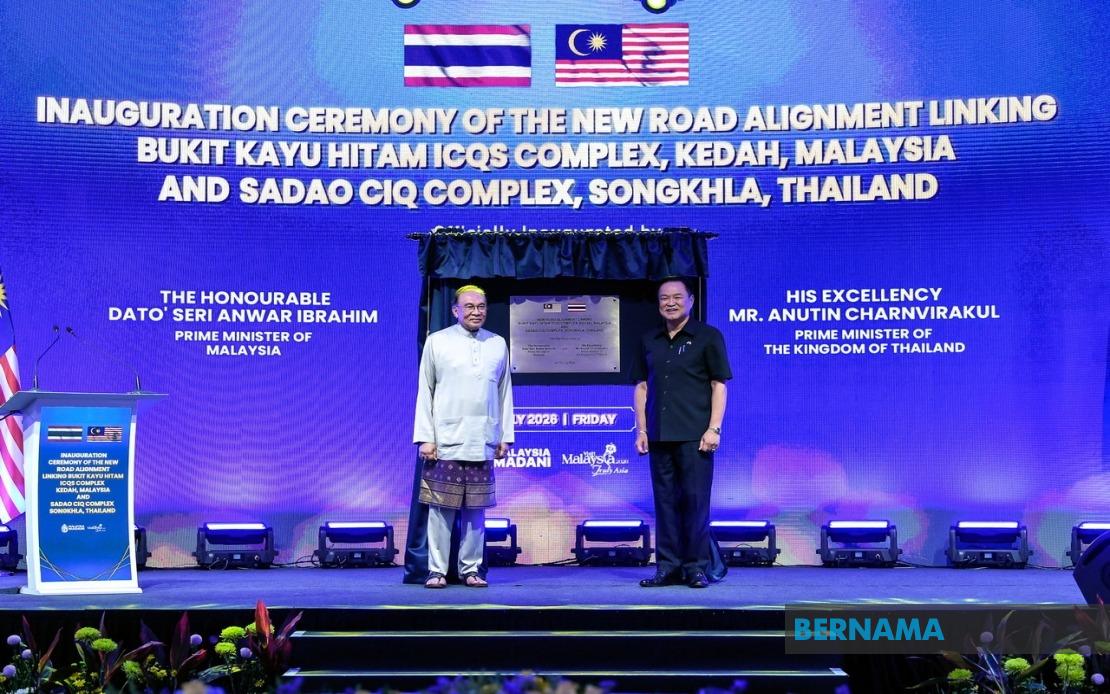
Prime Minister Datuk Seri Anwar Ibrahim and his Thai counterpart Anutin Charnvirakul jointly inaugurated a strategically significant road alignment at the Malaysia-Thailand border on July 10, marking what both leaders described as a watershed moment in bilateral relations. The new infrastructure connects the Bukit Kayu Hitam Immigration, Customs, Quarantine and Security Complex in Kedah with the Sadao Customs, Immigration and Quarantine Complex in Thailand's southern region, creating a modernised crossing point designed to facilitate seamless movement of goods, services, and people across the frontier.
Anwar characterised the project as far more than routine infrastructure development, positioning it instead as the foundation for a transformative approach to regional prosperity. He emphasised that the initiative reflects a fundamental shift in how Malaysia and Thailand conceptualise their shared border—not merely as a dividing line requiring security management, but as an opportunity hub where mutual economic interests converge. The Prime Minister stressed that addressing the economic disparities affecting communities in northern Peninsular Malaysia and southern Thailand requires deliberate, coordinated strategies that extend beyond traditional diplomatic protocols into substantive economic cooperation frameworks.
Central to this vision is the establishment of a special economic border zone encompassing Perlis, Kedah, Kelantan, Perak, and Penang on the Malaysian side, mirrored by corresponding arrangements in Thailand's southern provinces. Anwar acknowledged that constructing such an integrated economic space presents considerable challenges that cannot be resolved through hasty measures or superficial agreements. Instead, the endeavour demands sustained political will, institutional coordination, and willingness from both leaderships to prioritise cross-border prosperity over parochial interests. The zone concept represents recognition that border regions often lag economically compared to national capitals and major metropolitan centres, despite possessing considerable untapped potential in agriculture, manufacturing, services, and tourism sectors.
The two governments have committed to an ambitious bilateral trade target of USD30 billion by 2027, a figure that underscores confidence in the commercial possibilities unlocked by improved infrastructure and regulatory harmonisation. Current trade flows, while substantial, fall short of what proponents argue is achievable given the complementary nature of both economies and geographic proximity. Enhanced border connectivity should reduce transaction costs, shorten supply chains, and enable businesses to operate more efficiently across the frontier, thereby increasing trade volumes and investment flows in both directions.
Beyond infrastructure, Anwar and Anutin agreed to accelerate resolution of longstanding procedural obstacles that impede smooth commercial operations. These include customs clearance protocols, immigration procedures, fisheries management regulations, and trade documentation standards. The Prime Minister noted with evident satisfaction that issues requiring years or even decades of negotiation had been addressed with surprising expedition during recent bilateral discussions, suggesting that political commitment at the highest levels can overcome bureaucratic inertia. Such streamlining benefits traders and businesses operating across the border by reducing delays, lowering compliance costs, and creating predictability in cross-border transactions.
The fisheries dimension warrants particular attention given that both nations share maritime boundaries in the Andaman Sea and have historically experienced tensions over fishing rights, territorial claims, and resource management. By incorporating fisheries cooperation into the broader border economic framework, both governments signal intent to transform a traditionally contentious sector into one characterised by mutual benefit and sustainable resource stewardship. This approach aligns with international best practices in maritime governance and reflects growing recognition that environmental sustainability and economic prosperity are complementary rather than competing objectives.
For Malaysia's northern states, this development carries significant implications for economic diversification and employment generation. Kedah, Perlis, and Kelantan have historically relied heavily on agriculture, particularly rice cultivation and rubber production, sectors vulnerable to commodity price fluctuations and climate variability. A thriving border economic zone could catalyse manufacturing expansion, logistics hub development, and services sector growth, providing alternative income sources for rural populations and creating middle-class employment opportunities that encourage youth retention in northern regions. Similarly, Penang's established manufacturing base and port infrastructure position it advantageously to serve as an anchor for increased Malaysia-Thailand trade flows.
The initiative also reflects broader regional trends toward economic integration and intra-ASEAN cooperation. As Southeast Asian nations increasingly recognise that prosperity is interdependent and that zero-sum approaches to border management yield suboptimal outcomes, bilateral projects like the Bukit Kayu Hitam-Sadao alignment gain momentum. Such ventures provide templates for other ASEAN member states grappling with similar cross-border development challenges, demonstrating that political commitment, clear institutional frameworks, and long-term vision can transform borders from barriers into bridges.
Anwar's appreciation for Anutin's willingness to visit the border area—rather than conducting discussions purely in capital cities—underscores an important principle in contemporary governance: understanding constituent needs requires physical presence and direct engagement with communities beyond metropolitan centres. Border populations often feel neglected by national governments focused on urban agglomerations, and leaders' demonstrated commitment to addressing their concerns builds political capital and reinforces social cohesion.
The project's success will ultimately depend on implementation quality and sustained political commitment from successive governments in both nations. Infrastructure alone cannot guarantee economic transformation; accompanying investments in human capital development, institutional capacity-building, and regulatory harmonisation will prove equally crucial. Both governments must ensure that benefits from increased cross-border activity are widely distributed rather than concentrated among large corporations, so that ordinary citizens in border communities experience tangible improvements in living standards.
Looking ahead, the Bukit Kayu Hitam-Sadao alignment establishes a significant precedent for Malaysia-Thailand relations and offers a model potentially applicable to other bilateral and multilateral border cooperation initiatives within Southeast Asia. By demonstrating that shared infrastructure and coordinated economic policies can unlock mutual prosperity, Malaysia and Thailand contribute to regional stability and integration, reinforcing ASEAN's foundational principle that prosperity and peace are mutually reinforcing objectives worthy of sustained collaborative effort.

