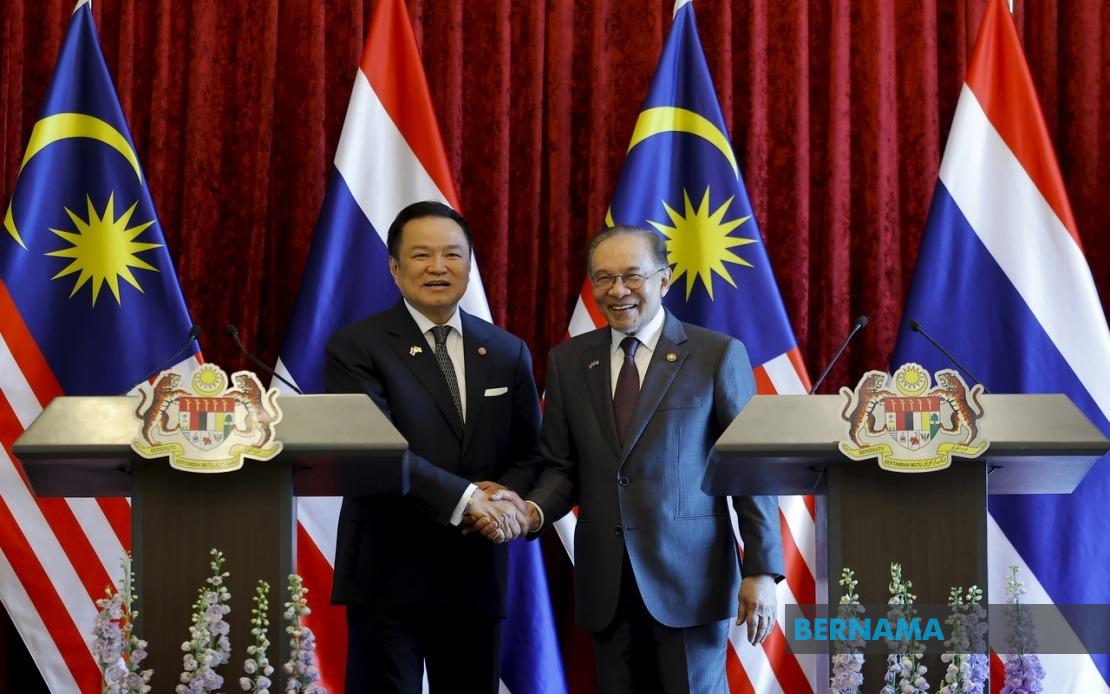
Malaysia and Thailand have committed to accelerating major infrastructure projects along their shared border while establishing specialized economic development zones, aiming to elevate bilateral trade to US$30 billion within the next three years. The ambitious initiative, unveiled during bilateral discussions in Putrajaya on July 9, represents a significant escalation in cross-border cooperation between the two Southeast Asian neighbours and signals renewed political commitment to regional integration.
Prime Minister Datuk Seri Anwar Ibrahim emphasized the substantive nature of his engagement with Thailand Prime Minister Anutin Charnvirakul, highlighting the broad scope of collaboration spanning historical ties, cultural exchanges, economic partnerships and investment flows. The Malaysian leader stressed that despite the longstanding relationship between Kuala Lumpur and Bangkok, considerable untapped potential remains in deepening cooperation across multiple sectors. This recognition suggests both governments view the relationship as needing strategic reinvigoration beyond routine diplomatic courtesy.
The agreement encompasses several concrete operational improvements designed to facilitate smoother cross-border movement of goods and people. Immigration and customs procedures are being reformed to eliminate unnecessary bureaucratic friction, a critical step given that Malaysia-Thailand trade currently falls significantly short of the ambitious 2027 target. The streamlining of these administrative processes reflects lessons learned from other regional trade blocs and addresses long-standing complaints from businesses operating in border regions about delays and documentation bottlenecks.
The establishment of special border economic zones represents the most innovative element of the partnership. These designated areas will operate under specially crafted regulatory frameworks that incentivize investment and commercial activity in previously underdeveloped frontier regions. Such zones have proven successful in other international border contexts, creating economic opportunities that benefit rural populations while simultaneously strengthening national integration. For Malaysia, these zones could transform the economic profile of Perlis and northern Perak, regions that have historically lagged behind more developed peninsular areas.
Anwar's reference to an upcoming visit to Bukit Kayu Hitam and Sadao underscores a deliberate strategy to move bilateral discussions beyond traditional capital-based diplomacy. The border communities in these areas represent crucial stakeholders in any cross-border initiative, and their direct engagement with both prime ministers signals that implementation concerns are being taken seriously. This approach contrasts sharply with previous agreements that remained largely ministerial-level exercises, often failing to generate meaningful ground-level results.
The US$30 billion trade target by 2027 appears ambitious yet potentially achievable given that bilateral commerce has shown consistent growth patterns over recent decades. However, realizing this figure depends heavily on removing supply chain constraints and expanding investment in complementary industries. Thai manufacturers seeking to access markets beyond their domestic base find Malaysia an attractive platform for regional distribution, while Malaysian businesses can leverage Thai expertise in agricultural processing and automotive sectors.
The timing of this initiative carries significant regional implications. As Southeast Asia navigates complex great power competition and economic uncertainty, stronger Malaysia-Thailand ties strengthen the broader ASEAN framework. Both nations serve as crucial anchors within the regional architecture, and their deepening integration sends reassuring signals about ASEAN's capacity for internal cohesion. Additionally, the emphasis on border development carries subtle security dimensions, as economic interdependence typically reinforces stability and reduces potential for friction.
Charnvirakul's personal involvement and commitment to the initiative reflects Thai recognition that bilateral relations with Malaysia require high-level attention. Recent years have witnessed periodic tensions over maritime boundary issues and resource management, making this renewed emphasis on cooperation strategically valuable. The Thai Prime Minister's willingness to extend his visit beyond Bangkok to border areas demonstrates serious engagement rather than ceremonial participation.
Implementation challenges should not be underestimated. Infrastructure projects of this scale require sustained funding, technical expertise and coordinated planning across multiple government agencies in both countries. Previous Malaysia-Thailand joint ventures have occasionally faltered due to divergent timelines, budget constraints or shifting political priorities. Success will depend on establishing robust institutional mechanisms that survive changes in government and maintain momentum regardless of bilateral political fluctuations.
The special economic zones merit particular scrutiny as they represent the most transformative element. Successful models from China-Vietnam and Thailand-Cambodia borders demonstrate that such zones can catalyze regional development when properly designed and managed. However, they also require transparent governance, protection of worker rights and environmental safeguards to avoid becoming sources of grievance. Malaysian stakeholders will be watching closely to ensure these zones deliver genuine economic opportunity rather than exploitative arrangements.
For Malaysian businesses, these developments create concrete opportunities in logistics, manufacturing and services sectors. Companies positioned in northern Malaysia stand to benefit most directly, though the broader business community could experience supply chain improvements and cost reductions. However, competitive pressure from Thai counterparts may intensify, necessitating continued focus on innovation and productivity improvements among Malaysian firms seeking to capture gains from enhanced market access.
Longer-term success hinges on maintaining political momentum and ensuring that technical ministries translate ambitious agreements into functional reality. The next phase will involve detailed negotiations on zone regulations, infrastructure specifications, and dispute resolution mechanisms. Regional observers will assess whether this partnership evolves into a model for enhanced intra-ASEAN cooperation or becomes another well-intentioned initiative that gradually loses momentum in the face of implementation complexities.

