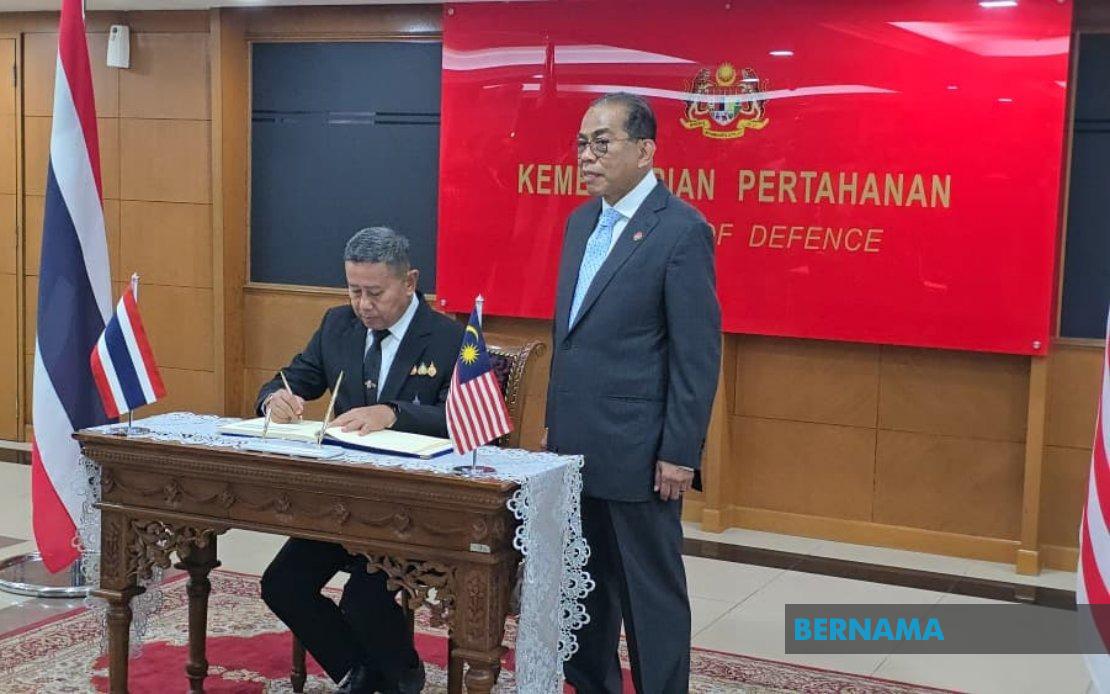
Malaysia and Thailand are intensifying their defence partnership as both nations seek to address mounting security challenges across Southeast Asia. The commitment was underscored during high-level talks between Malaysia's Defence Minister Datuk Seri Mohamed Khaled Nordin and his Thai counterpart Lieutenant General Adul Boonthumjaroen, who recently assumed his portfolio under Prime Minister Anutin Charnvirakul's government. The meeting, held at Wisma Pertahanan in Kuala Lumpur on July 14, represents the latest chapter in a longstanding security relationship between two of the region's most strategically positioned nations.
Lieutenant General Adul's inaugural visit to Malaysia's defence headquarters marks a symbolic moment for bilateral relations. The introductory nature of the engagement reflects the importance both governments place on establishing strong personal and institutional connections at the defence leadership level. By visiting Wisma Pertahanan early in his tenure, Thailand's new defence minister signalled his administration's intention to prioritise regional partnerships and demonstrate continuity in bilateral defence matters. Such diplomatic gestures carry significant weight in Southeast Asian foreign policy, where personal relationships between senior officials often translate into substantive cooperation.
The Malaysian Defence Ministry emphasised the warmth and mutual respect evident between the two defence leaders, noting their shared vision for strengthening institutional ties. Mohamed Khaled extended formal congratulations to Adul on his appointment, a customary but meaningful acknowledgment of Thailand's recent leadership transition. This personal rapport sets a constructive tone for negotiations on defence procurement, military training exchanges, and intelligence sharing—the practical mechanics of bilateral defence cooperation that benefit both nations' security apparatuses.
Crucially, both ministers reaffirmed their commitment to promoting peace and stability throughout Southeast Asia, a statement that carries particular resonance given the region's various ongoing tensions. Malaysia and Thailand face distinct but interconnected security challenges, from maritime disputes to transnational terrorism and smuggling networks. By framing their defence cooperation within a broader regional stability framework, the two countries signal their willingness to work beyond bilateral concerns and contribute to collective security mechanisms that benefit the entire Association of Southeast Asian Nations (ASEAN) community.
One notable development highlighted during the talks concerns Malaysia's diplomatic efforts in facilitating dialogue between Thailand and Cambodia regarding their disputed border. Thailand explicitly recognised and supported Malaysia's proactive role in these mediation attempts, acknowledging Kuala Lumpur's constructive engagement in one of Southeast Asia's most sensitive territorial disputes. This recognition underscores Malaysia's positioning as a neutral broker and trusted mediator within ASEAN, enhancing its soft power credentials and demonstrating the value of its defence diplomacy beyond purely military considerations.
The border dispute between Thailand and Cambodia has periodically flared into military confrontations, most notably in 2008 and subsequent years around the Preah Vihear temple area. Malaysia's efforts to help defuse tensions reflect both humanitarian concerns and enlightened self-interest, as instability along Thailand's eastern frontier could eventually ripple across the region and disrupt ASEAN's broader stability architecture. By supporting Malaysia's mediation role, Thailand signals openness to continued diplomatic solutions rather than military escalation, a position that carries significance for all ASEAN members invested in peaceful conflict resolution.
Beyond diplomatic exchanges, the visit included a substantive technical dimension. Lieutenant General Adul toured facilities operated by the National Aerospace and Defence Industries (NADI) Group of Companies, Malaysia's premier defence industrial player. This corporate engagement is far from ceremonial; such visits typically involve preliminary discussions on potential defence procurement, technology transfer, and joint development initiatives. For Malaysia, NADI's capabilities in aerospace and defence manufacturing represent valuable assets that can anchor bilateral defence relationships and create mutually beneficial commercial partnerships.
The NADI visit opened avenues for both parties to explore concrete cooperation opportunities in defence technology and manufacturing. Malaysia has been actively promoting its domestic defence industrial base and seeking regional partnerships to sustain growth in this strategic sector. Thailand, as a fellow ASEAN member and regional military power, represents both a potential customer for Malaysian defence systems and a collaborative partner in developing solutions tailored to shared regional security challenges. Such industrial partnerships strengthen the overall defence relationship beyond government-to-government diplomacy.
These defence strengthening efforts occur within a broader context of evolving regional power dynamics. Southeast Asia faces mounting pressure from great power competition, with the United States, China, and to a lesser extent India, jockeying for influence. ASEAN nations like Malaysia and Thailand must carefully calibrate their international relationships while preserving their strategic autonomy. Deepening intra-ASEAN defence cooperation serves both countries' interests by reinforcing regional self-reliance and reducing external dependencies, though neither nation is likely to entirely abandon its broader international security partnerships.
The timing of these developments also reflects post-pandemic efforts to restore diplomatic normalcy and in-person engagement at senior levels. Defence cooperation necessarily involves personal trust and regular communication channels, making high-level visits essential for maintaining relationship momentum. As both nations emerge from pandemic-related disruptions, revitalising defence dialogues demonstrates their commitment to forward-looking regional security strategies.
Looking forward, the Malaysia-Thailand defence partnership appears positioned for expansion across multiple domains. Training exchanges, joint exercises, maritime patrols in shared waters, and intelligence sharing on transnational threats all represent logical next steps. For Malaysian policymakers, deepening ties with Thailand strengthens ASEAN's internal cohesion and demonstrates Malaysia's capability to forge substantive regional partnerships. For Thailand, engaging actively with Malaysia reinforces its commitment to cooperative security approaches and positions it as a constructive regional player.
The broader implications for Southeast Asia are equally significant. Malaysia and Thailand's renewed defence cooperation contributes to ASEAN's collective security architecture at a time when the region faces multiple challenges from maritime disputes to terrorism and cybersecurity threats. As the two nations deepen their relationship, they set positive precedents for other ASEAN dyads, potentially encouraging similar initiatives across the organisation. This network of bilateral defence partnerships ultimately strengthens the entire regional framework and enhances ASEAN's capacity to address security challenges independently.

