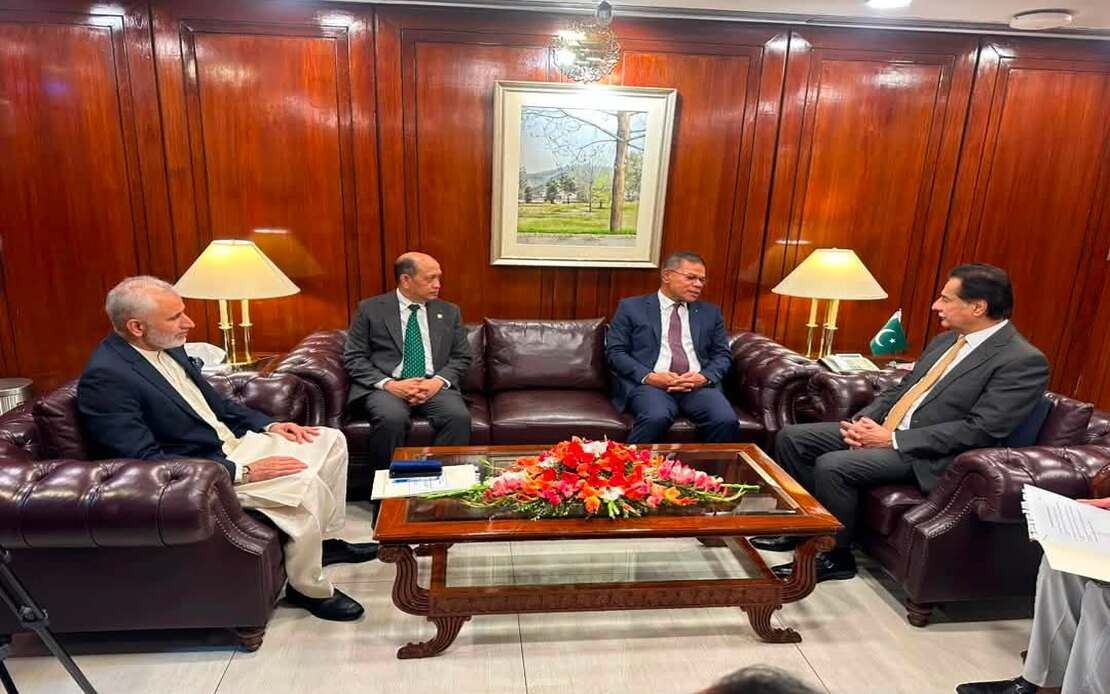
Malaysia and Pakistan have renewed their commitment to peaceful dialogue and diplomatic engagement as the primary tools for navigating complex geopolitical developments and emerging security challenges in their respective regions. Home Minister Datuk Seri Saifuddin Nasution Ismail underscored this shared position following high-level meetings with Pakistan's parliamentary leadership during his official visit to Islamabad, signalling both nations' dedication to multilateral cooperation at a time of regional tensions.
During the second day of his visit, Saifuddin Nasution held substantive discussions with Sardar Ayaz Sadiq, Speaker of the National Assembly of Pakistan, and paid a courtesy call on Syed Yousaf Raza Gilan, chairman of the Senate of Pakistan. These engagements provided a platform for both sides to articulate their mutual interests and explore avenues for strengthened institutional ties. The conversations reflected a broader regional approach where both countries seek to manage geopolitical complexities through measured diplomatic channels rather than confrontational posturing.
The Malaysian Home Minister drew upon his country's extensive experience in leveraging dialogue and constructive engagement within the ASEAN framework to maintain regional peace and stability. Malaysia's approach, refined over decades of navigating complex interstate relations in Southeast Asia, offers valuable lessons for Pakistan as Islamabad seeks to balance its own regional interests with the demands of maintaining stable relations with multiple stakeholders. This knowledge-sharing between two developing democracies represents a pragmatic exchange of best practices in conflict prevention and peaceful resolution mechanisms.
Central to the discussions was an emphasis on strengthening parliamentary-to-parliamentary relations and harnessing the potential of parliamentary diplomacy as a bridge between the two nations. Such institutional exchanges operate at a level that can complement formal government-to-government relations by fostering personal relationships among legislators and enabling candid discussions on sensitive matters. By elevating these parliamentary channels, Malaysia and Pakistan recognise that legislators often serve as important intermediaries in building public support for diplomatic initiatives and policy decisions.
Both countries anchored their bilateral relationship on foundations of mutual trust, respect, and the enduring bonds between their citizens. The Malaysia-Pakistan partnership, rooted in shared Islamic heritage and democratic values, has weathered various international transitions over the decades. However, sustained attention at the leadership level remains essential to ensure that this historical goodwill translates into contemporary cooperation that addresses the specific challenges facing both nations today, from counterterrorism to regional stability to economic partnerships.
Saifuddin Nasution's visit also included a cultural and educational dimension through his tour of the Parliament Museum, where he engaged with Pakistan's parliamentary and constitutional history. This immersion in Pakistan's democratic journey—encompassing the evolution of its constitutional framework and the development of its parliamentary institutions—demonstrates the depth of Malaysia's interest in understanding its partner nation beyond mere diplomatic protocol. Such gestures of genuine engagement create the interpersonal connections that underpin durable bilateral relationships.
The emphasis on dialogue and diplomacy emerging from these meetings carries particular significance for Southeast Asia and the broader Indo-Pacific region, where multiple actors pursue competing interests. Malaysia's public highlighting of its commitment to peaceful solutions, articulated through its engagement with Pakistan, sends a message to regional stakeholders that ASEAN-affiliated nations remain committed to rules-based multilateralism and diplomatic problem-solving. This positioning helps counterbalance narratives of inevitable conflict and demonstrates alternatives to zero-sum competition.
For Pakistan, engagement with Malaysia offers an opportunity to strengthen ties with a Southeast Asian leader that has navigated successfully the complexities of managing relations across multiple geopolitical alignments. Pakistan faces its own constellation of regional challenges, including tensions with neighbouring states and internal security pressures. By engaging with Malaysia's diplomatic experience and institutional approaches, Pakistani leadership can glean insights into how smaller to medium-sized powers can exercise disproportionate influence through strategic partnerships and multilateral institutions.
The timing of this visit reflects a deliberate effort to maintain momentum in bilateral relations despite competing pressures on both governments. In an era where bilateral relationships can be tested by shifts in international alignments or domestic political changes, regular high-level visits serve as anchors that prevent relationships from drifting into neglect. Such interactions also create space for discussing sensitive issues in confidence, away from public scrutiny, which facilitates finding creative solutions to complex problems.
Looking forward, the strengthened parliamentary connections and renewed emphasis on dialogue may yield tangible outcomes in areas including security cooperation, counterterrorism intelligence sharing, economic collaboration, and people-to-people exchanges. The Malaysia-Pakistan relationship, while solid, has significant untapped potential given both nations' strategic locations, economic capabilities, and influence within their respective regions. Regular institutional engagement at parliamentary and ministerial levels helps ensure that this potential translates into concrete benefits for both countries' citizens.
The Malaysian Home Minister's visit ultimately represents a reaffirmation that in an increasingly multipolar and contested international environment, nations continue to rely upon sustained diplomatic engagement, institutional cooperation, and genuine dialogue as the most sustainable path toward mutual prosperity and regional stability.

