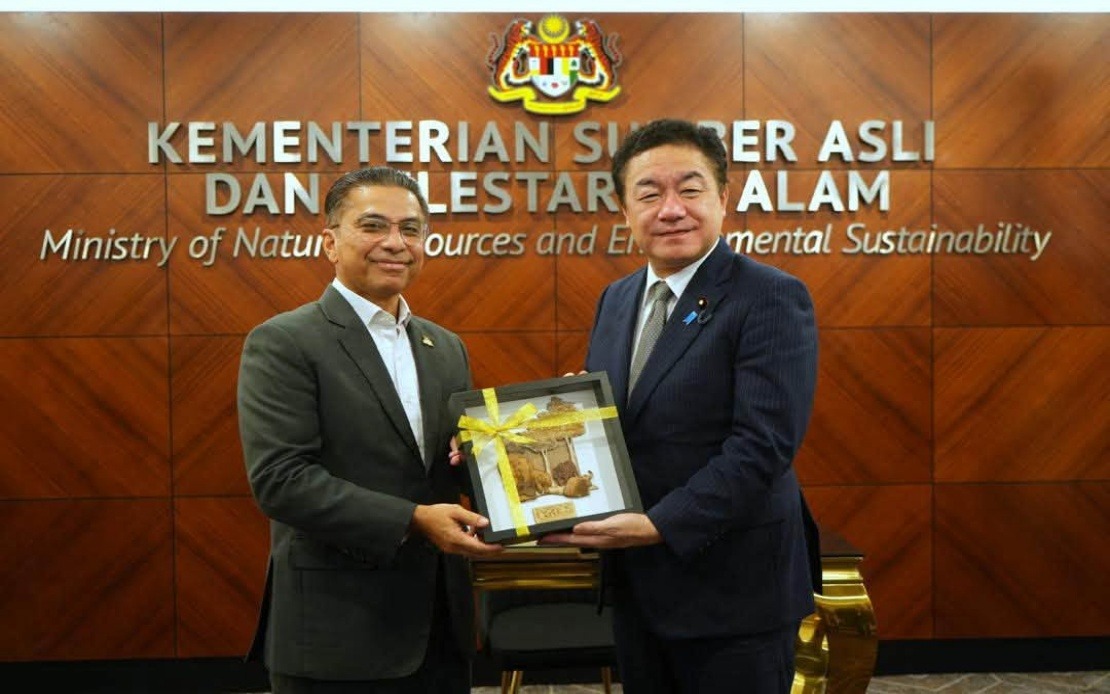
Malaysia and Japan are cementing their strategic alliance across critical economic and environmental domains, with high-level talks underway between the two nations to accelerate cooperation in rare earth elements, minerals processing, and climate transition initiatives. The engagement reflects deepening recognition that bilateral partnership serves both countries' long-term economic and sustainability objectives, particularly as global supply chains for critical materials undergo significant restructuring and climate commitments intensify across the Asia-Pacific region.
A courtesy visit by Japan's Parliamentary Vice-Minister of Economy, Trade and Industry Komori Takuo to Malaysia's Ministry of Natural Resources and Environmental Sustainability this week provided the platform for advancing these discussions. Led on the Malaysian side by Deputy Natural Resources and Environmental Sustainability Minister Syed Ibrahim Syed Noh, the meeting aimed to translate the strategic directions established during a bilateral summit held in June into concrete collaborative mechanisms and projects. The engagement operates within the broader Malaysia-Japan Comprehensive Strategic Partnership framework, indicating that resource and climate cooperation form essential pillars of modern bilateral relations between the two nations.
A cornerstone of Malaysia's negotiating position involves maintaining strict control over its rare earth sector through a longstanding moratorium on exporting raw REE materials. This policy ensures that value-added processing and refining activities remain anchored within Malaysia rather than being exported offshore, thereby maximizing domestic economic returns and building technological expertise in high-value mineral transformation. Malaysia's reaffirmation of this stance during discussions with Japan signals that despite international pressure to ease trade restrictions, the country remains committed to domestic value capture in this strategically important sector. For Japanese manufacturers and technology firms, this underscores the necessity of relocating or expanding processing operations within Malaysia to access raw materials efficiently.
The Japanese government has demonstrated sustained commitment to supporting Malaysia's resource development ambitions through multiple institutional channels. Both the Japan International Cooperation Agency (JICA) and the Japan Organisation for Metals and Energy Security (JOGMEC) have provided technical cooperation and facilitated technology transfer arrangements that enhance Malaysia's capacity to process and refine critical minerals. Malaysia's appreciation for these contributions, expressed during the high-level meeting, reflects the practical value of this partnership in building domestic industrial capabilities. Such cooperation becomes increasingly relevant as global competition for rare earth processing expertise intensifies, with countries worldwide seeking to reduce dependence on a small number of established processors.
Beyond minerals, the two nations are finalizing negotiations on a Memorandum of Cooperation concerning the Joint Crediting Mechanism (JCM), a framework established under Article 6.2 of the Paris Agreement. This mechanism allows countries to collaborate on climate mitigation projects and trade verified emission reductions, creating financial incentives for investment in low-carbon technologies. Completion of the JCM agreement by year's end would unlock new channels for channeling Japanese green technology expertise into Malaysian energy transition projects while generating tradeable carbon credits. For Malaysia, this alignment directly supports achievement of its Nationally Determined Contribution (NDC) targets, which establish emission reduction commitments under the global climate accord.
The convergence of rare earth development and climate action in these bilateral discussions reflects a sophisticated understanding of how resource extraction can be decoupled from environmental degradation. Malaysia explicitly framed the partnership as combining Japanese technological leadership in green industries with Malaysia's abundant sustainable resource potential. This positioning moves beyond transactional mineral trade toward a developmental model where advanced technology, environmental stewardship, and economic growth reinforce one another. For Malaysian policymakers, the appeal lies in building a competitive green economy that attracts investment while meeting international climate obligations—a combination that appears increasingly central to regional development strategies.
The Malaysian delegation's composition underscored the whole-of-government nature of this engagement, incorporating officials from the Natural Resources Ministry alongside senior figures from the Foreign Ministry. Japan's representation through Ambassador Shikata Noriyuki and senior METI officials similarly reflected the importance both governments attach to these discussions. This diplomatic formality and senior-level participation indicate that rare earth cooperation and climate mechanisms are not peripheral trade issues but rather strategic priorities shaping bilateral relations for the coming decade.
For Malaysia, the partnership with Japan offers pathways to competitiveness in minerals processing that increasingly incorporates environmental and sustainability standards as non-negotiable requirements. Japanese industry's reputation for precision manufacturing and technological innovation creates opportunities for Malaysian processors to access expertise in efficiency, waste reduction, and value recovery. Simultaneously, Japan's commitment to sourcing critical minerals from stable, democratic partners aligned with its strategic interests creates mutual incentives for deepening cooperation. This alignment is particularly significant given global concerns about supply chain vulnerabilities and geopolitical fragmentation in critical material sourcing.
The emphasis on green technology transfer and low-carbon investment mechanisms reflects how bilateral relations are being reshaped by global climate imperatives. Rather than treating climate action and economic development as competing priorities, the Malaysia-Japan framework integrates them into a single strategic vision. Malaysian policymakers evidently view Japanese partnership as instrumental to achieving dual objectives: maintaining competitiveness in resource-intensive industries while progressively reducing their environmental footprint. This strategic integration positions Malaysia as a potential hub for sustainable minerals processing in Southeast Asia, potentially attracting regional manufacturers seeking ethical supply chains.
The finalisation of the Joint Crediting Mechanism by year's end will establish formal structures for channeling investment into Malaysia's energy transition, particularly renewable energy development and industrial efficiency improvements. Beyond immediate financial benefits, the mechanism creates accountability frameworks that strengthen Malaysia's climate credibility internationally—an increasingly valuable asset as investors increasingly screen companies and countries for sustainability credentials. For Japanese investors, the JCM provides transparent mechanisms for supporting projects that generate measurable emission reductions while supporting business expansion in a strategically important market.
These developments in Malaysia-Japan cooperation must be understood within the broader context of Asian competition for critical minerals and green technology leadership. China's dominance in rare earth processing presents a strategic vulnerability that Japan and other developed economies are actively working to reduce through partnerships with countries like Malaysia. By supporting Malaysian capacity development, Japan is simultaneously addressing its own supply security concerns and contributing to a more diversified, resilient global minerals supply network. Malaysia's strategic location, resource endowments, and relative political stability make it an attractive partner in these repositioning efforts.
Looking forward, the success of these cooperation mechanisms will depend on translating high-level commitments into concrete investments and operational improvements. The establishment of formal MOC frameworks suggests both governments are moving beyond diplomatic pleasantries toward binding cooperative arrangements with measurable outcomes. For Malaysian industry, access to Japanese technology and investment capital could catalyze significant productivity improvements in minerals processing. For Japan, a secure, sustainable supply chain for critical materials strengthens its position as a technology-driven economy navigating a resource-constrained future.

