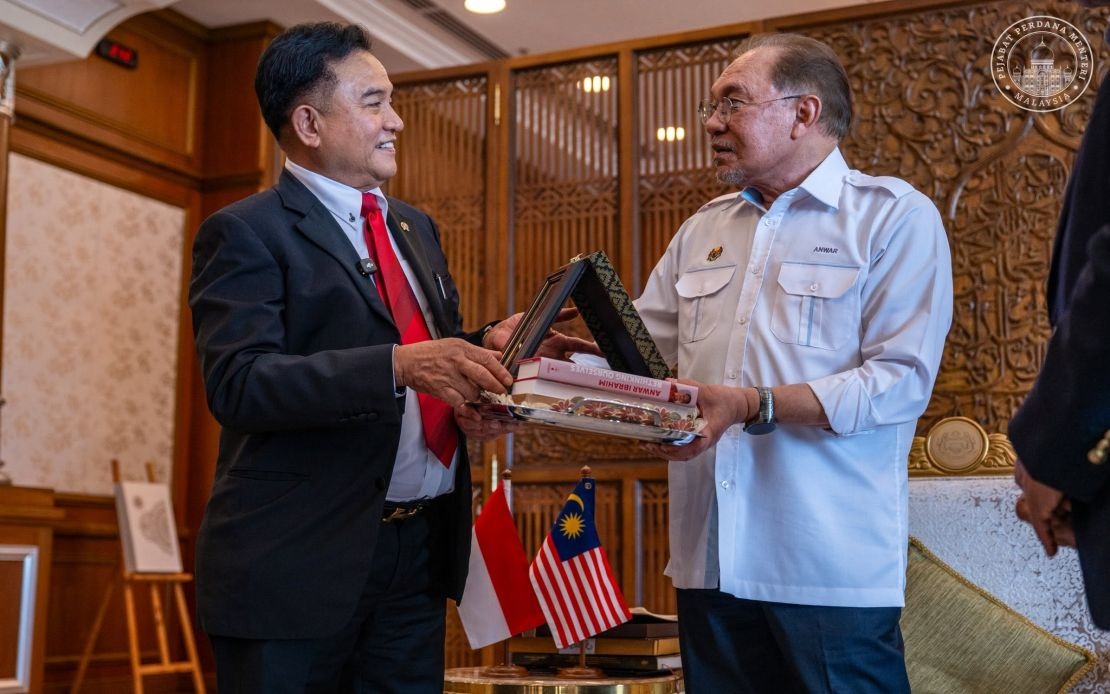
Prime Minister Datuk Seri Anwar Ibrahim has underscored Malaysia and Indonesia's determination to broaden their partnership across legislative and governance frameworks, signalling renewed momentum in bilateral relations between Southeast Asia's two largest Muslim-majority nations. The commitment emerged during a meeting at the Prime Minister's Office in Putrajaya, where Anwar received Prof Dr Yusril Ihza Mahendra, Indonesia's Coordinating Minister for Legal, Human Rights, Immigration and Correction, who visited to pay his respects to the Malaysian leader.
The discussion touched on substantive areas where both countries see potential for expanded collaboration, reflecting a pattern of deepening engagement between Kuala Lumpur and Jakarta on matters affecting their shared governance challenges. Rather than remaining confined to ceremonial exchanges, the talks addressed specific mechanisms through which Malaysia and Indonesia can harmonise legislative approaches and share governance expertise across multiple sectors. This focus on the mechanics of cooperation signals recognition that both nations face similar institutional pressures and policy complexities that benefit from coordinated responses.
For Malaysia, such engagement carries particular significance given the country's position as a regional financial hub and trading power. Enhanced legislative coordination with Indonesia—a nation of more than 270 million people and ASEAN's largest economy—creates opportunities to align regulatory standards, streamline cross-border procedures, and facilitate smoother investment flows between the two economies. When two major regional players align their legislative frameworks, the ripple effects extend beyond bilateral relations to reshape the broader Southeast Asian business environment and investment climate.
Indonesia's involvement of its Coordinating Minister for legal and human rights matters suggests Jakarta views this engagement as touching core institutional functions rather than peripheral diplomatic niceties. The inclusion of immigration and corrections within his purview indicates the discussions likely encompassed sensitive issues related to border management, cross-border crime, labour mobility, and judicial cooperation—all areas where Malaysia and Indonesia share complex, sometimes contentious histories requiring ongoing diplomatic attention.
From a Malaysian perspective, stronger governance cooperation with Indonesia addresses practical challenges that both nations confront. Maritime boundary issues, labour migration patterns, people smuggling and human trafficking, and transnational crime require coordinated legislative responses and institutional mechanisms that function effectively across borders. When senior officials from both capitals prioritise such discussions, it demonstrates seriousness about moving beyond rhetoric toward operational improvements in how their respective government systems interact.
Anwar's dual role as Prime Minister and Finance Minister may have influenced the nature of discussions, potentially bringing economic and fiscal dimensions into conversations that ostensibly focused on legislation and governance. Indonesia's economic trajectory and Malaysia's financial sector expertise create natural grounds for deeper institutional collaboration, particularly as both nations navigate post-pandemic economic adjustments and regional integration challenges within ASEAN frameworks.
The rhetoric of "close fraternal relations" employed by Anwar reflects the deep cultural, religious, and historical ties binding Malaysia and Indonesia, yet such language also masks inherent complexities in their relationship. Both nations compete for regional influence, regional investment, and leadership roles within ASEAN. Simultaneously, they share interests in maintaining regional stability, managing great power competition, and addressing transnational challenges that transcend nationalist considerations. The balance between competition and cooperation defines their relationship's trajectory.
Legislative and governance cooperation between Malaysia and Indonesia carries implications for the broader ASEAN community as well. When two regional heavyweights align their institutional approaches and legal frameworks, they establish precedents and standards that influence how other Southeast Asian nations approach similar challenges. This has particular relevance for ASEAN's ongoing efforts to strengthen regional integration, harmonise standards, and create more seamless mechanisms for cross-border cooperation in areas ranging from trade to environmental protection.
The visit also reflects Indonesia's strategic interest in strengthening ties with Malaysia beyond traditional diplomatic channels. Under Anwar's leadership, Malaysia has sought to position itself as a forward-thinking government open to institutional partnerships and governance innovations. Indonesia, managing its own governance challenges across an archipelago of tremendous ethnic, religious, and linguistic diversity, has reason to learn from Malaysian experiences in managing similar pluralistic complexities, even as Malaysia learns from Indonesia's scale of operations and institutional experience.
Governance cooperation between the two nations could extend to practical areas including judicial administration, legislative drafting processes, anti-corruption mechanisms, and civil service management. Both countries maintain professional bureaucracies and well-established legal traditions, yet each brings distinct institutional strengths and approaches. Structured exchange programs, joint training initiatives, and coordinated policy development in areas of mutual concern could yield tangible benefits for both populations.
The commitment expressed during this meeting will require follow-through through concrete institutional mechanisms, working groups, and dedicated bilateral channels focused specifically on legislative and governance matters. Without such infrastructure, diplomatic statements risk becoming symbolic gestures disconnected from operational reality. The challenge for both governments involves translating political will into sustained institutional engagement that produces measurable improvements in how their respective systems function and interact.

