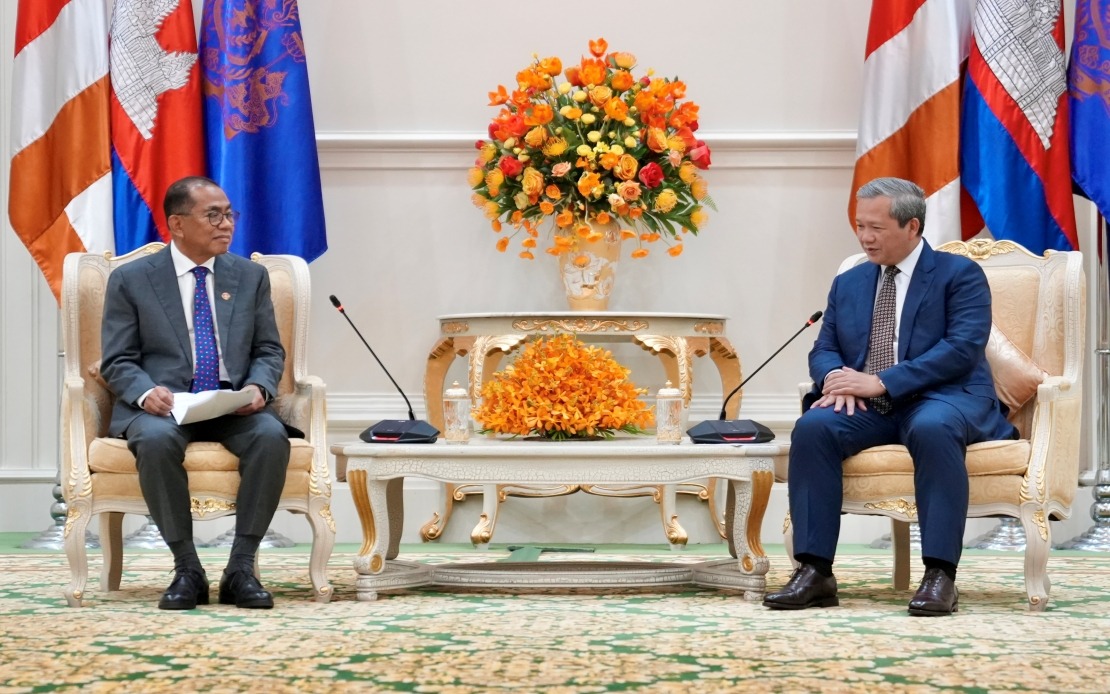
Malaysia and Cambodia are moving decisively to deepen their defence partnership, with both nations affirming their commitment to expanded cooperation during high-level talks in Phnom Penh this week. The bilateral engagement, led by Defence Minister Datuk Seri Mohamed Khaled Nordin's visit to the Cambodian capital, reflects a broader strategic repositioning within ASEAN as member states grapple with evolving regional security dynamics and the need for coordinated responses to transnational threats.
The centrepiece of the Malaysian delegation's visit was a series of substantive discussions aimed at finalizing the Malaysia-Cambodia Defence Cooperation Memorandum of Understanding, a framework document that will substantially broaden the institutional architecture underpinning defence relations between Kuala Lumpur and Phnom Penh. This MoU, now in advanced stages of negotiation, represents more than ceremonial diplomacy; it establishes formal mechanisms for sustained military-to-military engagement and joint capacity-building initiatives that both capitals view as essential to regional stability.
During his courtesy call on Cambodian Prime Minister Samdech Thipadei Hun Manet at the Peace Palace, Mohamed Khaled underscored the importance of ASEAN centrality in addressing complex security challenges that transcend national borders. The two leaders acknowledged that dialogue-based mechanisms and regional institutional frameworks remain the most effective tools for managing tensions and preventing escalation, particularly in areas where territorial disputes or cross-border tensions have historically generated instability. This emphasis on dialogue reflects a shared conviction that unilateral or coercive approaches ultimately undermine the collective security environment that all Southeast Asian nations depend upon for prosperity.
The substance of Malaysia's engagement extends well beyond traditional defence diplomacy. The two nations have identified several emerging domains for cooperation that reflect the technological transformation of modern military capability. Jungle warfare training represents a natural specialization for both countries given their shared tropical geography and experience with asymmetric security challenges; this practical dimension of cooperation offers concrete benefits for operational readiness and soldier professionalism. More innovatively, the defence partnership will encompass artificial intelligence applications and drone technology, areas where Malaysia seeks to strengthen its own defence industrial capacity while contributing to ASEAN's broader technological sophistication.
A critical element of Malaysia's diplomatic engagement involves support for the ASEAN Observer Team mechanism, which Malaysia continues to champion as an instrument for building confidence and transparency in regional military activities. Malaysia's advocacy for this mechanism, even after relinquishing its ASEAN Chair position, demonstrates continuity in strategic thinking and underscores the non-partisan nature of regional security concerns. The Malaysian government has signalled that regardless of which nation holds the annual ASEAN presidency, Kuala Lumpur remains committed to institutional processes designed to prevent misunderstandings and foster predictability in regional military activities.
The Cambodia-Thailand border dynamics featured prominently in Malaysia's discussions, with Mohamed Khaled expressing hope that the ceasefire framework will endure and that diplomatic solutions will prevail over military posturing. This concern reflects Malaysia's understanding that localized conflicts can rapidly escalate and pull neighbouring states into broader disputes, potentially destabilizing the entire region. By maintaining engaged diplomacy with both Cambodia and Thailand, Malaysia seeks to encourage restraint and reinforce the norm that disputes should be resolved through negotiation rather than force.
Equally significant is the emphasis both nations placed on finalizing the Code of Conduct in the South China Sea, a lengthy negotiation process that has involved all ten ASEAN member states alongside China. Malaysia has consistently advocated for a binding, rules-based framework that would prevent unilateral actions and establish clear protocols for maritime conduct in disputed waters. The Code of Conduct assumes particular importance for Malaysia, which maintains extensive maritime claims and has experienced direct confrontations with Chinese vessels in areas of overlapping jurisdiction. A robust COC provides Malaysia with institutional protection against coercive pressure while affirming the principle that territorial and maritime disputes should be adjudicated according to international law rather than raw power dynamics.
The Malaysia-Cambodia defence partnership takes on heightened significance against the backdrop of their forthcoming seventieth anniversary of diplomatic relations in 2027, a milestone that both governments are treating as an occasion to deepen institutional ties and set foundations for sustained cooperation. This forward-looking perspective suggests that defence collaboration is conceived not as episodic engagement but as a continuous process embedded within a broader relationship framework. The timing of these agreements allows both nations to move beyond ceremonial recognition toward substantive partnerships that will yield tangible operational benefits.
Mohamad Khaled's simultaneous working visits to Vietnam, where he met with Prime Minister Le Minh Hung and Defence Minister General Phan Van Giang, demonstrate that Malaysia is conducting a methodical engagement strategy across multiple Southeast Asian capitals. These visits are explicitly framed within Malaysia's Third Pillar of the National Defence Strategy, which emphasizes Credible Partnerships, highlighting the government's understanding that Malaysia's security ultimately depends upon deep institutional relationships with neighbouring states. By distributing ministerial attention across Vietnam and Cambodia, Malaysia is signalling that it views both nations as critical partners in the broader regional security architecture.
The Malaysian delegation's composition, which included Chief of the Royal Malaysian Navy Admiral Tan Sri Zulhelmy Ithnain and other senior defence officials, underscores the seriousness with which Kuala Lumpur approaches these bilateral relationships. The inclusion of senior uniformed and civilian defence officials indicates that discussions extended beyond diplomatic pleasantries to substantive military-to-military dialogue covering operational doctrines, training methodologies, and interoperability standards. This depth of engagement creates durable working relationships that survive political transitions and provide continuity in defence cooperation.
The broader strategic context framing these bilateral interactions involves Malaysia's recalibration of regional diplomacy amid shifting geopolitical patterns. Even as Malaysia acknowledges that it no longer holds the ASEAN Chair position, the government emphasizes its continued commitment to regional stability and institutional leadership. This messaging reflects an understanding that ASEAN leadership transcends any single year's presidency; instead, it involves sustained participation in regional mechanisms and continuous diplomatic engagement with neighbouring states.
For Malaysian policymakers, the Malaysia-Cambodia defence cooperation framework represents an important development in Southeast Asia's capacity to manage transnational security challenges collaboratively. The inclusion of emerging technologies and non-traditional security domains within the formal cooperation framework positions both nations to address future threats more effectively than traditional bilateral arrangements would permit. As regional security dynamics continue to evolve in response to great power competition and transnational challenges, Malaysia's deepening defence ties with Cambodia demonstrate that ASEAN nations remain committed to strengthening their collective capacity to protect their respective interests through coordinated action and institutionalized partnerships.

