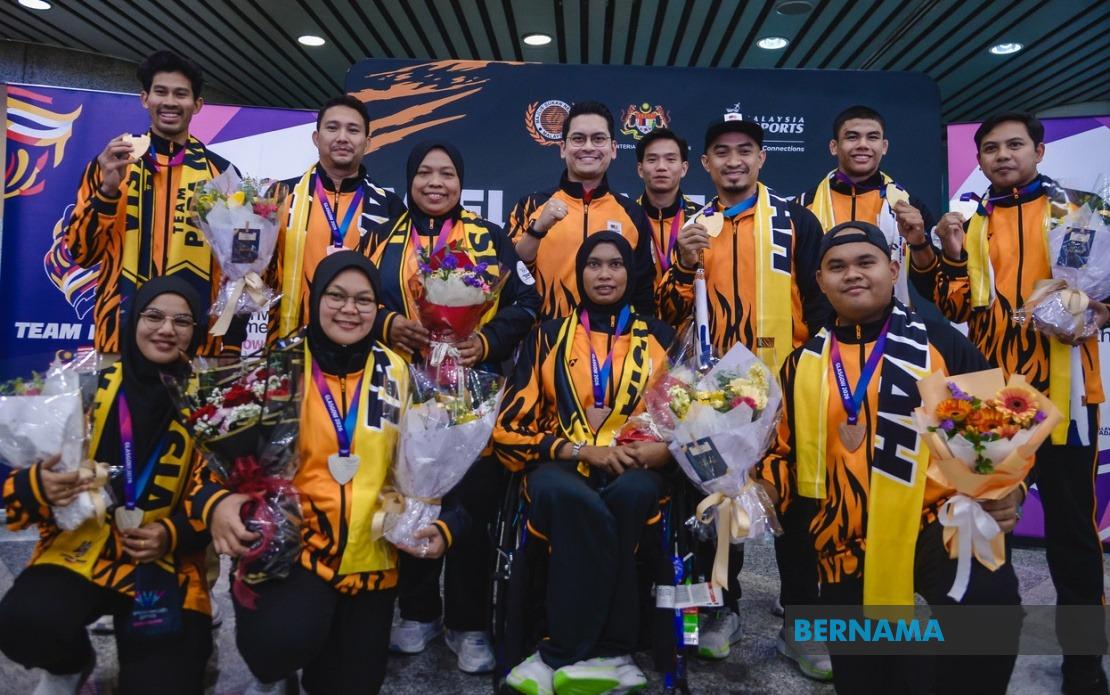
Malaysia's Youth and Sports Minister Dr. Mohammed Taufiq Johari announced a RM1.1 million allocation under the National Sports Incentive Scheme (SHAKAM) to honour athletes who delivered medals at the 2026 Glasgow Commonwealth Games, recognising their contributions to national pride and the sacrifices they made in their pursuit of excellence.
The reward structure reflects the government's emphasis on gold medal achievement, with winning gold now earning RM80,000 per athlete. Athletes who surpass existing Commonwealth Games records receive an additional RM10,000 on top of the gold medal bonus, creating further incentive for record-breaking performances. Silver medalists receive RM40,000 while bronze medalists are awarded RM20,000, establishing a tiered system that underscores the ministry's strategic priorities.
Dr. Mohammed Taufiq disclosed during a ceremonial welcome for the Glasgow contingent at Kuala Lumpur International Airport that the National Sports Council is currently engaging with the corporate sector to supplement the SHAKAM fund. This collaborative approach suggests the government recognises the importance of matching athlete compensation with international standards while seeking private sector investment in national sporting ambitions.
The Glasgow campaign yielded eight gold, three silver, and five bronze medals, marking one of Malaysia's strongest Commonwealth Games performances since 2010. This success exceeded the ministry's initial five-gold target, a significant achievement considering the national contingent was smaller than teams sent to previous editions. The overperformance indicates improved strategic planning and athlete preparation despite reduced numbers.
A pivotal shift in Malaysia's sports strategy underpinned this success: the adoption of colour-based medal targets rather than generic medal counts. This approach concentrates resources and athlete focus specifically on pursuing gold medals, fundamentally altering the psychology of competition. Rather than treating all medals equally, the system encourages athletes to pursue higher podium positions, cultivating a mindset geared toward championships excellence.
Initially, ministry officials harboured concerns that colour-based targeting might overwhelm athletes with excessive pressure. Instead, the strategy proved motivational, galvanising competitors with a unified, gold-focused objective. Dr. Mohammed Taufiq characterised the approach as instrumental preparation for Malaysia's longer-term ambition: securing the nation's first Olympic gold medal. By normalising gold-medal pursuit at Commonwealth level, athletes develop the competitive temperament necessary for Olympic success.
The decision to implement colour-based targets followed extensive consultation with sports associations, coaching staff, and athletes themselves. This inclusive planning process ensured buy-in from stakeholders and allowed the strategy to be tailored to Malaysia's sporting landscape. By grounding the initiative in empirical discussion rather than top-down mandate, the ministry created conditions for successful implementation and athlete commitment.
Malaysia's Chef de Mission Datuk Awalan Abdul Aziz, who heads the Malaysian Lawn Bowls Federation, acknowledged the tension between internal aspirations and formal targets. The lawn bowls team harboured unofficial gold medal hopes but refrained from establishing them as binding objectives, fearing psychological strain on competitors. Ultimately, the team secured two silver and two bronze medals, representing marked improvement over Birmingham 2022's one silver and one bronze, demonstrating that modest expectations can yield strong outcomes when combined with quality preparation.
The Glasgow medals carry particular significance given Malaysia's modest contingent size. Smaller teams typically struggle to accumulate medals across multiple sports, making the haul of 16 medals especially noteworthy. This efficiency reflects improved talent identification, targeted coaching investment, and athlete development pipelines. The performance suggests Malaysia is learning to compete smarter rather than relying on numerical advantage.
The SHAKAM scheme and its enhancement through potential corporate partnerships reflect broader trends in Southeast Asian sports funding. As regional nations compete for continental and Commonwealth supremacy, prize money structures have become increasingly competitive. Malaysia's commitment to RM1.1 million signals recognition that financial incentives, while not paramount to athletic motivation, serve as tangible government endorsement of athlete sacrifice and national sporting ambitions.
Looking forward, Dr. Mohammed Taufiq indicated the colour-based targeting framework will persist through subsequent Commonwealth Games and international competitions. This consistency allows athletes to align their preparation cycles with established benchmarks and permits the ministry to build cumulative institutional knowledge around gold medal performance. The approach also facilitates clearer resource allocation decisions, with funding concentrating on sports and athletes demonstrating realistic potential for top podium finishes.
For Malaysian sports administrators and aspiring Olympians, the Glasgow outcome validates a strategic reorientation toward excellence rather than participation. As the nation pursues Olympic gold, every Commonwealth Games represents a proving ground for the competitive systems and athlete development models that will eventually deliver Olympic success. The SHAKAM allocation and colour-based targeting framework represent concrete investments in that longer journey.

