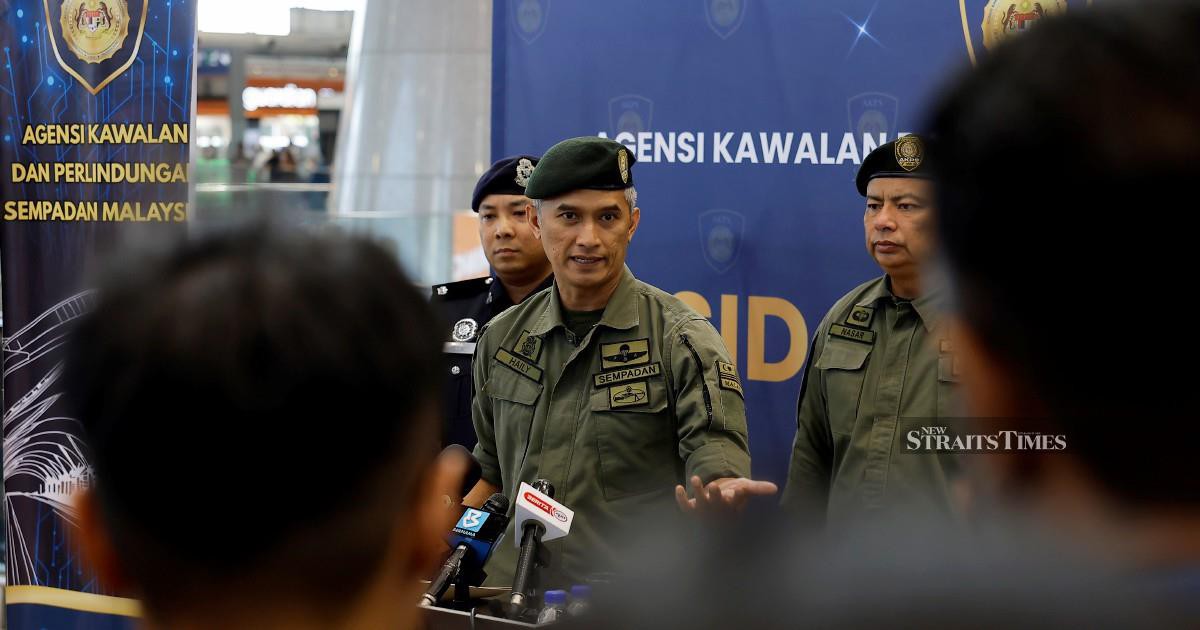
The baggage inspection process that failed to detect 70,000 ecstasy pills on a Malaysia Airlines pilot arrested in Indonesia last week was conducted by AVSEC, an airport security operator, rather than by officials under the Malaysia Border Control and Protection Agency (MCBA), government sources have clarified.
This distinction carries significant implications for understanding accountability and security protocols at Malaysian airports. While MCBA operates under federal border control authority and handles immigration and customs matters, airport baggage screening at departure points typically falls under the purview of private or specialized security contractors. AVSEC, which operates aviation security screening systems at Malaysian airports, handles the initial checkpoint inspection of baggage before passengers proceed to their flights.
The arrested pilot's case has prompted scrutiny of screening procedures following his apprehension with the substantial drug cache upon arrival in Indonesia. The discovery raised questions about how such a large quantity of controlled substances escaped detection during the standard baggage-screening process at the Malaysian departure point. Officials have now moved to clarify which organization was responsible for the checkpoint inspection, potentially to address public concerns about oversight and accountability.
The separation of duties between MCBA—which provides border protection and control functions—and AVSEC—which provides aviation security screening services—reflects the compartmentalized structure of Malaysian airport security operations. Understanding this distinction proves crucial for assessing whether security gaps exist at the screening stage or elsewhere in airport protocols. Different organizations operate under different performance standards, training requirements, and regulatory oversight frameworks, meaning the accountability pathway for any screening failure will depend on which entity's procedures are found to be deficient.
Malaysia has faced increasing pressure to tighten drug interdiction at its airports and borders, particularly given the country's location along major trafficking routes and its role as a regional aviation hub. The incident involving the Malaysia Airlines pilot underscores vulnerabilities that drug smuggling networks may exploit, regardless of the professional competence of individual security personnel. An operator or criminal organization willing to use an employee with direct access to aircraft and baggage handling systems represents a particular challenge for conventional screening methods.
The timing of this clarification appears designed to deflect potential criticism away from MCBA and toward AVSEC, or to establish the factual basis for determining where security improvements are needed. However, broader questions remain about inter-agency coordination, intelligence sharing, and whether suspicious activity by airline personnel is monitored through channels beyond routine baggage screening. The pilot's position afforded him certain privileges and access that passengers without aviation industry credentials would not enjoy.
Indonesian authorities conducted the actual arrest and subsequent investigation, which may explain why initial reports did not clearly attribute the baggage screening to a particular Malaysian organization. The apprehension occurred upon the pilot's arrival in Indonesia rather than during departure from Malaysia, suggesting that Indonesian customs or immigration officials discovered the pills. This raises the difficult question of whether Malaysia's exit screening would have caught the same contraband had more rigorous procedures been applied or different detection equipment been deployed.
For Malaysian travelers and the aviation industry, the clarification about AVSEC's role in the screening process is relevant to understanding how safe they should expect their flights to be. Public confidence in airport security depends on transparent accountability when systems fail. The distinction between MCBA and AVSEC matters because passengers and observers need to know which organization's performance was inadequate, and consequently which organization should face corrective action and enhanced oversight.
The incident also reflects the broader challenge that Southeast Asia faces in combating drug trafficking through civil aviation. Malaysia's major airports handle hundreds of thousands of passengers monthly, and implementing truly comprehensive screening that balances security with operational efficiency remains technically and logistically demanding. When smugglers successfully exploit screening systems—whether through technical gaps, procedural lapses, or corrupt cooperation—it reveals the asymmetrical nature of the security game: operators must succeed in detecting contraband every time, while smugglers need to succeed only once.
Moving forward, Malaysian aviation security authorities will likely review whether existing baggage-screening protocols, whether conducted by AVSEC or other entities, require enhancement or replacement with more advanced technology. The Malaysia Airlines pilot case provides a concrete example of a failure that serves as a test case for security improvements. Both MCBA and AVSEC may face questions from parliamentary committees or oversight bodies about how procedures should evolve to prevent similar incidents.
The involvement of a trusted airline employee with legitimate aviation access adds another dimension to the security challenge. Unlike typical passengers, pilots and crew members benefit from expedited screening procedures and greater freedom of movement in airport restricted areas. Smuggling networks have historically exploited this differential treatment, recruiting insiders to move contraband with fewer obstacles. Addressing this vulnerability likely requires enhanced vetting of personnel, surveillance of suspect individuals, and coordination between airlines and security agencies to flag suspicious behavior patterns.

