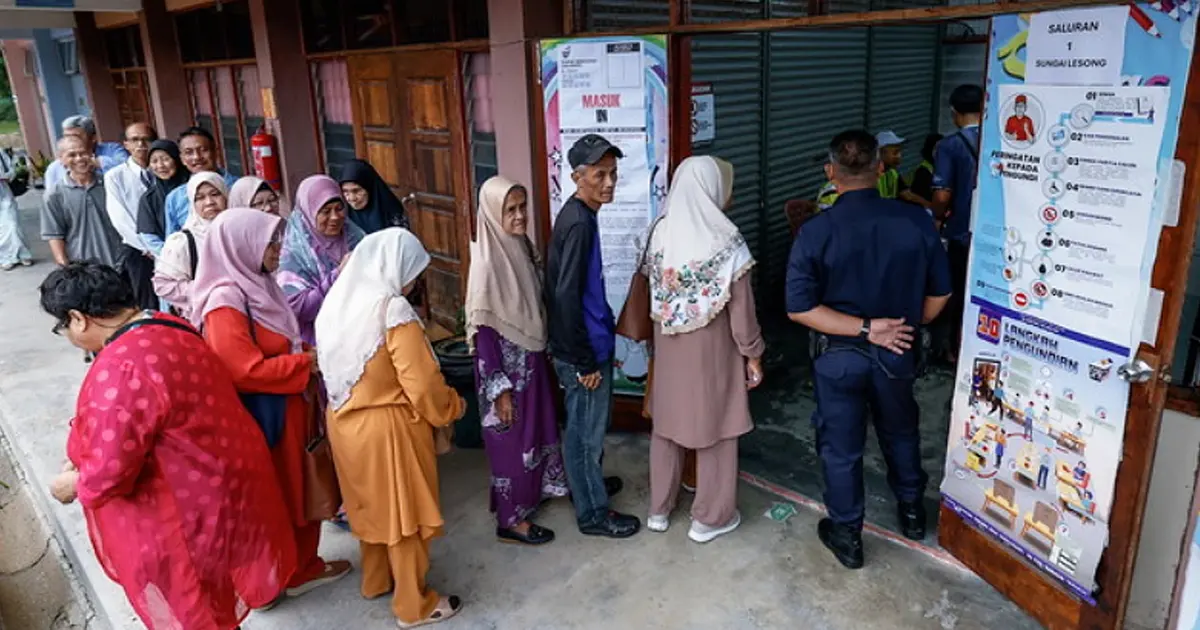
Relentless political messaging centred on 3R matters—a reference to race, religion, and royalty—threatens to exhaust Malay voters and diminish their electoral participation, according to a prominent academic observer of Malaysian politics. Awang Azman Pawi, a political scientist at Universiti Malaya, contends that persistent emphasis on these culturally sensitive themes risks triggering psychological disengagement among the electorate, potentially reshaping electoral dynamics in ways that political parties have not fully anticipated.
The concern reflects a broader pattern emerging across Malaysia's political landscape, where traditional mobilisation strategies centred on identity-based appeals appear to be encountering fatigue among voters increasingly preoccupied with material concerns. While 3R issues have historically formed the backbone of electoral competition in Malaysia, particularly within Malay-Muslim constituencies, their sustained deployment without substantive policy alternatives may be counterproductive for parties relying on this framework.
Awang Azman's analysis suggests that political parties will ultimately be evaluated not by their rhetorical commitments to these cultural and religious themes, but rather by their tangible capacity to deliver solutions to pressing societal challenges. This represents a significant observation for Malaysian politics, as it hints at a potential recalibration of voter priorities and the metrics by which political performance is assessed. The emphasis on delivery and problem-solving capability appears to be gaining salience relative to symbolic or rhetorical positioning.
The cost of living emerges as perhaps the most immediate concern among ordinary Malaysians, cutting across demographic and ethnic divisions. Rising inflation, elevated housing expenses, and increased expenditure on essential services have created material pressures that frame the political environment for millions of households. When voters struggle with monthly budgets and access to affordable necessities, their receptiveness to identity-centred political narratives naturally diminishes, a dynamic that political scientists have documented across diverse democracies.
This observation carries particular weight in the Malaysian context, where economic anxiety has periodically punctured established political coalitions and created openings for alternative movements. The 2018 general election, for instance, witnessed a significant realignment driven partly by voter frustration with economic management and perception of institutional corruption, demonstrating that Malay voters are capable of departing from traditional voting patterns when material conditions deteriorate sufficiently.
For political parties, the implications are substantial. Parties that continue deploying 3R messaging without complementary economic policy platforms risk appearing tone-deaf to voter concerns and potentially ceding electoral advantage to competitors presenting substantive solutions to cost-of-living pressures. The challenge intensifies when inflation persists and household budgets remain strained, creating conditions where symbolic appeals lose their mobilising power.
The phenomenon of emotional fatigue among voters represents a form of political exhaustion that occurs when populations are repeatedly exposed to high-intensity messaging around volatile issues without corresponding improvements in their lived circumstances. Unlike rational policy disagreement, emotional fatigue operates at a psychological level, causing voters to disengage from political participation entirely rather than switching allegiances to alternative parties. This outcome benefits no political actor and weakens democratic participation overall.
Awang Azman's warning also speaks to evolving generational dynamics within Malay-Muslim communities. Younger voters, in particular, appear more inclined to prioritise economic opportunities and quality of life over identity-based political positioning, though this pattern merits further investigation. Urban and semi-urban Malay voters have demonstrated capacity for nuanced political reasoning, supporting candidates based on personal track records and policy clarity rather than ethnic or religious loyalty alone.
The relationship between material wellbeing and receptiveness to identity-based messaging deserves careful monitoring by Malaysia's political class. Historically, periods of sustained economic growth have moderated identity-centred political competition, while economic downturns have occasionally intensified it. However, contemporary Malaysia may be entering a period where the inverse relationship predominates—where voter frustration with economic management overwhelms identity-based appeals regardless of broader macroeconomic conditions.
Political parties across Malaysia's spectrum would be wise to heed this analysis. Developing coherent responses to inflation, housing affordability, wage stagnation, and access to quality public services represents not a departure from core constituencies but rather an expansion of relevant political discourse. Voters across ethnic and religious lines increasingly judge their representatives by the concrete outcomes visible in their communities—improved infrastructure, functional healthcare systems, accessible education, and genuine employment opportunities.
The stakes extend beyond immediate electoral outcomes. Persistent emotional fatigue among voters, particularly if combined with declining participation rates, risks eroding democratic vitality and creating space for non-democratic actors or populist movements capitalising on generalised dissatisfaction. Conversely, political parties that successfully pivot toward substantive economic governance while maintaining principled stances on cultural and religious matters may discover larger electoral coalitions than identity-based strategies alone can generate.
As Malaysia approaches future electoral cycles, the tension between traditional 3R-centred mobilisation and economic-performance-based voter assessment will likely intensify. Awang Azman's analysis provides a timely reminder that political sustainability ultimately depends not on rhetorical intensity but on demonstrated capacity to enhance voter welfare and address tangible societal challenges that shape daily life.

%22%2F%3E%3C%2Fpattern%3E%3C%2Fdefs%3E%3Crect%20width%3D%22100%25%22%20height%3D%22100%25%22%20fill%3D%22url(%23ph2xodng)%22%2F%3E%3Crect%20width%3D%22100%25%22%20height%3D%22100%25%22%20fill%3D%22url(%23ph2xodnp)%22%2F%3E%3Ctext%20x%3D%2250%25%22%20y%3D%2250%25%22%20text-anchor%3D%22middle%22%20dominant-baseline%3D%22central%22%20fill%3D%22rgba(255%2C255%2C255%2C0.95)%22%20font-family%3D%22Georgia%2C%20'Times%20New%20Roman'%2C%20serif%22%20font-weight%3D%22700%22%20font-size%3D%22320%22%20letter-spacing%3D%22-0.02em%22%3EMMC%3C%2Ftext%3E%3C%2Fsvg%3E)