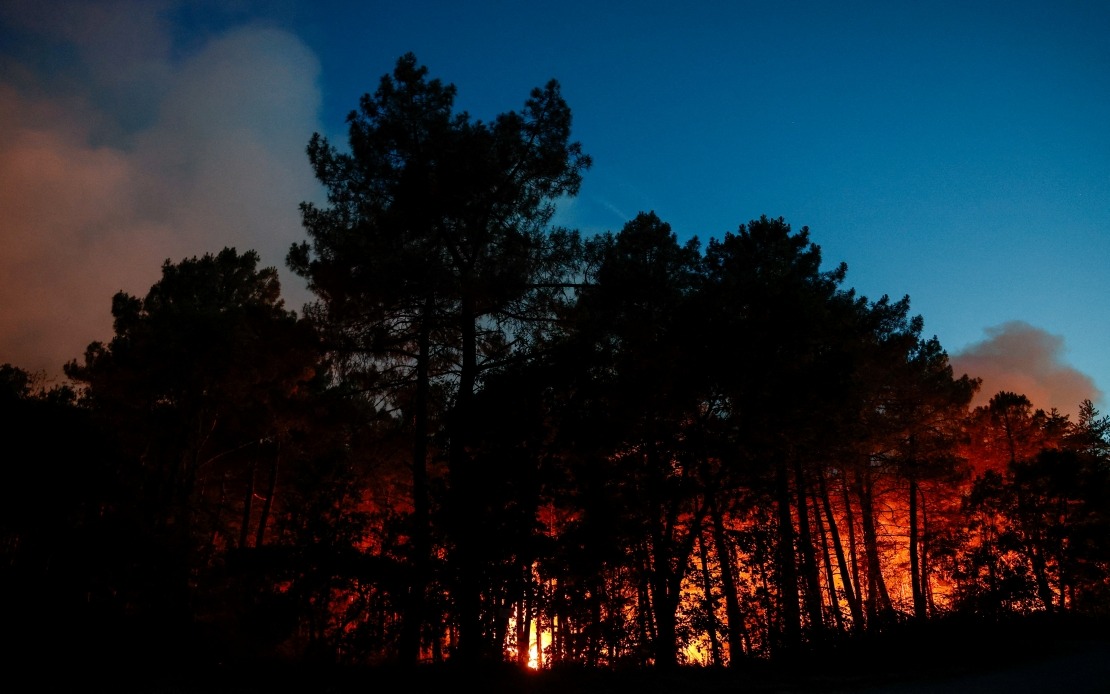
Hundreds of firefighters are engaged in an intensive battle against a major wildfire ravaging the Fontainebleau forest, a UNESCO World Heritage site located south of Paris. The blaze, which erupted late on Sunday near a motorway, has already consumed approximately 800 hectares of valuable woodland by Monday. The scale of the conflagration has drawn comparisons to rare and dramatic fire events in northern France, where such large-scale incidents have historically been uncommon despite seasonal challenges.
The response to the crisis has been substantial and coordinated. Approximately 400 firefighters have been mobilized to contain the advancing flames, supported by two water-bombing aircraft that have been drawing supplies directly from the Seine river. The Seine-et-Marne department coordinated this aerial support, recognizing early that ground-based efforts alone would prove insufficient against the rapidly spreading inferno. The involvement of aircraft signals the gravity of the situation and underscores the determination of French authorities to prevent further territorial loss.
What distinguishes this incident from natural wildfire occurrences is the strong likelihood of human involvement. French Interior Minister Laurent Nuñez visited the fire zone and publicly stated that preliminary evidence suggests deliberate ignition. His assessment was based on the troubling pattern of multiple distinct fire outbreaks detected within a radius of just 1,000 metres, a spatial clustering that defies the random distribution expected from natural causes such as lightning strikes. This observation prompted the gendarmerie to initiate a formal investigation into potential arson, introducing a criminal dimension to what was initially treated as a natural disaster.
The evacuation of civilians has been extensive and precautionary. Authorities relocated more than 1,000 residents and tourists from the affected area, with the mayor of Le Vaudoué providing harrowing descriptions of the conditions on the ground. Eyewitness accounts depicted an approaching "wall of flames" that rapidly advanced toward residential structures at the forest's periphery, creating scenes of considerable panic and urgency. The successful evacuation, despite the speed and intensity of the fire's progression, prevented what could have been a catastrophic loss of life.
Fontainebleau forest holds immense cultural and ecological significance far beyond France's borders. The woodland landscape has served as the setting for the historic Château de Fontainebleau and functions as one of the largest continuous forested expanses in Western Europe. The destruction of 800 hectares represents not merely the loss of timber or habitat, but damage to a landscape of continental importance and historical resonance. Environmental and heritage organizations across Europe have taken notice of the threat posed by this incident to one of the continent's most valuable natural and cultural assets.
The broader context of French climate challenges has amplified concern about the wildfire's implications. France has endured three distinct heatwave episodes during the current year, with each successive wave creating progressively drier conditions in forests and vegetation zones. The national weather service, Météo-France, elevated its alert status significantly at the start of the week, placing 37 departments under its highest red heat alert designation. This widespread warning system reflects the systemic vulnerability of French territory to fire risk during periods of sustained high temperatures and abnormally low humidity.
Concurrently with the Fontainebleau emergency, French firefighters have been managing multiple additional blazes across various regions of the country. These simultaneous incidents place substantial strain on national firefighting capacity and resources, requiring difficult prioritization decisions and mutual aid requests between departments. The convergence of multiple fires during the same weather period underscores the reality that heatwave conditions generate widespread vulnerability rather than isolated incidents, creating a cascade effect of emergency response demands.
French government spokeswoman Maud Bregeon characterized the situation as "exceptional" in scope and severity, reflecting official recognition that the incident transcends normal wildfire management protocols. Her acknowledgment that such large-scale fires have remained rare in northern France contextualizes the shock and disruption caused by the Fontainebleau event. The deployment of all available containment resources signals a determination to prevent the fire from expanding beyond its current footprint and to restore stability to the region.
For Malaysian and Southeast Asian observers, this incident carries several pertinent lessons. While the geographic and climatic contexts differ substantially from tropical and equatorial regions, the underlying vulnerabilities prove universal: extended heat stress, vegetation desiccation, and the consequences of inadequate prevention or early detection systems. The rapid escalation from uncontrolled outbreak to mass evacuation demonstrates how quickly environmental crises can overwhelm local response capacity, necessitating regional and international cooperation frameworks. Furthermore, the suspicion of deliberate ignition raises uncomfortable questions about security vulnerabilities in critical forest infrastructure, a concern that extends across jurisdictions and development levels worldwide.

