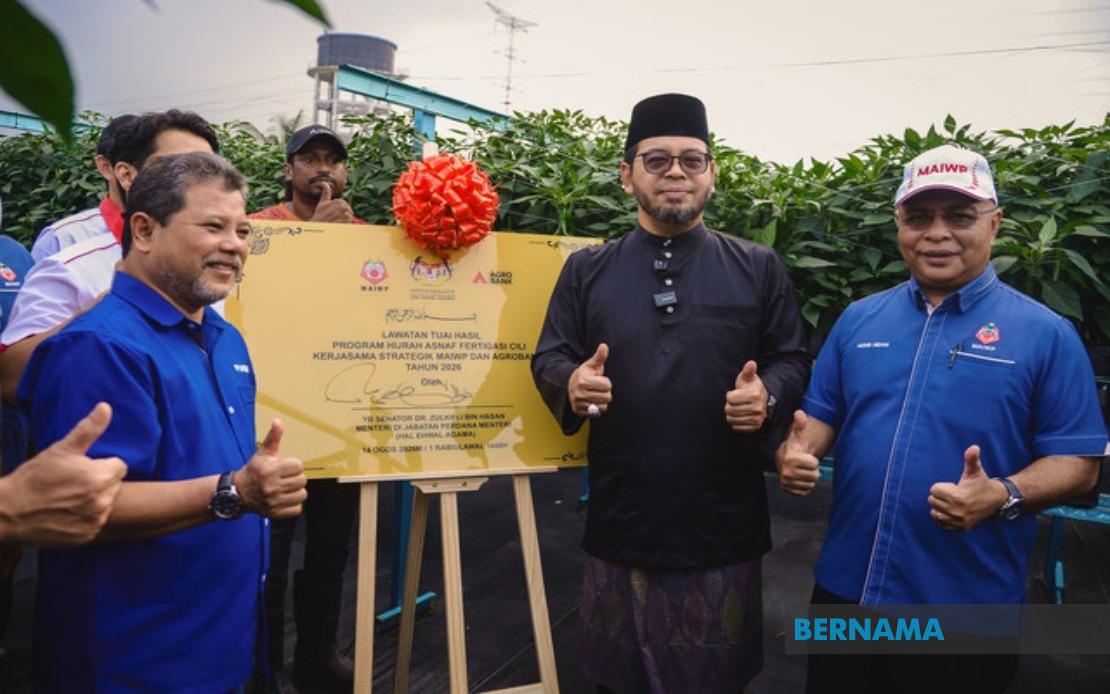
Malaysia's Islamic Development Department (MAIWP) is scaling up its innovative chilli cultivation programme for economically disadvantaged asnaf communities, expanding the successful fertigation project across five acres following exceptionally strong results from pilot operations. The expansion underscores a strategic shift within Malaysia's zakat-management sector toward productive capacity-building rather than traditional welfare handouts, positioning the initiative as a model for sustainable poverty alleviation across the Islamic social economy.
The programme's initial phase demonstrated remarkable commercial viability, with participants harvesting more than 16.7 tonnes of chillies and generating returns exceeding RM207,000—a result that captured the attention of Dr Zulkifli Hasan, the Minister in the Prime Minister's Department (Religious Affairs). Speaking on the project's broader significance, Zulkifli highlighted how equipping vulnerable populations with modern agricultural knowledge creates pathways toward genuine economic independence, moving beneficiaries beyond aid dependency into productive entrepreneurship. The minister's visible endorsement reflects growing government confidence in knowledge-transfer models as catalysts for systemic poverty reduction, particularly within Muslim-majority communities where zakat historically concentrated on immediate relief.
Crucially, the initiative extends beyond primary cultivation into value-addition opportunities, recognizing that smallholder farmers frequently face margin compression when selling raw commodities. Programme participants now have structured access to downstream processing, allowing them to develop branded chilli pastes, powders, and specialty sauces targeting both domestic retail channels and potential export markets. This vertical integration approach creates multiple income streams from a single crop, substantially amplifying returns and building household resilience against commodity price volatility—a persistent challenge for Malaysian agriculture that claimed numerous farming households during the recent pandemic disruptions.
Personal testimonies underscore the human dimension of this economic restructuring. Alinda Rosely, a 49-year-old single mother and programme participant, describes how fertigation training fundamentally altered her economic trajectory. Within six months of the previous year when chilli prices were favourable, she generated RM40,000—income that for single-parent households represents transformative purchasing power, enabling investment in children's education, health care, and housing stability. Her experience exemplifies how technical skills transfer addresses root causes of poverty rather than merely treating symptoms, positioning beneficiaries as active agents in their own economic advancement rather than passive aid recipients.
The expansion aligns with MAIWP's institutional mission to cultivate self-reliant and competitive asnaf communities capable of contributing productively to Malaysia's broader economic ecosystem. This philosophical reorientation marks a departure from purely consumptive welfare models toward what development practitioners term "productive zakat," wherein religious almsgiving funds catalyze entrepreneurship and skill acquisition. For MAIWP, which manages enormous charitable resources, this shift carries significant implications for how Islamic institutions deploy capital across Southeast Asia's largest Muslim-majority nation.
The financial scale of MAIWP's operations underscores the programme's strategic importance within the organization's portfolio. As of August 12, 2026, MAIWP had distributed RM699.57 million in zakat across 38 distinct welfare assistance schemes, alongside separate funding mechanisms supporting various community development initiatives. Within this broader context, the chilli fertigation expansion represents a deliberate reallocation of zakat toward productive rather than consumptive purposes—a significant strategic decision affecting millions of ringgit annually and setting institutional precedent for peer zakat organizations across Malaysia's thirteen states.
Fertigation technology, which delivers water and nutrients through drip-irrigation systems with precise dosing, addresses longstanding productivity constraints in Malaysian smallholder agriculture. The technique reduces water consumption by up to 60 percent compared to conventional flooding methods while improving crop yields through optimized nutrient delivery, making it particularly suitable for resource-constrained farming communities. By transferring this knowledge to asnaf participants, MAIWP essentially democratizes access to agricultural technology previously concentrated among large-scale commercial operators, leveling competitive dynamics and enabling small farmers to achieve unit yields approximating industrial-scale producers.
The chilli sector itself presents considerable strategic opportunity for Malaysian agriculture and rural development. Domestic consumption of chillies remains robust across Malaysian cuisines, while export markets in Singapore, Brunei, and regional ASEAN economies consistently absorb premium local produce. By developing asnaf chilli producers capable of meeting consistent quality and volume standards, MAIWP simultaneously addresses food security considerations while creating employment in rural areas experiencing persistent out-migration toward urban centers. This dual benefit—poverty reduction plus rural stabilization—positions the programme within larger national development objectives articulated across multiple government economic blueprints.
The expansion to five acres raises important questions about scalability and replication potential across MAIWP's operational geography. Successful five-acre operations require sophisticated input supply chains, technical extension services, and market linkages—infrastructure that may not uniformly exist across all Malaysian communities where asnaf populations concentrate. Future programme success will depend substantially on MAIWP's capacity to replicate not merely the physical infrastructure of fertigation systems but the institutional support networks that currently enable positive outcomes in initial pilot locations. This institutional challenge represents the genuine test of whether the model constitutes a scalable solution or a localized success story.
For Malaysian policymakers and development practitioners, the MAIWP chilli initiative offers instructive lessons about matching technology adoption to beneficiary capacity levels and ensuring that skill transfers produce sustainable behavioral change rather than temporary productivity spikes. The programme demonstrates that religious charitable institutions, when strategically oriented toward productive investment, can function as powerful instruments for inclusive economic development. As Malaysia navigates post-pandemic economic restructuring and emerging digital-era employment disruptions, models like this—combining traditional Islamic social obligation with modern agricultural science and entrepreneurship—may increasingly define effective antipoverty strategy across Southeast Asia's Muslim communities.

