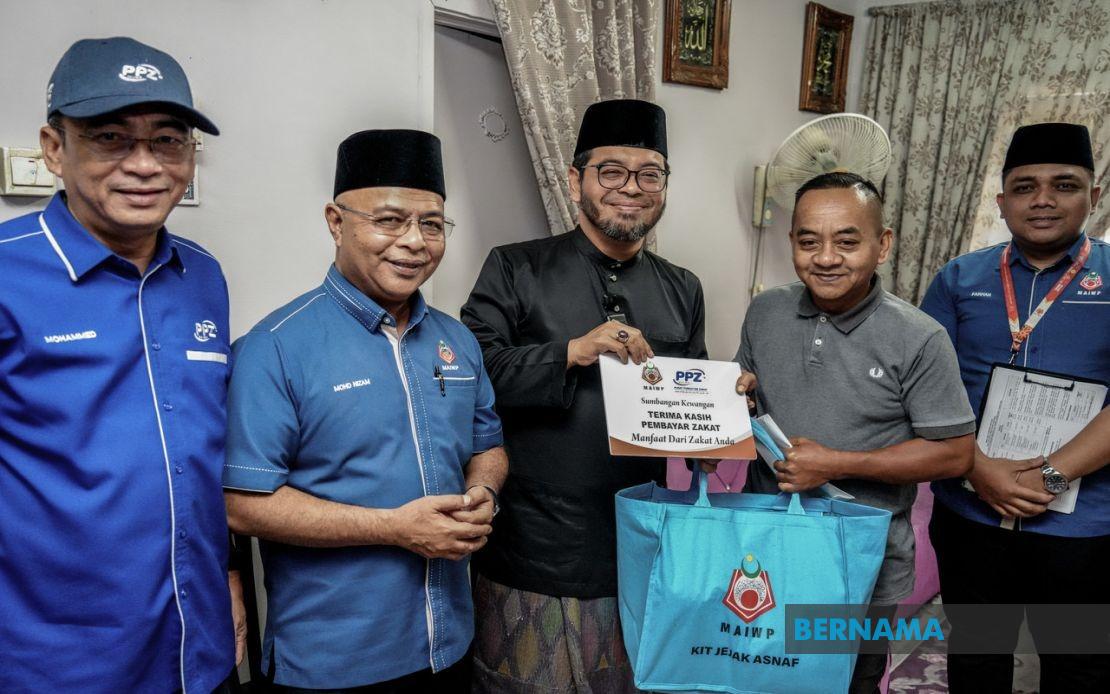
A widow in Kuala Lumpur caring for five children aged between six and 15 has received approval for comprehensive financial assistance from the Federal Territories Islamic Religious Council (MAIWP) following the death of her husband earlier this month. The support package encompasses monthly living expenses, rental payments, and schooling costs, marking part of the council's broader initiative to assist families experiencing financial hardship.
Senator Datuk Dr Zulkifli Hasan, the Minister in the Prime Minister's Department (Religious Affairs), emphasised during a recent facility visit that direct engagement with aid recipients remains crucial for understanding their genuine circumstances. By conducting on-the-ground assessments, MAIWP can calibrate its assistance programmes to address actual needs rather than applying a one-size-fits-all approach. This methodology underpins the council's commitment to delivering aid that genuinely alleviates hardship within Federal Territories communities.
The widow's family case illustrates MAIWP's tiered support system. Previously, the household had benefited from the council's General Schooling Aid programme. The expansion to include monthly living assistance, rental support, and enhanced educational funding represents a recognition that losing the family's primary income earner demands comprehensive intervention. The council's decision reflects an understanding that educational continuity becomes vulnerable when families face immediate survival pressures.
Beyond the widow's situation, Zulkifli highlighted MAIWP's work with other vulnerable households. A family comprising parents and eight school-going children received attention during the visit, with the father employed as a driver for Kuala Lumpur City Hall and the mother managing domestic responsibilities. This household receives monthly medical assistance covering items such as diapers and diabetic supplies, alongside wheelchair support and schooling aid—demonstrating how MAIWP tailors programmes to specific health and educational requirements.
A third case involved a divorced single mother who has managed household responsibilities independently since 2018 while raising three school-going children. Her assistance package includes ongoing monthly cost-of-living support, basic necessities provision, and educational expense coverage. These diverse cases reveal the Islamic religious council's recognition that vulnerability manifests across different family structures and circumstances within the Federal Territories.
The scope of MAIWP's intervention extends beyond immediate financial transfers. By combining monthly stipends with targeted assistance for education, healthcare, and housing, the council acknowledges that sustainable poverty alleviation requires addressing multiple dimensions of family welfare simultaneously. Educational support proves particularly significant, as school-related expenses often represent prohibitive barriers for households experiencing income loss or chronic underemployment.
The approach reflects broader Malaysian policy discussions regarding social safety nets and targeted welfare distribution. While cash transfers provide immediate relief, programmes integrating education and health components address longer-term family stability and upward mobility prospects. MAIWP's methodology suggests recognition that children's educational progression offers pathways out of poverty that extend beyond the current generation's immediate circumstances.
For Malaysian readers, MAIWP's work demonstrates how religious institutions operate beyond ceremonial or purely spiritual functions, instead serving as critical social welfare providers, particularly within Federal Territories where Muslim residents predominate. The council's financial commitments and administrative capacity position it as a significant actor in the social protection landscape, complementing government agencies and civil society organisations.
The cumulative scale of MAIWP's operations underscores this institutional significance. As of mid-August 2026, the council had distributed RM699.57 million in assistance, indicating the substantial resources deployed to support vulnerable communities. This figure contextualises individual cases like the widow's family within a broader, systematic commitment to welfare provision grounded in Islamic principles of community responsibility and social justice.
Such programmes carry particular resonance for Southeast Asian audiences where informal social safety nets have traditionally cushioned household shocks, yet urbanisation and economic transformation have eroded these traditional mechanisms. MAIWP's structured approach represents institutional adaptation to contemporary realities where extended family networks cannot absorb crises independently, necessitating formal mechanisms and stable funding.
The emphasis on educational continuity across recipient families indicates recognition that breaking poverty cycles requires investment in human capital, particularly during childhood when educational foundations prove most malleable. By supporting schooling costs alongside immediate survival needs, MAIWP pursues dual objectives: stabilising current family welfare while investing in future economic capacity of the next generation.
Looking forward, MAIWP's visible commitment to systematic assistance, evidenced through direct ministerial engagement and transparent case documentation, may influence broader policy discussions regarding targeted social protection in Malaysia. As urbanisation intensifies and household economic vulnerability persists across income groups, models integrating religious institutional capacity with systematic welfare provision warrant attention from policymakers and development practitioners throughout Southeast Asia.

