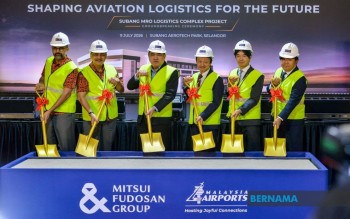
Malaysia Airports Holdings Bhd and Mitsui Fudosan Group have joined forces in a major infrastructure venture, committing RM80 million to construct a dedicated air cargo logistics complex at Subang Airport. The partnership reflects MAHB's strategic pivot toward monetising its substantial real estate holdings through collaboration with experienced international operators. Under the arrangement, MAHB retains a 30 per cent shareholding while Mitsui Fudosan takes the dominant 70 per cent stake, positioning the Japanese developer as operational lead for the facility.
Transport Minister Anthony Loke Siew Fook unveiled the project during a groundbreaking ceremony at Subang on Thursday, framing the venture as emblematic of a broader Malaysian strategy to harness airport land through targeted partnerships. Rather than developing such complexes independently, the government and MAHB have opted to tap the specialised knowledge of international players with proven track records in aviation logistics. This collaborative model aims to reduce execution risk while accelerating the project's deployment and operational effectiveness.
Mitsui Fudosan brings formidable credentials to the undertaking. The Tokyo-based conglomerate has constructed and operated multiple logistics facilities at Japan's Haneda Airport, one of the world's busiest aviation hubs. Their experience navigating complex regulatory environments, managing high-volume cargo operations, and optimising supply chains within constrained airport settings positions them as well-equipped to replicate success in Malaysia. Loke noted that Mitsui Fudosan's international expertise would substantially mitigate risks that MAHB might otherwise face attempting to develop and manage the facility without such specialised guidance.
The project unfolds within Subang Aerotech Park, a designated industrial zone adjacent to Subang Airport that has increasingly attracted aerospace and aviation firms. The facility is being developed through MFMA Industrial Sdn Bhd, a joint venture entity combining Mitsui Fudosan (Asia) Malaysia Sdn Bhd with Malaysia Airports (Subang) Sdn Bhd. This structure formalises the partnership while enabling both entities to contribute their respective strengths—MAHB's regulatory relationships and airport infrastructure access, Mitsui Fudosan's operational expertise and capital deployment capability.
The cargo complex represents a strategic response to evolving Malaysian aviation demand. As e-commerce continues reshaping global logistics, air freight has become increasingly essential for time-sensitive shipments, particularly across Southeast Asia where rapid urbanisation and rising consumer spending drive delivery expectations. Subang Airport, serving the Klang Valley's 7.8 million residents and the nation's commercial heartland, occupies a strategic position for domestic and regional air cargo operations. Yet the airport's cargo infrastructure has lagged competitors in Singapore and Thailand, presenting both challenge and opportunity for modernisation.
For MAHB, the venture exemplifies a capital-efficient strategy to generate returns from non-core assets. Rather than financing construction independently, MAHB leverages its land holdings as equity contribution, accessing Mitsui Fudosan's development and operational capabilities while maintaining meaningful financial participation. This approach preserves cash for other airport improvements while establishing a revenue stream from the cargo complex once operational. The model differs markedly from traditional airport models where single operators control all terminal and commercial activities.
Mitsui Fudosan's interest reflects Japan's broader regional expansion strategy. Japanese corporations increasingly view Southeast Asia as a growth market, particularly in logistics where supply chain nearshoring and manufacturing dispersal are creating demand for distribution hubs. Malaysia, with its strategic geographic position between India and China and access to Asean markets, attracts such investment. Subang's proximity to Kuala Lumpur's business district and industrial zones further enhances its appeal as a regional logistics node.
The cargo complex will support aviation and aerospace enterprises clustering around Subang Airport. Malaysia has cultivated aerospace and aircraft maintenance sectors through various incentive schemes and industrial parks. MRO (maintenance, repair and overhaul) services for commercial aircraft generate substantial economic value and skilled employment. A dedicated cargo logistics facility would enhance the ecosystem's competitiveness by reducing operational costs and improving supply chain efficiency for firms servicing aircraft components and systems.
Regional implications extend beyond Malaysia's borders. Southeast Asia's aviation sector faces mounting pressure to modernise infrastructure amid rising air travel and e-commerce demands. Successful cargo logistics complexes in Malaysia could establish a template for similar developments in other Asean nations. Singapore's established dominance in regional air cargo through Changi Airport has created opportunities for secondary hubs like Subang to capture overflow and niche operations, particularly for domestic and shorter-haul regional services.
The project timeline and anticipated capacity remain commercially sensitive pending detailed disclosure. However, the venture represents tangible progress on Malaysia's stated ambitions to position Subang Airport as a secondary aviation hub serving Klang Valley and complementing Kuala Lumpur International Airport's international operations. Investment in cargo capacity particularly matters given current infrastructure constraints limiting Malaysian air freight competitiveness relative to regional peers.
Integration of Japanese operational standards and technologies through Mitsui Fudosan could elevate service quality and reliability expectations across Malaysian logistics sectors. Knowledge transfer regarding automated cargo handling, real-time tracking systems, and process optimisation may generate spillover benefits beyond the facility itself. Such technological advancement supports Malaysia's transition toward higher-value logistics services and digital supply chain integration.
The partnership signals confidence in Malaysia's aviation sector trajectory despite recent regional competition and changing travel patterns. Institutional investors like Mitsui Fudosan conduct exhaustive feasibility analysis before committing capital. Their willingness to co-invest alongside MAHB suggests optimistic assessments regarding cargo demand growth and operational profitability within the Subang catchment area. Such institutional confidence, while not guaranteed, provides constructive signals regarding aviation sector fundamentals across the medium term.

