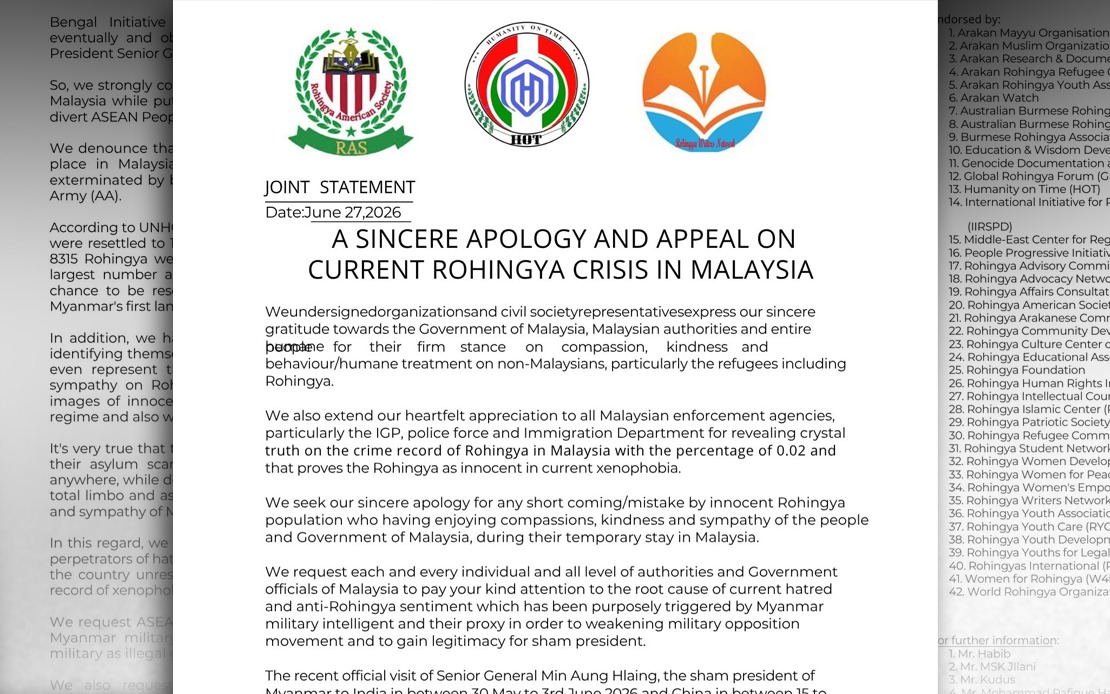
Malaysian Humanitarian Aid and Relief (MAHAR) has expressed satisfaction at an apology tendered by 40 Rohingya non-governmental organisations, viewing the gesture as evidence of accountability within the refugee support sector. However, the organisation has seized the moment to articulate a broader vision for humanitarian engagement that extends well beyond conventional notions of charity work in Malaysia.
In formal remarks released on June 28, MAHAR positioned the apology not merely as a symbolic gesture but as a foundation upon which more substantive relationships between refugee-led groups and Malaysian society can be built. The organisation stressed that the path forward requires these NGOs to meaningfully shift their operational focus toward fostering mutual understanding and respect between displaced communities and their Malaysian hosts.
Central to MAHAR's argument is the contention that effective humanitarian assistance cannot remain confined to distributing food parcels or erecting temporary shelters. Instead, the organisation emphasises that refugee organisations bear responsibility for educating their constituencies about the legal frameworks, cultural norms, and social expectations that govern life in Malaysia. This perspective reflects growing recognition within Malaysia's humanitarian sector that integration requires active engagement from both receiving and refugee populations.
MAHAR has explicitly called upon the 40 NGOs to amplify their efforts in promoting adherence to Malaysian law and respect for local customs among Rohingya populations. The organisation contends that failure to address this dimension of humanitarian work undermines long-term community cohesion and risks perpetuating stereotypes that damage the broader refugee cause. By positioning cultural and civic education as part of humanitarian responsibility, MAHAR suggests that refugee organisations themselves must become agents of integration rather than merely service providers.
Simultaneously, MAHAR has urged these organisations to escalate their international advocacy activities, particularly regarding the ongoing persecution of Rohingya populations in Myanmar. The organisation's perspective reflects a sophisticated understanding that sustainable humanitarian outcomes cannot be achieved through domestic interventions alone. Rather, addressing the root causes of forced displacement—particularly systematic persecution in the country of origin—remains essential to any comprehensive humanitarian response. Without international pressure to resolve the Myanmar dimension of the crisis, MAHAR suggests, domestic integration efforts remain fundamentally incomplete.
Jismi Johari, MAHAR's president, introduced an additional dimension to this discussion by emphasising the imperative of protecting both refugee populations and Malaysian communities. His framing acknowledges widespread concerns within Malaysia regarding security and public safety, particularly in communities where incidents involving individuals from refugee backgrounds have generated local anxiety. Rather than dismissing these concerns as xenophobic, Johari suggests they merit serious consideration and engagement.
Crucially, however, Johari cautioned against the logical fallacy of attributing the behaviour of individuals to entire communities. He noted that every society experiences misconduct and that scapegoating entire populations based on isolated incidents represents a form of injustice that compounds rather than resolves underlying tensions. This distinction between taking legitimate safety concerns seriously and avoiding collective blame represents a delicate balancing act that MAHAR argues must characterise the national conversation on refugee integration.
The MAHAR president emphasised that bridging the gap between refugee communities and Malaysian society requires sustained engagement grounded in empathy and mutual respect. His remarks suggest that resolution of safety-related tensions cannot be imposed through either top-down government directive or the unilateral actions of humanitarian organisations. Rather, all stakeholders—government agencies, refugee communities, local residents, and humanitarian organisations—must participate in dialogue that acknowledges legitimate concerns while resisting scapegoating and collective blame.
MAHAR's stance reflects broader international experience with refugee integration. Research from other nations hosting significant refugee populations demonstrates that successful integration depends upon refugee communities actively demonstrating commitment to host country values and laws, while host communities extend reasonable accommodation and resist prejudicial generalisation. Malaysia's approach, as articulated through MAHAR, attempts to balance these imperatives by simultaneously validating Malaysian concerns and insisting upon fair treatment of refugee populations.
The organisation has reaffirmed its foundational commitment to humanitarian work that serves all parties with dignity and fairness. This formulation suggests that MAHAR views humanitarian action not as charity extended by Malaysians to dependent refugee populations, but rather as a mutual enterprise grounded in universal human rights principles and shared commitment to community safety and social cohesion.
As Malaysia continues to host one of the world's largest refugee populations, particularly Rohingya displaced by the Myanmar crisis, the framework articulated by MAHAR offers a potentially productive middle path between restrictive securitisation and uncritical acceptance of all refugee community activities. The acceptance of the NGOs' apology, coupled with demands for expanded integration efforts and international advocacy, positions humanitarian organisations as crucial mediators capable of building sustainable coexistence between refugee and host communities.

