The MADANI Government has reinforced its pledge to pursue balanced and sustainable development throughout Malaysia, with Pakatan Harapan secretary-general Datuk Seri Saifuddin Nasution Ismail emphasising that no state will be left behind in the administration's modernisation agenda. Speaking in Johor Bahru on June 29, Saifuddin Nasution, who doubles as Home Minister, outlined how Prime Minister Datuk Seri Anwar Ibrahim's cabinet is channelling resources into priority sectors that directly enhance living standards for ordinary Malaysians.
The government's developmental philosophy extends beyond traditional metrics of economic growth, instead centering on tangible improvements to everyday life. Under this framework, infrastructure investment, public transportation networks, healthcare expansion, and disaster mitigation emerge as core pillars. This approach acknowledges a critical gap in development discourse across Southeast Asia, where headline GDP figures often mask inequality and inadequate public services in secondary cities and rural zones. By positioning these sectors as interconnected drivers of progress, the MADANI administration signals a departure from previous models that privileged urban centres or private sector activity.
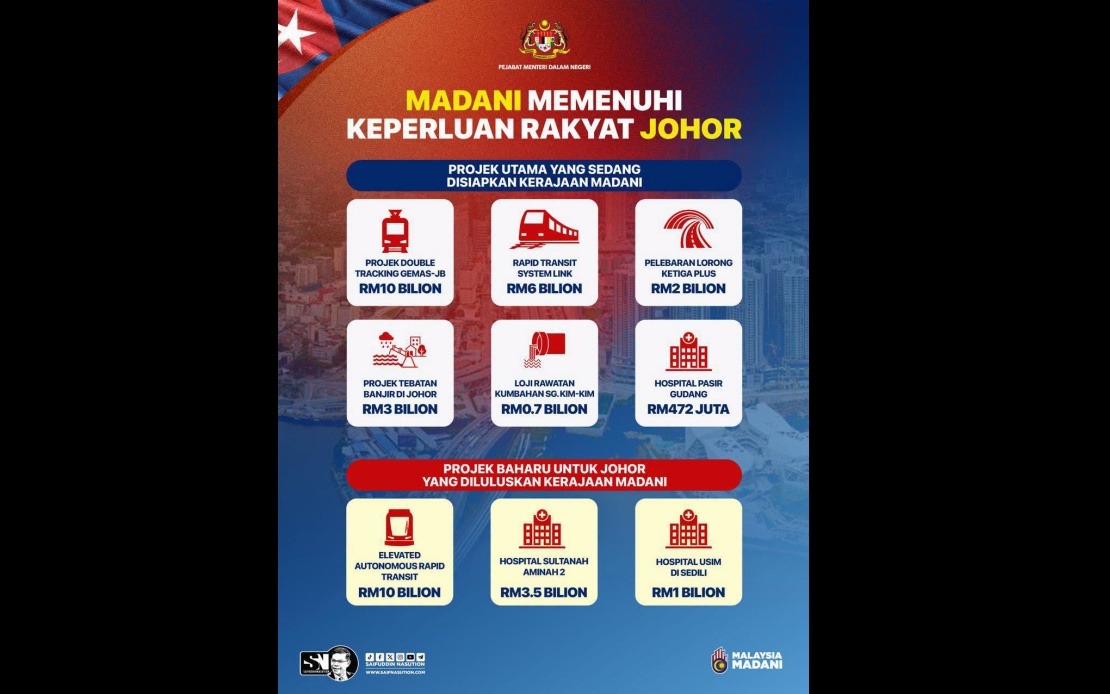
Johor state serves as a visible testing ground for this integrated development strategy. The southern peninsula region, Malaysia's second-largest economy and home to nearly 4.1 million people, faces distinct challenges ranging from ageing transportation infrastructure to periodic flooding that disrupts commerce and displaces communities. The government has identified several flagship projects designed to address these systemic constraints simultaneously. The Gemas-Johor Bahru Electrified Double Tracking Project exemplifies the transport modernisation agenda, promising faster, cleaner regional connectivity and reduced road congestion that hampers logistics and tourism sectors.
The Rapid Transit System (RTS) Link represents another transformative intervention, particularly for cross-border commuters and those working in Johor Bahru's urban core. Such mass transit systems have proven effective in peer economies like Singapore and South Korea for reducing vehicle emissions, alleviating traffic strain on aging road networks, and unlocking economic potential in previously underserved districts. When layered with the third lane widening of the PLUS Highway, these projects collectively reshape how people and goods move through one of Malaysia's most economically vital corridors, benefiting not only Johor but also neighbouring Selangor and Kuala Lumpur through improved supply chain efficiency.
Heath infrastructure expansion deserves particular scrutiny, as it addresses a long-standing gap in Malaysia's public medical system. The Sungai Kim Kim Sewage Treatment Plant and Pasir Gudang Hospital modernisation tackle both environmental and clinical capacity challenges. Johor, home to significant petrochemical and manufacturing clusters, has historically struggled with industrial pollution affecting water quality and public health outcomes. Targeted sewage treatment investments signal recognition that development cannot proceed without environmental stewardship. Simultaneously, hospital expansion addresses rising patient demand driven by demographic ageing and lifestyle diseases increasingly prevalent across Southeast Asia.
The recently approved Sultanah Aminah Hospital 2 and USIM Hospital in Sedili represent a strategic diversification of healthcare provision, distributing clinical capacity beyond Johor Bahru's congested medical district. This decentralisation model encourages rural populations to seek treatment locally rather than undertaking costly and time-consuming journeys to urban centres, improving health equity while reducing pressure on flagship institutions. For Malaysia's broader healthcare system facing workforce shortages and escalating costs, such distributed networks offer a scalable blueprint applicable to other states.
The Elevated Autonomous Rapid Transit (E-ART) project occupies a particularly forward-looking position within this development package. As an innovation pilot, it positions Johor as Malaysia's testing ground for autonomous transit technologies that could reshape urban mobility across the region. Success here provides valuable data and operational experience that could inform future roll-outs in Kuala Lumpur, George Town, and other congested corridors. This technological dimension reflects how development in competitive regional markets increasingly hinges on adopting and mastering emerging technologies rather than merely replicating established solutions.
Crucially, Saifuddin Nasution's articulation of development emphasises that infrastructure alone remains insufficient without corresponding employment generation and service quality improvement. This nuance distinguishes the MADANI framework from purely construction-focused development paradigms common in the region. Job creation across construction, transport operations, healthcare administration, and technology sectors provides immediate household income support, while improved transportation reduces commuting costs and expands employment catchment areas for workers. Better healthcare access prevents catastrophic health-related spending that destabilises household finances, particularly among lower-income demographics.
The flood mitigation component warrants emphasis given Southeast Asia's increasing vulnerability to climate variability and extreme weather. Johor's history of devastating inundations, particularly in 2014 and 2022, demonstrates how inadequate drainage and water management systems exacerbate economic losses and humanitarian costs. Integrated flood mitigation strategies combining infrastructure hardening with natural water retention systems and early warning networks offer protection for estimated assets worth tens of billions of ringgit while reducing insurance costs and business interruption losses. For Malaysian corporations operating regionally, flood-resilient infrastructure in domestic hubs reduces supply chain vulnerability and operational risk.
These initiatives collectively reveal how the MADANI Government conceptualises development as systemic rather than sectoral. Transportation and healthcare improvements generate multiplier effects throughout local economies: healthier, more mobile populations participate more productively in labour markets; reduced congestion lowers business operating costs; reliable transit attracts skilled talent to regional centres; and environmental improvements enhance competitiveness for attracting high-value manufacturing and service investments. This interconnectedness distinguishes the current approach from earlier models that compartmentalised development planning.
For Malaysian investors and policymakers monitoring the Johor blueprint, the implications extend to competitiveness within the ASEAN framework. Regional competitors including Thailand, Vietnam, and Indonesia are simultaneously investing in port infrastructure, transit networks, and industrial parks to capture manufacturing relocation from China. Johor's integrated development strategy, if executed effectively, strengthens Malaysia's position as a diversified regional hub offering not only competitive labour costs and established supply chains but also modern infrastructure and quality-of-life amenities that attract and retain multinational employers and their workforces.
The government's continued commitment to sustainable, inclusive development across all states fundamentally rests on effective project delivery and measurable outcomes reaching ordinary citizens. While ambitious infrastructure pipelines generate optimism, execution challenges remain formidable: cost overruns, construction delays, and capacity constraints at implementing agencies plague development projects throughout Southeast Asia. Public perception and electoral support for the MADANI administration will ultimately hinge less on announcement grandeur than on whether these projects materially improve commute times, reduce medical waiting lists, prevent flood damages, and expand employment opportunities for Malaysian households in coming years.

