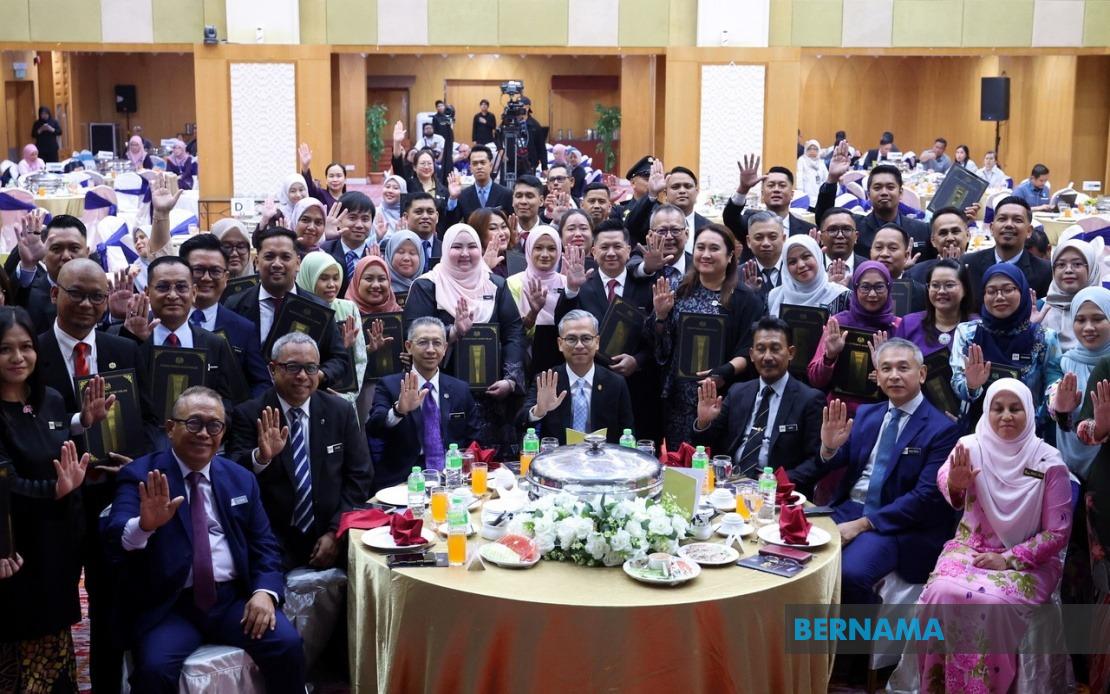
The MADANI administration is doubling down on its commitment to translate macroeconomic gains into concrete improvements in citizens' living standards, Communications Minister Datuk Seri Fahmi Fadzil declared while addressing government officials in Kota Kinabalu. Speaking at the Communications Ministry's Sabah and Labuan Zone Excellent Service Awards ceremony, Fahmi stressed that national prosperity means little without direct positive impact on household finances and daily consumer experiences across the country.
While Malaysia's economic indicators paint an encouraging picture—with figures showing steady growth in investment, government revenue, foreign reserves, gross domestic product, and bilateral trade—Fahmi cautioned against treating these statistics as an end goal. Instead, he framed them as intermediate milestones that matter only insofar as they filter down to ordinary Malaysians. This philosophical distinction reflects a broader shift in how the government measures success beyond traditional economic metrics, recognising that public confidence hinges on tangible purchasing power and service quality improvements.
The concept of "people's economy" that Fahmi articulated goes beyond abstract policy frameworks. He illustrated this principle through concrete examples, particularly referencing the BUDI MADANI targeted diesel subsidy programme. This scheme represents the government's attempt to balance fiscal sustainability with social welfare by directing assistance more efficiently to those who need it most. Prime Minister Datuk Seri Anwar Ibrahim and the Cabinet have made understanding the real-world mechanics of such programmes a cabinet-level concern, signalling serious commitment to implementation beyond bureaucratic checkboxes.
Geographic challenges in Sabah and Sarawak provide a crucial test case for people's economy principles. These states feature vast distances between districts with dispersed populations, meaning transport costs and logistics expenses significantly impact household budgets differently than in peninsular Malaysia. Fahmi highlighted how the government recognises that one-size-fits-all economic policies often fail to account for regional variation. Subsidies and support programmes must be calibrated to reflect these ground realities, or they risk being ineffectual or even counterproductive for isolated communities.
The emphasis on translating excellence at the national level into tangible wallet-and-pocket impacts reveals administration thinking about policy communication and public perception. Fahmi suggested that citizens need to experience economic improvements directly—seeing them reflected in reduced living costs, improved wages, or better access to services. Without this connection between headline growth figures and daily lived experience, national economic performance becomes abstract and politically vulnerable to criticism.
Fahmi also underscored the responsibility incumbent on government ministries and agencies to explain policies comprehensively and accurately to the public. Misunderstanding or confusion about subsidy schemes, eligibility criteria, or programme mechanics can undermine even well-intentioned initiatives. This recognition points to a broader governance challenge: the gap between policy design and public understanding often proves as significant as implementation challenges. Government communication departments must ensure that citizens grasp not just what programmes exist but how to access and benefit from them.
The award ceremony itself—honouring excellent service from Communications Ministry staff in Sabah and Labuan—served as a platform to reinforce these priorities. Senior ministry officials present, including secretary-general Datuk Abdul Halim Hamzah and various department heads, signalled organisational commitment to service quality as integral to the people's economy agenda. The government appears increasingly conscious that bureaucratic efficiency and responsiveness directly impact public experience of state capacity.
For Malaysian readers, particularly those in East Malaysia where geographic dispersal exacerbates economic challenges, Fahmi's remarks carry significant implications. They suggest the government recognises that development strategies must account for local contexts and that economic policy effectiveness depends partly on how well government agencies explain and implement programmes. This represents an implicit acknowledgement that previous administrations' top-down approaches sometimes failed to account for regional particularities.
The people's economy framework also reflects global trends in how governments measure development success. Beyond GDP growth, policymakers increasingly consider household income distribution, cost-of-living pressures, and service accessibility. For a middle-income nation like Malaysia navigating inflationary pressures and global economic uncertainty, this refocus on ground-level economic realities represents pragmatic politics and genuine economic necessity. Citizens experiencing stagnant wages despite national growth will not reward governments regardless of headline statistics.

