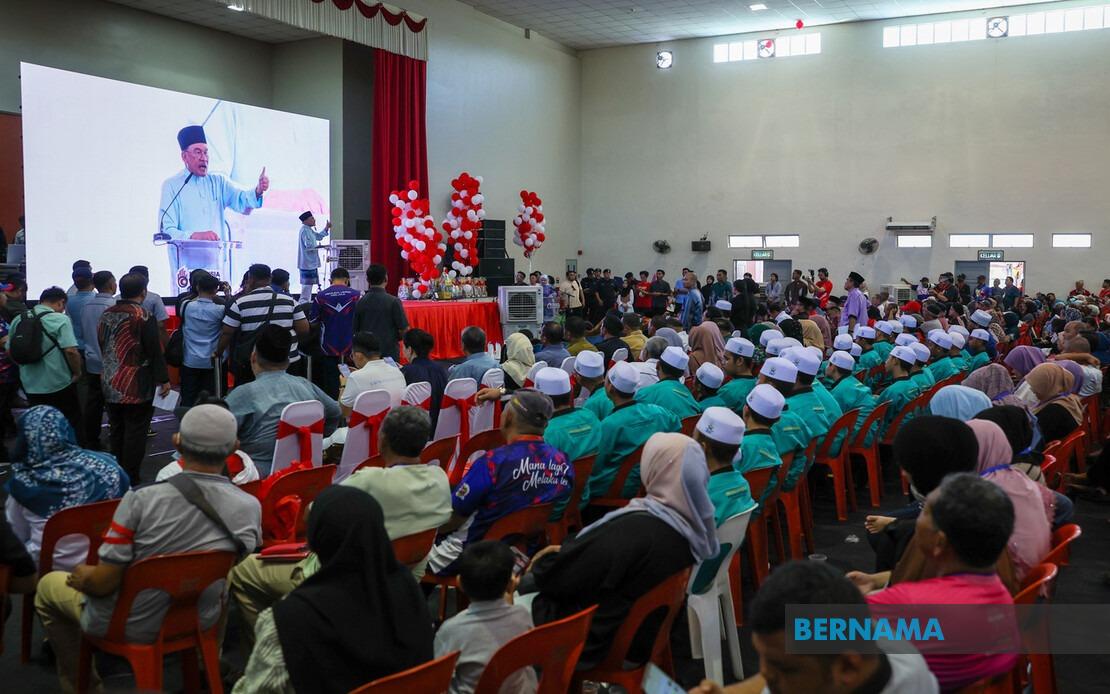
Prime Minister Datuk Seri Anwar Ibrahim has moved to reassure Malaysia's diverse education sector that the government's increased support for Islamic schools does not signal reduced commitment to vernacular institutions, addressing concerns about resource allocation across different community educational systems. Speaking at the Gelombang MADANI Carnival in Alor Gajah on August 7, Anwar stressed that the MADANI Government prioritises equitable treatment of all educational pathways as fundamental to preserving the nation's multicultural fabric.
The Prime Minister acknowledged that Islamic educational institutions, including pondok schools and tahfiz centres, had suffered prolonged neglect under previous administrations and warranted remedial investment. However, he emphasised that this course correction did not come at the expense of Chinese and Tamil vernacular schools, whose funding packages had already been finalised and would be unveiled in Kuala Lumpur within a fortnight. This phased announcement strategy appears designed to manage expectations within different communities whilst demonstrating sequential commitment to each segment.
Anwar articulated a broader philosophical position centred on inclusive governance and social cohesion. He contended that Malaysia's continued stability and prosperity depend on consciously addressing the needs of all communities without marginalising any group, a principle he linked directly to the nation's success as a plural society. The Prime Minister framed educational equity not merely as policy but as an ethical imperative necessary for maintaining the interethnic and interreligious harmony that has historically defined Malaysian society.
The concept of 'ummatan wasatan'—a balanced and moderate community—formed the intellectual foundation of Anwar's remarks. Drawing on Surah Al-Baqarah verse 143, he urged Muslims to embody equilibrium in faith, knowledge, character, and human relations as a means of setting positive example to broader society. This framing sought to position increased Islamic education funding within a framework emphasising moral conduct, integrity, and environmental stewardship rather than communal preference, thereby recontextualising the initiative as serving universal values rather than particular interests.
Anwar highlighted the practical transformation of Islamic educational institutions since the Unity Government's formation in 2022. Following years of withdrawal of state assistance, the administration restored funding in 2023 and expanded allocations in 2024, enabling modernisation initiatives including artificial intelligence and computer literacy programmes. The Prime Minister presented this investment as preventing Islamic schools from technological obsolescence relative to better-resourced Chinese and Tamil institutions, framing the intervention as corrective balancing rather than preferential treatment.
The announcement of RM1.29 million in infrastructure grants to thirteen Islamic educational establishments across Melaka provided concrete evidence of this commitment. Distribution among institutions including Madrasah Tahfiz Al-Quran Wal Qiraat Kota Melaka, various religious primary and secondary schools managed by the State Islamic Religious Department, and community Islamic educational centres demonstrated a deliberate strategy to strengthen the Islamic education ecosystem at multiple levels and geographic locations within the state.
For Malaysian education policymakers and stakeholders, Anwar's remarks signal an attempt to navigate the politically sensitive terrain of educational funding distribution across religious and cultural lines. The government faces the challenge of addressing historical imbalances whilst managing community sensitivities about resource allocation, a task complicated by the presence of federal government oversight alongside state-level educational administration. The forthcoming announcement regarding Chinese and Tamil school allocations will constitute a critical test of whether the government can deliver comparable substantive support to these communities.
The Prime Minister's emphasis on Malaysia as a successful model of plural coexistence carries particular relevance given regional instability and transnational religious tensions. By positioning educational equity within a framework of mutual respect and social cohesion, Anwar sought to prevent the instrumentalisation of school funding decisions as indicators of communal preference or religious bias. This rhetorical strategy acknowledges underlying anxieties whilst attempting to reframe policy through inclusive rather than zero-sum language.
The gathering included significant political figures including Melaka Chief Minister Datuk Seri Ab Rauf Yusoh and Deputy Higher Education Minister Adam Adli Abdul Halim, suggesting coordinated messaging across state and federal levels regarding educational funding. The presence of Anwar's wife, Datuk Seri Dr Wan Azizah Wan Ismail, alongside religious and civil authorities underscored the government's attempt to project unity in championing educational development across community lines.
For Southeast Asian observers, Malaysia's approach to education funding distribution within a multicultural context offers a case study in managing competing demands for resource allocation alongside communal identity preservation. The government's explicit commitment to sequenced announcements regarding different education streams, combined with the philosophical framework of balanced moderation, reflects careful political calibration aimed at preventing perception of winner-and-loser outcomes from funding decisions. Whether this strategy succeeds in satisfying legitimate aspirations within all communities whilst maintaining fiscal discipline will significantly influence social cohesion trajectories in coming years.
The modernisation agenda for Islamic schools, incorporating digital literacy and contemporary pedagogical approaches, positions religious education within twenty-first century competitiveness frameworks rather than traditional/modern binaries. This reorientation aligns Islamic education with knowledge economy participation whilst maintaining spiritual and moral dimensions, potentially offering an educational model of broader applicability within Malaysian society. The government's willingness to invest substantially in this modernisation suggests recognition that sustainable social stability requires ensuring no significant segment of the student population experiences technological or skills disadvantage relative to peers in alternative educational pathways.

