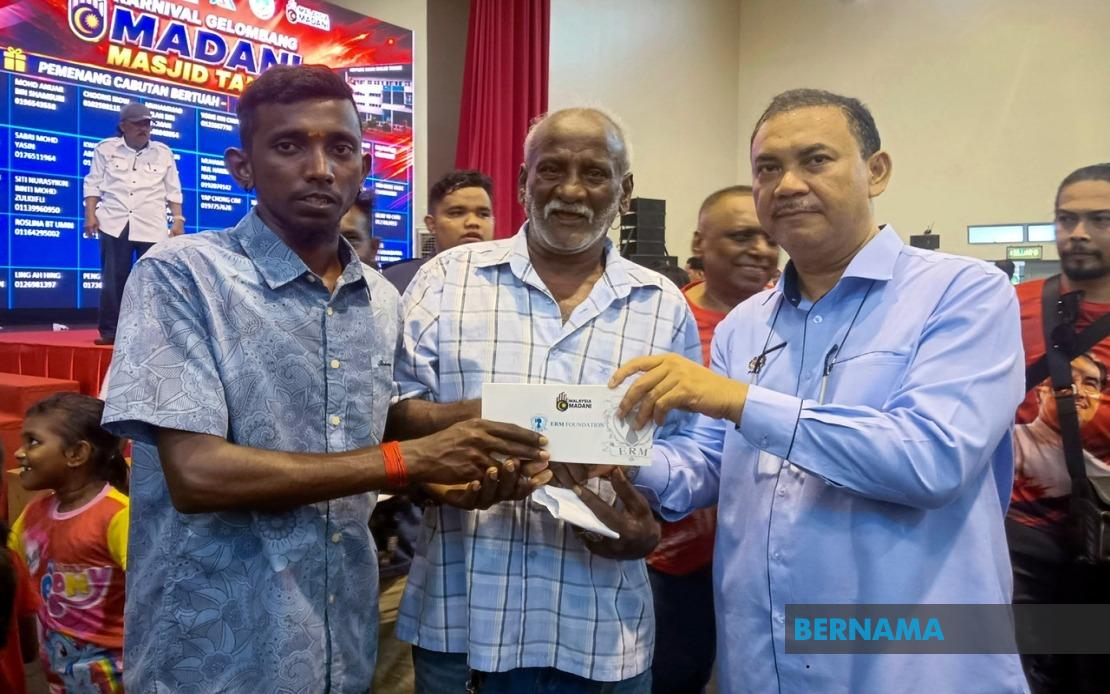
The Gelombang MADANI Carnival brought tangible relief to thousands of underprivileged households in Masjid Tanah on Wednesday, distributing direct cash assistance as part of the government's Sentuhan MADANI initiative aimed at easing the financial pressures facing Malaysia's most vulnerable populations. Held at the Masjid Tanah Sports Complex in Alor Gajah, the event focused on delivering targeted support to residents struggling with daily economic hardships, with each beneficiary receiving RM200 to help manage household expenses during an increasingly challenging cost-of-living environment.
The assistance programme encompassed recipients across five state constituencies nested within the Masjid Tanah parliamentary constituency: Kuala Linggi, Lendu, Tanjung Bidara, Ayer Limau, and Taboh Naning. By spreading the initiative across these administrative divisions, organisers ensured that aid reached communities throughout the broader electoral region, reflecting a coordinated approach to addressing localised pockets of economic vulnerability. Prime Minister's political secretary Datuk Azman Abidin oversaw the distribution ceremony, emphasising that the contributions targeted multiple disadvantaged demographics simultaneously.
The Sentuhan MADANI initiative deliberately cast a wide net across vulnerable groups, explicitly prioritising recipients from the B40 income bracket—Malaysia's bottom 40 per cent of earners by household income. Beyond this foundational focus, the programme extended support to persons with disabilities, whose employment prospects and earning potential are frequently constrained by accessibility barriers and workplace discrimination. Senior citizens, many of whom depend on inadequate pensions or family support following retirement, constituted another key beneficiary category, recognising the particular vulnerability of elderly populations facing inflation without regular income adjustments.
Ramlah Othman, a 63-year-old resident of Tanjung Bidara, represented the programme's typical beneficiary profile. She articulated the practical significance of the RM200 transfer, explaining that the funds would meaningfully reduce her household's daily financial strain. Her gratitude reflected not merely appreciation for monetary relief but recognition of governmental acknowledgment of her family's economic circumstances. Such validation—the symbolic and material assertion that the state recognises and responds to citizens' hardship—often carries psychological weight beyond the monetary value itself, affirming vulnerable citizens' place within the national community.
The testimonial of N. Mariappan, a 69-year-old stroke survivor from Ladang Sungai Baru, illustrated how the initiative addressed intersecting vulnerabilities among the elderly and disabled populations. Mariappan characterised the programme as tangible evidence of state concern for these marginalised groups, whose specific needs—medical expenses, mobility assistance, daily care support—frequently exceed standard social welfare provisions. His observation underscored how targeted cash transfers communicate policy intent beyond their narrow fiscal function, signalling governmental prioritisation of particular constituencies during a period when cost pressures disproportionately affect those with limited income-earning capacity or chronic health conditions.
The timing of the Gelombang MADANI Carnival within Malaysia's broader political calendar reflected strategic positioning ahead of potential electoral contests, yet the mechanics of the assistance programme demonstrated substantive attempts to address concrete hardship rather than purely performative gestures. Direct cash transfers to identified vulnerable populations bypass bureaucratic intermediaries that often delay or fragment targeted support, ensuring immediate utility for household management. The RM200 quantum, while modest in absolute terms, represents meaningful purchasing power for B40 households, potentially covering essential groceries, utilities, or medical expenses for several weeks depending on family size and local cost structures.
The geographical scope—spanning five state constituencies within a single parliamentary district—reflected administrative coordination between federal, state, and local government mechanisms, revealing how the MADANI initiative attempted to operationalise cross-level governance structures. Such coordination remains complex in Malaysia's federal system, where resource allocation, programme implementation, and beneficiary identification typically requires negotiation across multiple bureaucratic levels. The Masjid Tanah operation demonstrated capacity to execute this coordination at significant scale, reaching 2,000 distinct households through a single coordinated event.
From a Southeast Asian comparative perspective, Malaysia's Sentuhan MADANI initiative represents evolution in social protection approaches within the region. Unlike some neighbouring countries that rely heavily on conditional cash transfers requiring beneficiaries to meet behavioural requirements—school attendance, health screening participation—the MADANI programme appears structured as unconditional assistance, reducing administrative burden and stigma while expanding accessibility. This design choice reflects recognition that extreme economic vulnerability often precludes compliance with conditionalities, creating exclusionary barriers that undermine programme effectiveness.
The demographics targeted—B40 households, persons with disabilities, senior citizens, low-income earners—encompass populations whose consumption of social services and demand on public healthcare systems typically exceeds their tax contributions, presenting recurring policy tensions in resource-constrained governments. Direct cash assistance acknowledges these groups as legitimate beneficiaries of collective resources while avoiding paternalistic assumptions about consumption preferences. Recipients experience autonomy in determining how funds best serve their immediate circumstances, whether medical expenses, food security, or utility payments, rather than receiving predetermined goods or services.
The implementation through carnival-format events, combining assistance distribution with community gathering, served multiple functions simultaneously. Beyond the logistical efficiency of concentrating beneficiary processing, the carnival context fostered social connection among recipients, reducing isolation that often accompanies extreme poverty while creating visible public affirmation of governmental commitment to disadvantaged constituencies. Such visibility carries political significance in competitive democracies, where opposition parties scrutinise and contest governmental claims regarding social protection effectiveness.
For Malaysian policymakers, the Masjid Tanah operation provided operational data regarding programme scalability, beneficiary identification accuracy, and recipient satisfaction. The apparent success in reaching 2,000 households suggested functional systems for identifying eligible recipients within parliamentary constituencies, critical infrastructure for potential programme expansion. Recipient testimonials indicating meaningful impact suggested that the RM200 quantum, while individually modest, generates appreciable household utility among target populations, informing potential future discussions regarding adequate assistance levels within similar programmes.
The initiative occurred within Malaysia's broader context of persistent income inequality and growing cost-of-living pressures affecting lower-income households disproportionately. Inflation-driven increases in essential goods pricing—food, energy, housing—erode real incomes for populations dependent on fixed incomes or irregular employment, creating genuine hardship that exceeds their adaptive capacity. Targeted assistance programmes like Sentuhan MADANI represent governmental attempts to provide temporary buffer against these structural pressures, though sustained poverty reduction ultimately requires complementary policies addressing employment creation, skill development, and minimum wage adequacy.
The programme's success ultimately depends on consistent implementation across Malaysia's diverse constituencies, adequate annual funding sustaining regular distributions, and integration with broader social protection frameworks addressing long-term vulnerability reduction. Single cash transfers, however well-targeted, provide temporary relief rather than systemic poverty exit mechanisms. However, their immediate utility for vulnerable households and symbolic affirmation of state responsibility for citizen welfare make them politically significant and practically important components within comprehensive social safety networks.

