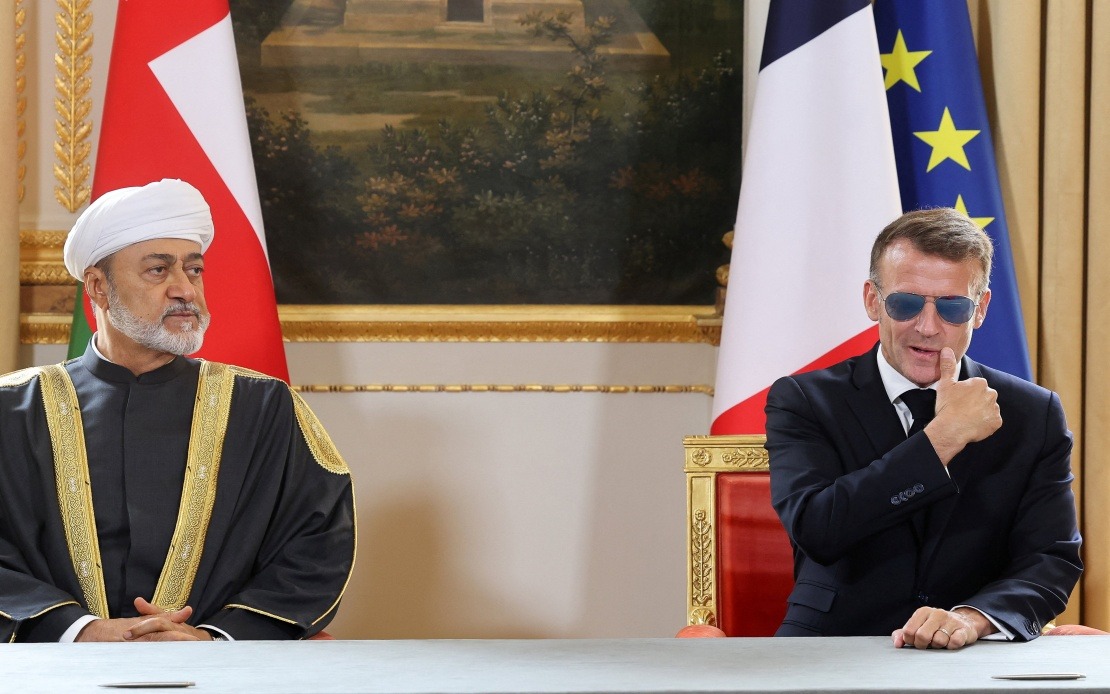
French President Emmanuel Macron appeared at the Élysée Palace on Monday wearing sunglasses during his reception and subsequent discussions with the Sultan of Oman, Haitham bin Tariq, reigniting attention on the eyewear that has become unexpectedly infamous in diplomatic circles. According to French media reports citing sources within the presidential inner circle, Macron's decision to retain the aviator-style glasses throughout the bilateral meeting stemmed from a persistent eye condition requiring medical accommodation. The choice to wear the sunglasses during formal state engagements underscores how health considerations can unexpectedly intersect with high-profile diplomacy, particularly when visual symbols carry considerable weight in international relations.
The eyewear itself represents more than a mere medical accessory; it has accumulated considerable cultural baggage over recent months. Earlier in the year, during the World Economic Forum in Davos, Macron's appearance in the same sunglasses sparked considerable international commentary, with United States President Donald Trump among those who offered commentary on the choice. Within France, the sunglasses became the subject of widespread cultural commentary, with observers drawing comparisons to film actor Tom Cruise, transforming what should have been a straightforward medical accommodation into a point of public fascination and humour. The incident exemplified how even practical health decisions by world leaders can be interpreted through the lens of celebrity culture and diplomatic optics rather than purely medical necessity.
Official explanations from the French presidency indicate that Macron had experienced a minor eye inflammation beginning in January, a condition that necessitated protective eyewear for approximately two weeks. However, the persistence of the eye problem into late June suggests either a lingering condition or recurring symptoms requiring ongoing management. Such medical situations are not uncommon among world leaders, many of whom endure significant stress and extensive travel schedules that can exacerbate various health conditions. The decision to wear sunglasses during a formal state meeting rather than postponing the engagement or finding alternative solutions demonstrates Macron's commitment to maintaining France's diplomatic schedule despite personal health challenges.
From a diplomatic perspective, the meeting between France and Oman carries significance for European-Middle Eastern relations. The sultanate, located strategically at the mouth of the Persian Gulf, maintains a delicate balancing role among regional powers and serves as an important partner for European nations seeking to maintain diplomatic channels across the Middle East. Oman's traditional neutrality and reputation for quiet diplomacy make it a valuable interlocutor for France in navigating complex regional dynamics. The bilateral engagement, despite Macron's health accommodation, would have addressed contemporary regional concerns, trade relationships, and France's strategic positioning in the Gulf region.
The international attention garnered by Macron's sunglasses also reflects broader patterns in how contemporary media covers world leaders. The twenty-four-hour news cycle and social media amplification mean that incidental details—such as eyewear—can achieve disproportionate prominence, overshadowing substantive policy discussions and diplomatic outcomes. For Malaysian observers and Southeast Asian readers following international affairs, this phenomenon demonstrates how global media narratives are shaped by visual and cultural elements that transcend traditional foreign policy analysis. What might otherwise be a routine note about an eye inflammation becomes fodder for international commentary, memes, and sustained cultural reference.
The commercial dimension of the sunglasses situation adds an intriguing layer to this diplomatic episode. French luxury eyewear manufacturer Henry Jullien capitalised on the unexpected publicity by promoting the model prominently, leveraging photographs of Macron wearing the glasses in official contexts. This unplanned product placement highlights the intersection between state power, personal health, and commercial opportunity in the modern world. The surge in inquiries about the specific model demonstrates consumer interest in items associated with powerful figures, a phenomenon that extends across luxury goods markets globally. For companies in Southeast Asia and Malaysia involved in fashion and accessories, such cases illustrate the unpredictable ways that international news cycles can create marketing opportunities.
Macron's willingness to conduct high-level diplomatic meetings while accommodating a medical condition also reflects evolving standards around workplace flexibility and health disclosure among political leaders. Unlike previous eras when leaders might have concealed health issues or postponed engagements, contemporary approaches often involve transparent communication about medical accommodations. This shift represents progress in normalising the reality that public figures, regardless of their position, experience health challenges requiring practical solutions. The French president's straightforward approach—wearing the necessary eyewear rather than attempting concealment—suggests a pragmatic attitude toward health management in professional contexts.
The broader context of Franco-Omani relations provides important background for understanding this meeting's significance. France maintains substantial business interests across the Gulf region, including defence contracts, energy partnerships, and cultural exchanges. Oman, despite its smaller population compared to neighbouring Gulf states, punches above its weight diplomatically due to its historical role as a maritime trading hub and its contemporary position as a constructive voice in regional disputes. For Southeast Asian nations similarly navigating relationships with both European and Middle Eastern powers, observing how France conducts diplomacy with careful Gulf partners offers instructive lessons in managing diverse international partnerships.
The incident also illustrates how personal presentation intersects with political messaging. While Macron's sunglasses were medically necessary, their appearance during state functions inevitably influenced how international observers perceived the meeting. Diplomacy operates simultaneously at multiple levels—the formal discussion of policy issues, the symbolic communication conveyed through appearance and protocol, and the media narrative that subsequently frames international relations. Malaysian diplomatic observers and regional leaders often navigate similar challenges in balancing health considerations, cultural expectations, and the demands of high-visibility state functions.
Looking forward, Macron's continued use of the sunglasses raises questions about long-term management of his eye condition and whether future diplomatic engagements will similarly feature the distinctive aviators. If the condition persists beyond the expected recovery period, it may represent a more serious underlying issue than initially disclosed. Alternatively, the sunglasses may become a recognisable element of Macron's public image, much as other world leaders have distinctive visual markers. Regardless of the outcome, the incident demonstrates how even routine health accommodations can achieve unexpected diplomatic and cultural significance in our interconnected, media-saturated world.

