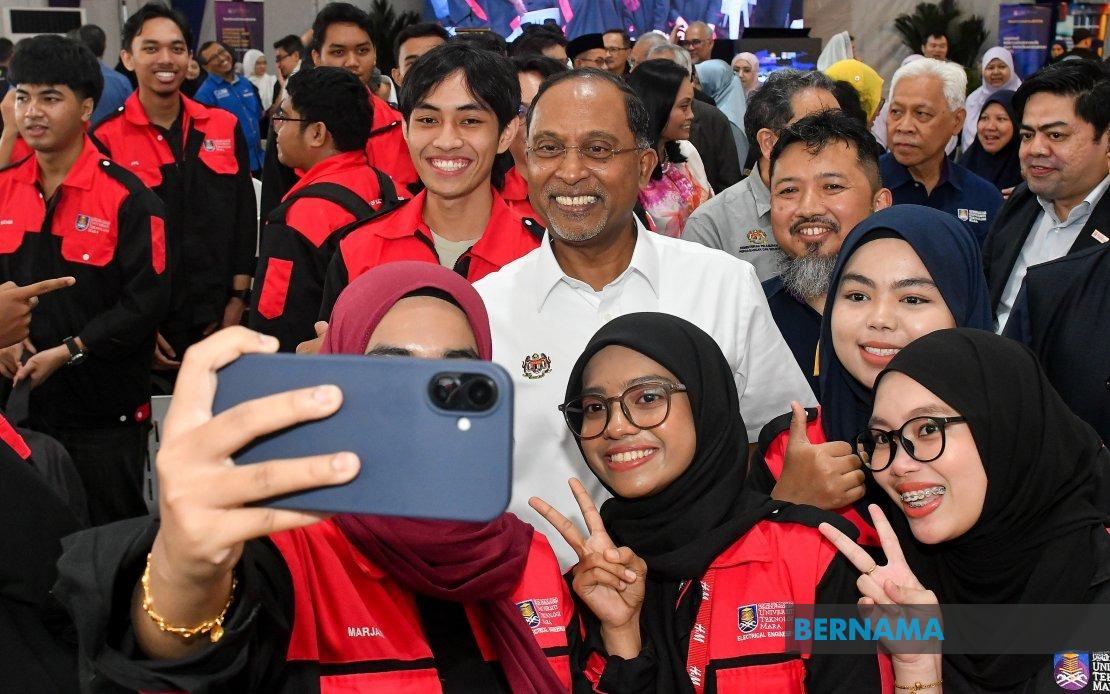
The launch of the Light Rail Transit 3 Shah Alam Line represents a watershed moment for student mobility across the Klang Valley, with the UiTM Shah Alam Station directly addressing longstanding transportation challenges that have plagued one of the country's largest university campuses. Speaking on June 30 in Shah Alam, Higher Education Minister Datuk Seri Dr Zambry Abd Kadir underscored the practical impact of the new 20-station network, noting that students have already responded with palpable enthusiasm to the availability of affordable mass transit linking their institution to the broader metropolitan region.
The timing of the LRT3 opening coincides with Prime Minister Datuk Seri Anwar Ibrahim's announcement of complimentary fares across the entire Shah Alam Line through July 31, effectively eliminating financial barriers to usage during the critical initial adoption period. For a student population that has historically absorbed transportation costs as a significant budget item, this temporary subsidy removes a considerable friction point in daily campus access. The UiTM Shah Alam Station occupies a strategic position within the 20-station corridor, which stretches from Bandar Utama through Klang, connecting established residential areas, commercial zones, and emerging suburban developments that collectively house tens of thousands of daily commuters.
Beyond the immediate relief from traffic congestion that has characterised the Shah Alam area during peak hours, the rail infrastructure addresses a broader Klang Valley connectivity challenge that has constrained educational and economic mobility across the region. Students previously reliant on private vehicles or inconsistent bus services now access a frequency-based, weather-independent transportation option that substantially reduces both commute uncertainty and household transportation expenditure. For UiTM Shah Alam, which serves one of Malaysia's largest student populations, this infrastructure upgrade represents an institutional development asset comparable in significance to capital improvements to campus facilities themselves.
During his June 30 visit, Zambry simultaneously directed attention toward UiTM's strategic Semiconductor@UiTM initiative, a comprehensive programme reflecting the university's intent to position itself as a nursery for advanced technology talent. The initiative represents an investment of RM20 million in government allocations directed toward infrastructure development, curriculum alignment with industry standards, and cultivation of expertise ecosystems that mirror international practise. This parallel announcement underscores the Malaysian government's two-pronged approach to university development: improving operational infrastructure through transportation connectivity while simultaneously deepening academic specialisation in high-value sectors.
The semiconductor initiative aligns explicitly with Malaysia's National Semiconductor Strategy, which recognises that sustained competitive advantage in advanced manufacturing requires a deepening talent pipeline capable of engaging with cutting-edge technologies and global supply chain architectures. By concentrating resources at UiTM, a university with established engineering credentials and significant student enrolment, the government targets rapid capability development across the Electrical and Electronics Engineering discipline. Zambry's framing emphasised that this represents more than academic programme enhancement; it constitutes deliberate human capital development designed to capture and retain high-value economic activity within Malaysia's borders.
Malaysia's existing semiconductor sector contribution of 13 per cent to global markets, generating more than RM300 billion annually, establishes a substantial economic foundation upon which the Semiconductor@UiTM initiative builds. However, this dominance remains precarious without corresponding domestic talent development capable of advancing beyond assembly and testing functions toward design, process engineering, and intellectual property creation. UiTM's initiative addresses precisely this vulnerability by creating a learning ecosystem where academic instruction integrates directly with engagement from established industry participants, enabling students to develop practical exposure to contemporary technologies and firsthand understanding of supply chain dynamics.
The cross-learning emphasis embedded within Semiconductor@UiTM reflects international best practise in advanced technology education, where productive university-industry collaboration substitutes for the practical experience gaps that plague purely theoretical curricula. Through structured engagement with global semiconductor supply chain participants, UiTM students transition from classroom learners to apprentices capable of autonomous problem-solving within industrial contexts. This pedagogical approach transforms the university from an institution that produces graduates into one that cultivates practitioners immediately capable of contributing to enterprise-level technical challenges.
Zambry's articulation of the initiative as a benchmark for other universities suggests governmental intent to replicate this UiTM model across Malaysia's higher education sector. Such replication would substantially accelerate the production of semiconductor-literate graduates across multiple institutions, multiplying the human capital development impact beyond what UiTM alone can achieve. The minister's positioning reflects strategic thinking about ecosystem effects, recognising that concentrated excellence at single institutions produces insufficient talent density to satisfy the sector's growing demands across multiple geographic locations.
The simultaneous progress on transportation infrastructure and specialised skills development illustrates the complementary nature of these interventions. Students accessing UiTM via the LRT3 line experience reduced commute friction that enhances their capacity to engage fully with intensive technical curricula. The transportation improvement effectively extends the geographic catchment area from which UiTM can recruit capable students, while simultaneously improving the daily life quality of current enrolees. For institutions competing for talented students in increasingly distributed metropolitan contexts, such infrastructure integration determines recruitment success and retention outcomes.
From a Southeast Asian perspective, Malaysia's coordinated approach to semiconductor ecosystem development through simultaneous infrastructure and skills investments positions the nation as a competitor to regional alternatives in Thailand, Vietnam, and Indonesia that are rapidly expanding semiconductor capabilities. The Klang Valley's emergence as a connected metropolitan region through transportation modernisation, combined with intensified skills development through university initiatives like Semiconductor@UiTM, creates reinforcing advantages that attract both multinational semiconductor investment and domestic talent retention. Neighbouring governments monitoring Malaysia's progress recognise that such integrated strategies prove more effective than isolated interventions in either infrastructure or education.
The LRT3 Shah Alam Line inauguration and Semiconductor@UiTM launch together signal Malaysian confidence in long-term high-technology sector development. These initiatives require sustained multi-year commitments, substantial capital deployment, and coordinated action across government agencies, educational institutions, and private sector participants. Their simultaneous announcement suggests that policymakers perceive the coming decade as decisive for Malaysia's positioning within advanced technology manufacturing sectors. Whether these coordinated investments translate into the intended outcomes of enhanced mobility, improved talent development, and strengthened sectoral competitiveness will become increasingly evident over the coming years as student enrolment, graduation outcomes, and industry placements accumulate measurable data.

