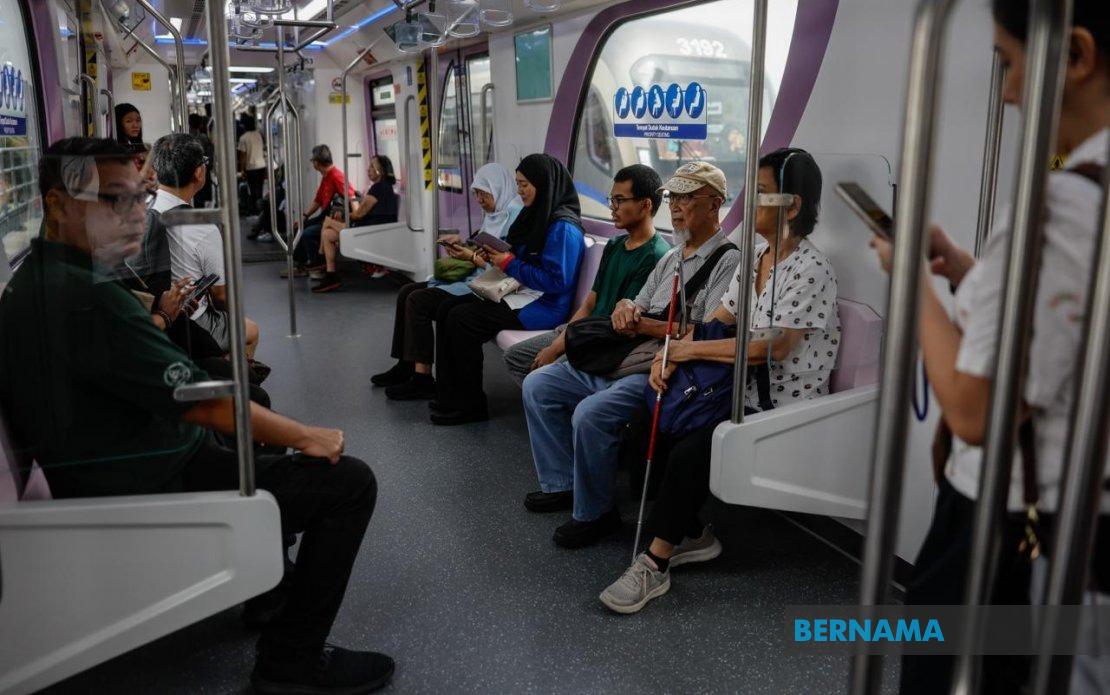
The LRT3 Shah Alam Line commenced operations on June 29 to widespread approval from its first passengers, who highlighted the service's comfort, efficiency, and potential to transform commuting patterns across the Klang Valley. The RM16.63 billion project represents a significant government investment in expanding Malaysia's rapid transit infrastructure, and early user feedback suggests the investment is already delivering tangible benefits to a diverse cross-section of commuters navigating the route between Kajang and Glenmarie 2.
Accessibility emerged as a central theme in passenger responses, reflecting both genuine progress and remaining gaps. Razlan Ibrahim, a 40-year-old visually impaired commuter who travelled the full length of the line on opening day, commended the tactile pathways installed at stations including Bandar Utama, which he described as effective in guiding persons with disabilities to essential facilities including accessible toilets, prayer rooms, and lift access. The physical infrastructure demonstrates thoughtful universal design principles that acknowledge the specific navigational challenges faced by vision-impaired users.
However, Razlan's feedback also pinpointed a critical shortcoming: the absence of comprehensive Braille signage at key locations throughout the network. While the tactile guidance systems successfully direct users to important facilities, they do not convey directional information or identify which services await at each location. This gap means visually impaired passengers can physically locate amenities but lack the information resources to independently understand their surroundings and plan their journeys. Razlan's suggestion to enhance Braille provision at lift entrances, toilet facilities, and prayer rooms represents a practical enhancement that would substantially improve information access for this user group without requiring extensive infrastructure modifications.
The broader commuting public has responded positively to operational aspects of the new line. Samantha Fong, a 26-year-old private sector employee, emphasized the time savings and journey simplification the LRT3 delivers by eliminating the need for interchanges between Bandar Utama and Glenmarie 2. For workers and students traversing the Klang Valley's increasingly congested corridors, such direct routing offers material quality-of-life improvements through reduced commute times and journey unpredictability. Fong's experience aligns with the transport efficiency objectives underpinning the LRT3 project, which aims to redistribute passenger loads away from increasingly saturated highway networks.
Passenger comfort considerations have also surfaced in early feedback. Fong expressed interest in women-only coaches, a feature increasingly common in Southeast Asian rapid transit systems responding to safety and comfort concerns among female commuters. Such provisions have proven effective in other regional networks in encouraging greater female transit ridership, particularly during peak hours when general coaches experience crowding. The suggestion warrants serious consideration as the service establishes operational patterns and ridership grows beyond the initial free-fare promotional period.
Rainchie Lee, another early adopter, praised the smoothness of her inaugural journey and highlighted the strategic value of Prime Minister Datuk Seri Anwar Ibrahim's announcement of free rides extending through July 31. This month-long promotional period, which encompasses both LRT3 services and Prasarana feeder bus connections, creates a low-risk trial opportunity for potential regular users. Students, workers, and other commuting populations can evaluate whether the LRT3 genuinely suits their daily travel patterns without financial commitment, generating valuable data about demand patterns and user preferences while building ridership momentum during the critical initial phase.
The free-fare initiative carries particular significance for students and lower-income workers in the Klang Valley, populations for whom transport costs represent meaningful budget constraints. By removing the financial barrier to trial, even temporarily, the government facilitates informed decision-making about transit adoption while demonstrating public commitment to accessibility in the broadest sense. This approach acknowledges that transport equity extends beyond physical accessibility to encompassing affordability during service establishment phases when ridership remains uncertain.
The LRT3 Shah Alam Line represents part of a broader Malaysian policy emphasis on metropolitan rapid transit infrastructure as a cornerstone of sustainable urban development. The scale of investment and political prominence accorded to the launch reflect recognition that congestion, air quality, and livability concerns in major urban centres demand substantial public transport capacity expansion. For Malaysia's transport sector, the LRT3 adds meaningful capacity to a network that has experienced sustained ridership growth, though capacity constraints on existing lines continue to constrain regional mobility.
The feedback received during the first operational day also highlights the importance of disability inclusion in transport policy implementation. While planners incorporated accessibility features into the LRT3 design, the gaps identified by users like Razlan Ibrahim demonstrate that achieving genuinely inclusive systems requires ongoing dialogue with disability communities throughout implementation and operational phases. Information accessibility—enabling independent navigation and understanding of transport networks—deserves equivalent emphasis to physical accessibility in future Malaysian transit projects.
Looking forward, the operational period through July 31 will generate substantial data regarding actual usage patterns, peak-hour loads, passenger demographics, and real-world experience of both design features and operational procedures. This information should inform decisions regarding any subsequent expansion phases and guide refinements to existing facilities based on authentic user feedback. The suggestions emerging from early passengers—enhanced Braille signage, women-only coaches, comfort optimizations—represent implementable improvements that could differentiate the LRT3 as a model for inclusive transit development within the Southeast Asian region.
The LRT3 Shah Alam Line's positive launch reflects competent project execution and thoughtful infrastructure design, while user feedback indicates clear pathways for enhancement. As Malaysia continues expanding its rapid transit footprint, mechanisms for capturing and prioritizing accessibility feedback from diverse user groups should become standard practice, ensuring that subsequent projects benefit from lessons learned during the LRT3's inaugural period. The challenge ahead involves translating this enthusiastic reception into sustained ridership growth and demonstrating that public transport investment can materially improve metropolitan livability for populations across socioeconomic and ability spectrums.

