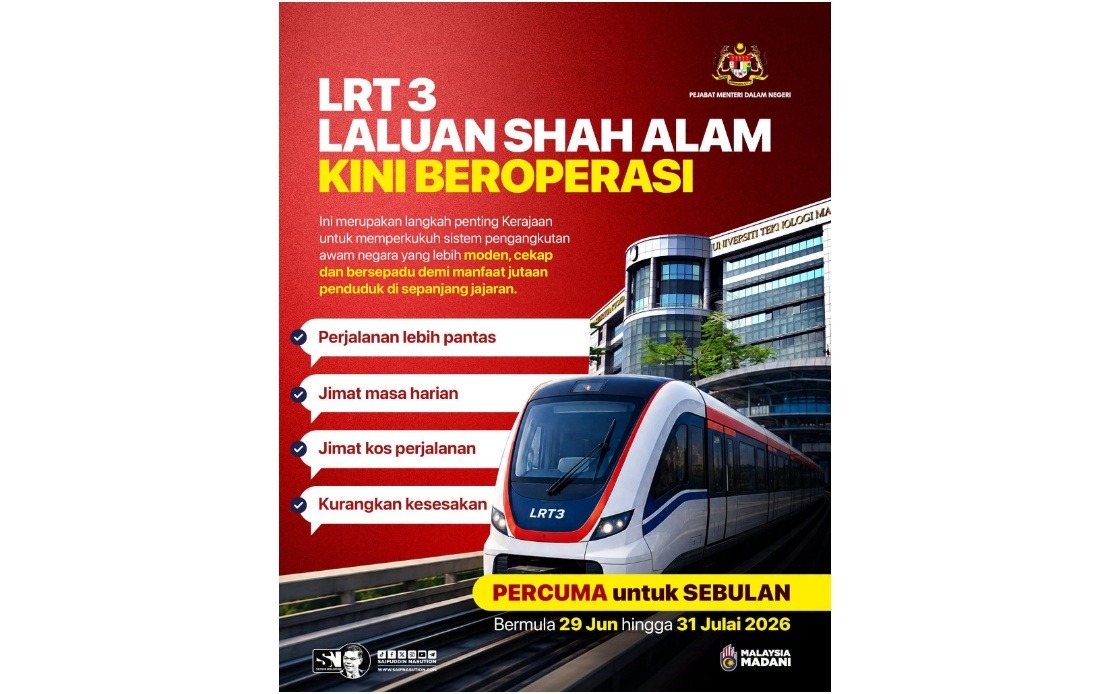
The Shah Alam Line LRT3 represents far more than just another addition to Malaysia's rail network—it is a physical manifestation of the MADANI Government's broader strategy to transform how millions of Malaysians move about their daily lives. Home Minister Datuk Seri Saifuddin Nasution Ismail underscored this point in recent remarks, positioning the new line as evidence of the administration's commitment to constructing a public transport ecosystem that is not only modern and efficient but also genuinely integrated across multiple modes.
The timing of LRT3's operational launch could hardly be more strategic. The Shah Alam Line addresses one of the most persistently congested transport corridors in the Klang Valley, an area that has long grappled with severe traffic bottlenecks during peak hours. By introducing an alternative rail route, the government aims to siphon considerable volume away from increasingly saturated road networks that serve commuters travelling between Shah Alam, Klang, Subang and surrounding areas. This geographical focus is deliberate, targeting a densely populated region where congestion directly impacts economic productivity and quality of life.
The government's investment in LRT3 operates on multiple strategic levels. On the surface, it expands the number of public transport options available to commuters, giving residents genuine choice rather than forcing dependence on private vehicles. Beyond that immediate benefit, the line functions as congestion-relief infrastructure—by redistributing passenger flows from roads to rails, it creates capacity that allows remaining vehicles to move more freely. For individual commuters, this translates into shorter journey times and measurably reduced daily transport expenditure, benefits that accumulate particularly significantly for workers, students and those regularly traversing the corridor for essential activities.
Prime Minister Datuk Seri Anwar Ibrahim's announcement of complimentary fares on the Shah Alam Line LRT3 from June 29 through July 31 demonstrates strategic thinking beyond mere ribbon-cutting ceremony. The free-travel initiative extends to Prasarana Malaysia Bhd feeder bus services that connect to the line, creating a temporary window during which potential users can sample the entire integrated system without financial barrier. This approach recognises a psychological dimension to transport adoption—many commuters accustomed to private vehicles harbour genuine concerns about the reliability, convenience and actual cost-effectiveness of public alternatives. A month-long free trial allows sceptics to test these assumptions against lived experience.
Saifuddin's public exhortation to residents of Shah Alam, Klang, Subang and adjacent communities to exploit the free-travel period carries implicit acknowledgment that behaviour change does not occur spontaneously. Even when infrastructure exists, established commuting habits persist. By framing the initiative as a time-limited opportunity—essentially creating an incentive to participate before the trial concludes—the messaging encourages uptake among those who might otherwise defer consideration. The Home Minister's colloquial appeal to "leave your car behind for a while" and personal prediction that riders will "want to ride it again" reflects deliberate effort to normalise public transport usage within a society where private vehicle ownership has become culturally entrenched.
This strategic transport investment sits within the MADANI Government's broader quality-of-life agenda, one that recognises infrastructure investment as central to national competitiveness. Modern, efficient public transport systems generate spillover benefits extending far beyond immediate commuters. They attract skilled talent to cities, reduce environmental costs associated with vehicular congestion, lower household transport expenses that can then be redirected to consumption and investment, and create employment across construction, operation and maintenance sectors. For Malaysia specifically, developing world-class public transport becomes increasingly important as regional competition intensifies for foreign direct investment and talented workers.
The Klang Valley context matters significantly here. As Malaysia's economic heartland, the region's transport infrastructure directly influences national productivity. Congestion imposes substantial costs through lost working hours, increased logistics expenses, and environmental degradation that ultimately impacts public health and liveability. LRT3 addresses these systemic inefficiencies by providing a rail alternative that operates independently of road congestion, maintaining reliable travel times regardless of weather, accidents or peak-hour volume. This predictability itself provides value—commuters can reliably plan their schedules around rail service rather than constantly accounting for uncertain road conditions.
The feeder bus integration component deserves particular emphasis, as it reflects sophisticated transport planning rather than standalone rail development. A modern LRT line generates maximum value only when complemented by effective first-mile and last-mile connectivity. Prasarana's alignment of feeder services with LRT3 stations means passengers can travel across the metropolitan area using predominantly public transport, rather than requiring private vehicles to access rail stations. This integration is precisely what transforms rail infrastructure from a limited urban corridor service into a genuine metropolitan transport system.
Successful adoption during the free-trial period will likely depend heavily on broader public communication efforts and user experience quality. Commuters evaluating public transport alternatives assess not merely cost and journey time but also comfort, cleanliness, safety, reliability and ease of navigation. The government's investment in marketing the free period, ensuring staff are available to assist unfamiliar users, and maintaining service quality throughout the trial period all influence whether temporary users become permanent adopters.
Looking forward, the LRT3 launch carries implications for transport planning across Malaysia more broadly. Success in the Klang Valley creates political momentum and practical evidence supporting further rail expansion to other congested corridors. Each successful line demonstrates benefits to stakeholders—commuters, local businesses, property developers, and municipalities—creating coalitions supporting subsequent projects. Conversely, operational challenges during this critical launch period could temporarily dampen enthusiasm for additional rail investment, though detailed operational data would ultimately prove more influential than initial impressions.
The government's positioning of LRT3 as emblematic of MADANI governance reflects understanding that infrastructure policy carries political significance beyond technical specifications. Citizens' daily experiences navigating their cities, time spent in commuting versus productivity, costs extracted by inefficient transport systems—these tangible quality-of-life factors influence how voters assess government performance. By connecting transport infrastructure explicitly to the MADANI platform's quality-of-life commitments, political messaging leverages demonstrated delivery of promised benefits. Whether this initial LRT3 launch generates the ridership and congestion-relief impacts projected will substantially influence public perception of the government's broader infrastructure competence.

