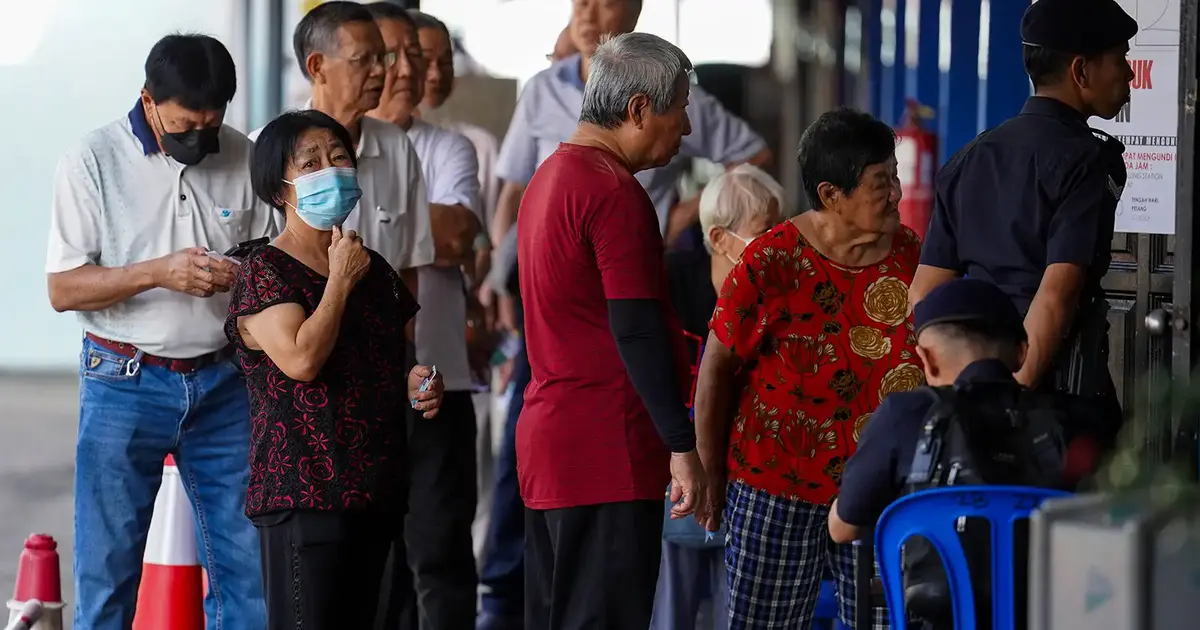
Former Bangi MP Ong Teng Cheong has offered a more nuanced reading of Pakatan Harapan's electoral performance among Chinese voters in Johor's recent polls, arguing that what appeared to be a significant reversal was substantially driven by lower-than-expected participation rates rather than wholesale voter abandonment to the Barisan Nasional coalition. His comments introduce an important distinction in interpreting the results, one that carries implications for opposition strategizing heading into future electoral contests across Malaysia.
Ong's assessment centers on the mechanics of voter behaviour during the Johor election, suggesting that the headline numbers obscure a more complex reality. When voter turnout declines, parties relying on traditionally higher participation rates among their base—as the opposition has among urban Chinese communities—face disproportionate impacts on their overall vote share. The former MP contends that Chinese voters did not shift en masse toward BN candidates, but rather stayed home, fundamentally altering the mathematical composition of the electorate that actually cast ballots.
This interpretation has significant bearing on how opposition parties should interpret their recent setbacks. If Ong's reading is correct, the challenge facing PH is not necessarily one of recovering voters actively wooed away by BN messaging or governance performance, but rather of rebuilding enthusiasm and participation among an already-supportive constituency. Voter apathy among traditional opposition supporters presents a different strategic problem than genuine ideological realignment, requiring distinct approaches to campaign mobilization and party messaging.
The context of Chinese voting patterns in Johor reflects broader trends across Malaysian politics. Chinese voters, particularly in urban and semi-urban areas, have historically served as a pivotal swing constituency, capable of delivering substantial numbers to either major coalition. They have also demonstrated sensitivity to issues ranging from education policy to economic opportunity to perceived discrimination or unfair treatment. Any decline in their participation, therefore, warrants careful analysis rather than acceptance at face value as an indicator of fundamental preference change.
Ong's emphasis on turnout rather than switching aligns with observable patterns in recent Malaysian elections. Urban voters of all communities have shown inconsistent participation rates, sometimes mobilized by specific issues or concerns, sometimes remaining disengaged despite campaign activities. The 2023 general election and subsequent state-level contests have produced varied results across different regions, with local factors often outweighing national narratives in determining actual electoral outcomes.
The distinction also matters for BN's own strategic reading of its performance. If the coalition attributes gains to successful persuasion of former opposition voters, it may pursue different policy directions than if the actual dynamic was opposition voter disengagement. Misinterpreting electoral results can lead parties to double down on ineffective strategies while neglecting areas where genuine opportunity exists. Accurate diagnosis of what transpired in Johor thus carries implications extending well beyond that single state.
Chemically, maintaining or rebuilding turnout among core constituencies presents operational challenges for opposition parties. It requires sustained grassroots activity, consistent communication with local communities, and cultivation of issues that resonate sufficiently to overcome voter apathy. The Malaysian opposition has faced recurring struggles in this arena, particularly when facing internal divisions or when political momentum appears to favour the ruling coalition.
The relevance of Ong's argument extends to understanding the broader Malaysian political landscape's trajectory. A political system where election outcomes are substantially determined by differential turnout rather than stable preference shifts may be more volatile and less predictable than one reflecting genuine voter realignment. It also suggests that the intensity and quality of campaign organization could prove decisive in future contests.
For Chinese voters specifically, Ong's framing potentially reflects a community that has not necessarily turned decisively toward BN, but one that may be experiencing uncertainty about PH's direction, internal cohesion, and capacity to represent their interests effectively. Low turnout can signal either indifference or active dissatisfaction, and distinguishing between those states remains important for political analysis and strategy.
Ong's commentary also implicitly acknowledges the opposition's responsibility in maintaining voter engagement. Even when structural or demographic factors appear favourable, political parties cannot assume that support will automatically translate into votes cast. The Johor result, viewed through his lens, becomes partly a mobilization failure rather than a popularity failure—a distinction that, while perhaps small in electoral terms, carries substantial implications for opposition parties' tactical and strategic approaches as they prepare for future contests.
Moving forward, opposition parties will likely place greater emphasis on turnout mechanisms and grassroots mobilization infrastructure. The 2024 Johor election, if Ong's analysis holds merit, teaches a lesson not about lost voters but about the importance of maintaining connection and enthusiasm among existing supporters, a lesson that transcends Johor and applies broadly across Malaysian politics.

