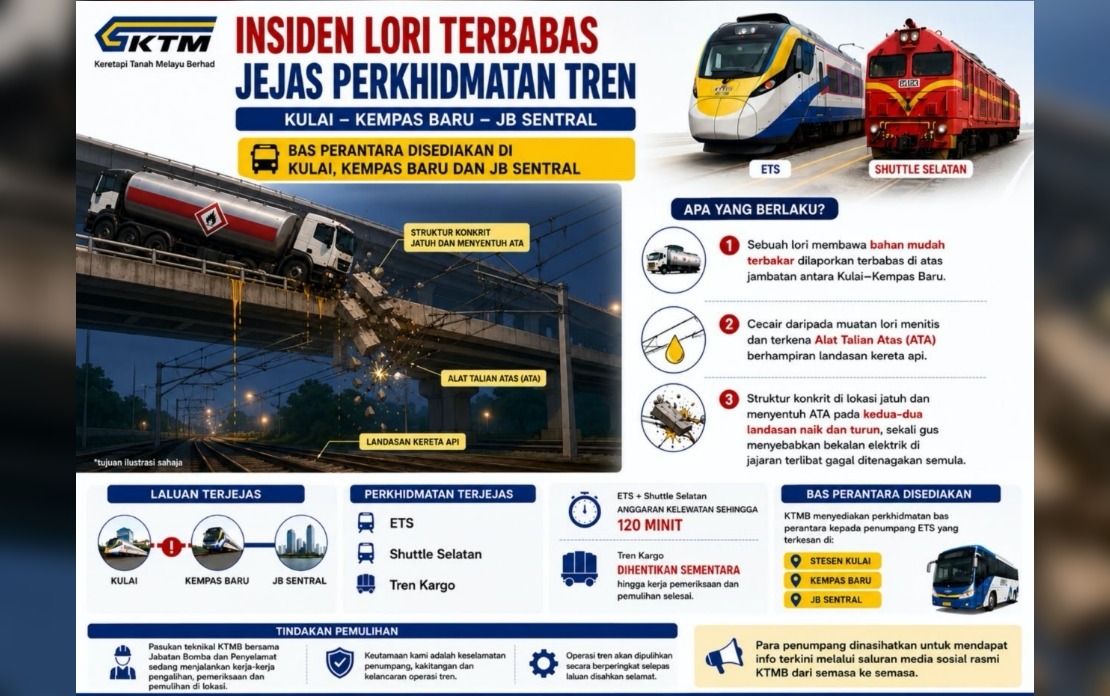
Train services on the Kulai–Kempas route in Johor Bahru experienced substantial disruptions on August 5 after a lorry transporting flammable liquid skidded dangerously close to the railway infrastructure, severing the electrical supply needed to operate both the Electric Train Service and Shuttle Selatan operations. The incident, which occurred alongside the tracks, forced Keretapi Tanah Melayu Berhad (KTMB) to immediately halt scheduled services while emergency crews mobilised to address the dual challenges of ensuring safety and restoring power connectivity.
The ripple effects of this transportation mishap were felt across the southern rail corridor, leaving commuters scrambling for alternative arrangements during evening peak hours. KTMB's swift response through social media channels provided real-time updates to the travelling public, acknowledging that the incident had created operational bottlenecks that would require time to resolve. The railway operator emphasised that cleanup operations and infrastructure repairs were progressing, though no specific timeline for full service restoration was provided initially.
To mitigate passenger inconvenience, KTMB implemented a multi-pronged contingency strategy centring on substitute shuttle bus services at three critical stations along the affected corridor: Kulai, Kempas Baru, and JB Sentral. This intervention aimed to prevent complete service collapse and maintain passenger movement through alternative road-based transport, ensuring that travellers could still reach their destinations despite the rail network's temporary unavailability. The deployment of shuttle buses represents standard protocol for Malaysian railways when infrastructure failures occur.
For Shuttle Selatan passengers, the situation proved more challenging, as these services lack a direct substitute within the existing KTMB framework. The operator consequently advised these passengers to explore other transportation modes, whether private vehicles, taxis, or ride-hailing applications, reflecting the difficult trade-offs inherent in managing unexpected transit emergencies. This recommendation implicitly acknowledged that some commuters would face extended journey times or additional costs during the disruption period.
Recognising the financial burden imposed on stranded passengers, KTMB committed to providing fare adjustments to those affected by the delays and service interruptions. While the statement did not specify the precise mechanism or quantum of these adjustments, this commitment demonstrated corporate responsibility and an attempt to compensate for the inconvenience suffered. Such measures are increasingly important in maintaining public confidence in rail infrastructure during disruptions.
Specific delay figures released by KTMB highlighted the severity of the disruption's impact on individual train services. The ETS9449 service accumulated a 32-minute delay by 10.37 pm, while the ETS9533 service trailed its schedule by 55 minutes, figures that underscore how a single infrastructure incident can cascade through an entire timetable. Both measurements were noted as provisional, suggesting that conditions remained fluid and delays could worsen or improve depending on the pace of restoration efforts.
The involvement of a flammable liquid tanker adds a critical safety dimension to this incident, elevating concerns beyond mere logistical disruption. Such cargo requires strict handling protocols, and the proximity of a skidding vehicle carrying hazardous materials to active or recently-used railway infrastructure raises questions about road-rail safety coordination in this area. Investigators would likely examine whether appropriate separation measures exist at this particular location and whether the lorry driver maintained proper control throughout the incident.
This disruption highlights the vulnerability of Malaysia's rail infrastructure to road traffic incidents, particularly along corridors where road and rail networks run in close proximity. The southern Johor region experiences substantial commercial vehicular movement, and instances of vehicles straying dangerously near tracks pose recurring operational and safety risks. Such incidents underscore the importance of continued investment in protective infrastructure and safety protocols at rail-road interfaces.
Commuters dependent on these services, particularly regular users of the Kulai–Kempas route, faced cascading consequences extending beyond immediate delays. Evening travellers heading home faced uncertainty about service reliability, while those with time-sensitive commitments encountered dilemmas about alternative transport. The incident also carried implications for neighbouring stations and connecting services, as delayed trains can create congestion throughout connected networks.
KTMB's appeal for affected passengers to contact station staff for assistance represented an effort to personalise customer service during the crisis, ensuring that individuals facing particular hardship could access direct support rather than relying solely on automated systems. This human element remains crucial during infrastructure emergencies when standardised solutions cannot address all passenger circumstances.
The broader context of this incident contributes to ongoing discussions about rail service reliability and resilience in Malaysia's transport sector. While such unexpected disruptions are inevitable in any major transport network, their frequency and duration often influence public perception of rail services and competitive positioning relative to road-based alternatives. For commuters evaluating transport mode choices, incidents like this carry weight in decision-making processes.

