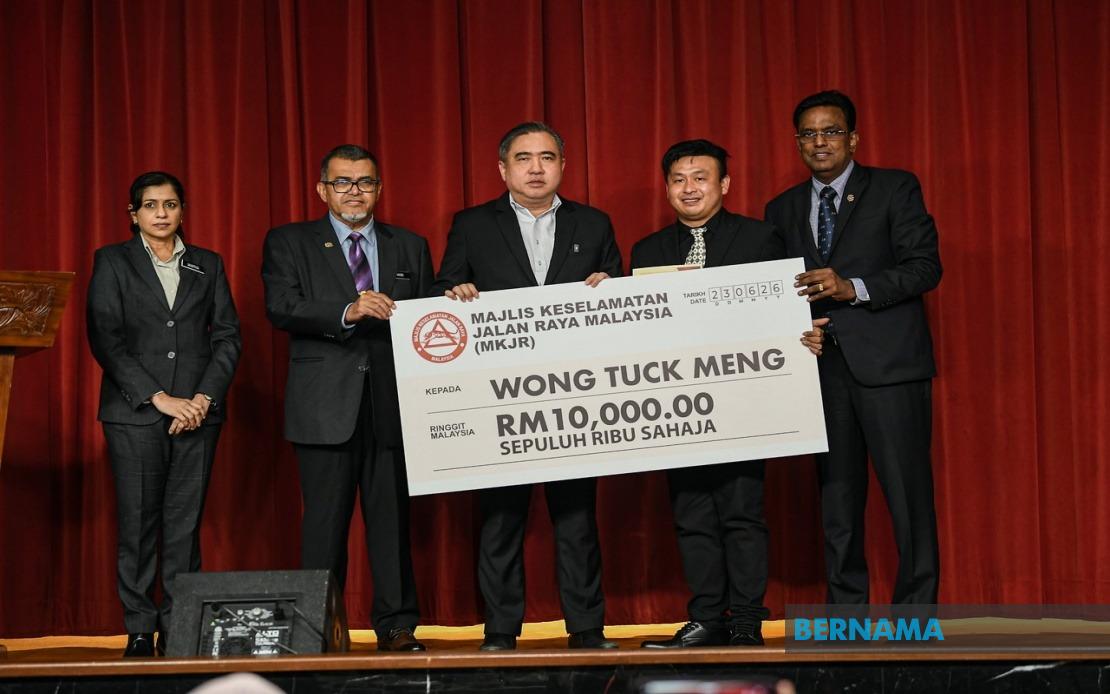
Wong Tak Ming, a lorry driver whose quick reflexes and decisive action prevented a potentially devastating highway disaster, was honoured today with a Special Certificate of Appreciation and RM10,000 in recognition of his heroism. The award ceremony, held at the Parliament building in Kuala Lumpur, acknowledged his role in averting tragedy on June 15 when an express bus travelling from Kedah to Kuala Lumpur lost control near the Menora Tunnel in Perak. Transport Minister Anthony Loke presented the recognition, which was funded by the Malaysian Road Safety Council (MKJR), to the humble driver whose actions saved 21 passengers from potential harm.
The incident unfolded when the express bus encountered a technical malfunction while descending a steep gradient approaching the Menora Tunnel. Losing control as it descended the challenging terrain, the bus veered dangerously toward Wong's vehicle. Rather than attempting to evade, Wong demonstrated exceptional composure and judgment by utilizing his lorry as an instrument of safety. He allowed his vehicle to absorb the initial impact from the bus, then skillfully positioned his lorry closer to the guardrail while simultaneously applying brakes, effectively creating a controlled deceleration that brought both vehicles to a safe halt before they could plummet further down the slope or collide with other traffic.
Transport Minister Loke, speaking during the formal ceremony, characterized Wong as a hero whose intervention prevented what could easily have become a tragic loss of life. The minister emphasized that Wong's actions reflected extraordinary courage, particularly given the personal risks he undertook in making split-second decisions that prioritized the safety of strangers over his own security. Loke noted that the swift and calculated response prevented a catastrophic accident that could have claimed multiple lives, highlighting the profound impact of individual vigilance and decisive action in traffic safety scenarios.
Wong himself remained characteristically modest about his actions, explaining that his instinctive response was simply to prevent fatalities and create space for vehicles ahead to move to safety. In his account of the incident, the driver revealed that his immediate concern was not his own wellbeing but rather using precious seconds to sound his horn, alerting motorists further ahead of the danger. This warning gave other road users crucial time to position themselves away from the collision zone. Wong's explanation suggests that his intervention was not a single heroic gesture but rather a sequence of calculated decisions made under extreme pressure, each one contributing to the overall positive outcome.
The incident achieved broader public recognition when video footage circulated across social media platforms, generating widespread admiration for Wong's composure and bravery. This digital amplification of his actions served to underscore the importance of responsible driving behaviour and swift decision-making in emergency situations on Malaysia's highways. The viral nature of the incident transformed a potentially localized event into a national conversation about road safety consciousness and the extraordinary individuals who exemplify it.
Parliament formally acknowledged Wong's contribution to road safety during proceedings today, with Deputy Speaker Datuk Dr Ramli Mohd Nor conveying the legislative body's appreciation for his bravery. This recognition occurred during the tabling of the Road Transport (Amendment) Bill 2025 for its second reading, connecting Wong's individual act of heroism to the broader national conversation about strengthening road safety frameworks and regulations. The timing of the recognition provided an opportune moment to demonstrate how individual responsibility and systemic improvements work together to enhance public safety on Malaysian roads.
The award carries significance beyond its monetary value of RM10,000, representing official state recognition of actions that embody civic responsibility and courage. For Malaysian road users, the incident and its recognition underscore several critical road safety lessons. First, it demonstrates that technical failures on buses represent genuine hazards requiring vigilant monitoring by vehicle operators and regular maintenance protocols. Second, it illustrates how quick thinking by other motorists can provide a crucial buffer against disaster, emphasizing the interconnected nature of road safety where every driver bears responsibility for collective wellbeing.
The incident also highlights the particular vulnerability of Malaysian highways to accidents involving heavy vehicles on steep gradients, a recurring challenge in Peninsular Malaysia's topography. The Menora Tunnel approach, with its significant elevation changes, presents engineers and safety officials with ongoing challenges requiring continuous assessment and improvement. Wong's intervention essentially bought time and reduced velocity at a critical moment, preventing what might otherwise have been a high-impact collision at full speed with catastrophic consequences for the 21 passengers aboard.
From a road safety perspective, this incident provides valuable lessons about the importance of maintaining adequate spacing between vehicles, particularly in challenging terrain. The fact that Wong had sufficient distance and time to respond suggests that both drivers were exercising appropriate caution given the circumstances. However, the underlying technical failure of the express bus raises important questions about maintenance standards and inspection regimes for commercial passenger vehicles operating on Malaysian highways. Regular technical checks and prompt repairs of identified issues represent essential preventive measures that can eliminate incidents before they become emergencies requiring heroic intervention.
The recognition of Wong's actions by the government and Parliament sends an important cultural message about valuing ordinary citizens who demonstrate exceptional character during critical moments. In a society where road accidents claim thousands of lives annually, highlighting examples of responsible behaviour and quick thinking can contribute to broader cultural shifts toward greater road safety consciousness. Wong's actions remind Malaysian motorists that individual vigilance, calm decision-making, and willingness to prioritize others' safety can mean the difference between tragedy and survival.
Looking forward, the incident and its aftermath should catalyze discussions about enhancing safety features on Malaysian highways, particularly in challenging terrain like the Menora Tunnel approaches. Modern safety technologies, improved signage, better maintenance practices, and driver training programs all represent potential improvements that could prevent similar incidents. However, Wong's story also reminds us that no amount of infrastructure investment entirely eliminates the need for alert, responsible drivers who remain prepared to respond appropriately when emergencies arise.