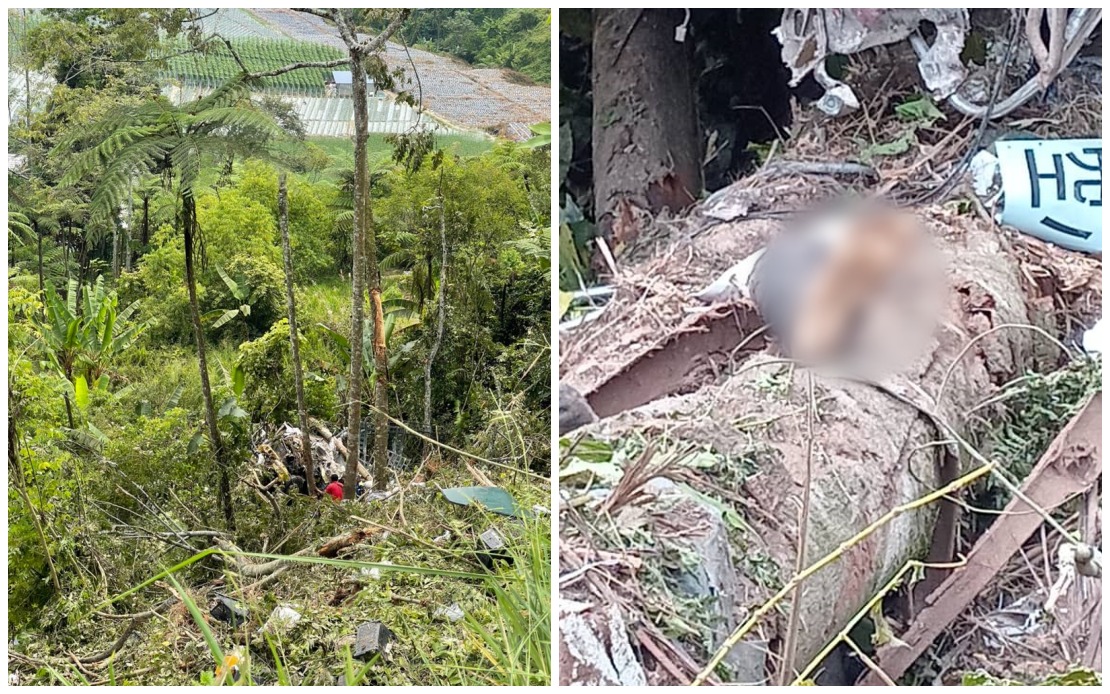
A fatal road accident claimed the life of a lorry driver on July 4 when his 10-tonne vehicle careened off a mountain road and plummeted into a ravine near the Pos Blau-Lojing Bridge in Gua Musang, Kelantan. The incident occurred in a remote area approximately 98 kilometres from the Gua Musang Fire and Rescue Station, presenting significant operational challenges for emergency responders attempting to retrieve the victim and conduct a preliminary investigation into the cause of the crash.
The sequence of events began when emergency services received a distress call at 11.58 am, reporting the missing lorry. The firefighting team from Gua Musang Fire and Rescue Station mobilised immediately, though the distance to the crash location meant rescuers did not arrive until 1.59 pm—a delay of nearly three hours that underscores the logistical difficulties inherent in servicing remote, mountainous regions of peninsular Malaysia. According to Asst Senior Fire Supt Muhammad Azrul Izzham Zulkifli, the station chief, the terrain and accessibility challenges required careful planning to safely retrieve the vehicle occupant from such a considerable depth.
Upon arrival, the rescue team discovered the 10-tonne lorry had descended approximately 150 feet into the ravine, landing in a densely vegetated area near an orchard. Preliminary reports from responding police officers indicated that the driver, a man in his 40s, had become trapped beneath a large tree trunk following the vehicle's impact. This unfortunate positioning meant that direct access to the casualty was compromised, necessitating the removal of substantial timber obstructing rescue efforts. The combination of the depth of the ravine, dense vegetation, and the pinning debris created a complex extraction scenario that demanded both technical expertise and physical labour from the assembled emergency response personnel.
Firefighters carefully worked to dislodge and remove the tree trunk that had trapped the driver, a painstaking process given the risk of causing additional harm or destabilising the debris field surrounding the casualty. Despite the efforts of the rescue team and their professional approach to the extraction, the driver was pronounced dead at the scene. The extended timeframe between the initial incident and the rescue arrival, combined with the severity of injuries sustained from the 150-foot fall, likely contributed to the fatal outcome. The body was subsequently handed over to police authorities for documentation and further processing according to standard procedures.
Gua Musang district police chief Supt Sik Choon Foo confirmed the incident through official channels and disclosed that police investigations remain ongoing to establish the precise circumstances that led to the vehicle's departure from the roadway. Initial inquiries would typically focus on factors such as mechanical failure, driver error, adverse weather conditions, road conditions, or potential medical episodes experienced by the driver immediately prior to losing control of the vehicle. The remote location and the apparent single-vehicle nature of the incident suggest that establishing an accurate sequence of events may require careful examination of physical evidence at the crash site, potential witness testimony from nearby orchards or residences, and consideration of the vehicle's mechanical condition.
This incident reflects broader road safety concerns in Malaysia's more remote and mountainous regions, where the combination of challenging terrain, extended emergency response times, and limited infrastructure creates heightened risks for motorists. The Pos Blau-Lojing area forms part of the main transportation corridor through the interior of peninsular Malaysia, a route that sees regular heavy vehicle traffic transporting goods between major distribution centres. The vulnerability of lorry drivers operating in such environments—often traversing steep grades, narrow stretches, and areas with minimal lighting or mobile communication coverage—remains an ongoing concern for transport industry stakeholders and highway safety advocates.
The response demonstrated by Gua Musang Fire and Rescue Station, whilst hampered by distance, illustrates the dedication of emergency personnel serving rural communities. However, the incident raises questions about optimal rescue infrastructure positioning in Kelantan and whether additional resources stationed at strategic points along major mountain routes could reduce response times for future emergencies. For the transport industry, this tragedy serves as a stark reminder of the importance of vehicle maintenance programmes, driver fatigue management, and adherence to speed restrictions on particularly hazardous sections of road.
The death marks another addition to Malaysia's road fatality statistics, a persistent public health concern affecting the nation. The lorry transport sector, which forms a critical backbone of Malaysia's logistics and supply chain networks, regularly grapples with safety challenges. Driver welfare, vehicle standards, and road design represent interconnected factors that contribute to accident prevention. This incident in Gua Musang will likely prompt renewed discussions among transport associations, government agencies, and industry bodies regarding best practices for maintaining safety on rural and mountainous thoroughfares.
Local authorities and the police investigation team will continue examining all available evidence to determine whether this was an isolated mechanical failure, a driver-related incident, or a consequence of road or environmental factors. The preliminary nature of current information means that final conclusions regarding causation may take several weeks to establish. What remains clear is that the remoteness of the location, the depth of the ravine, and the delayed response window all combined to create a scenario where survival proved impossible, even with prompt emergency services intervention.

