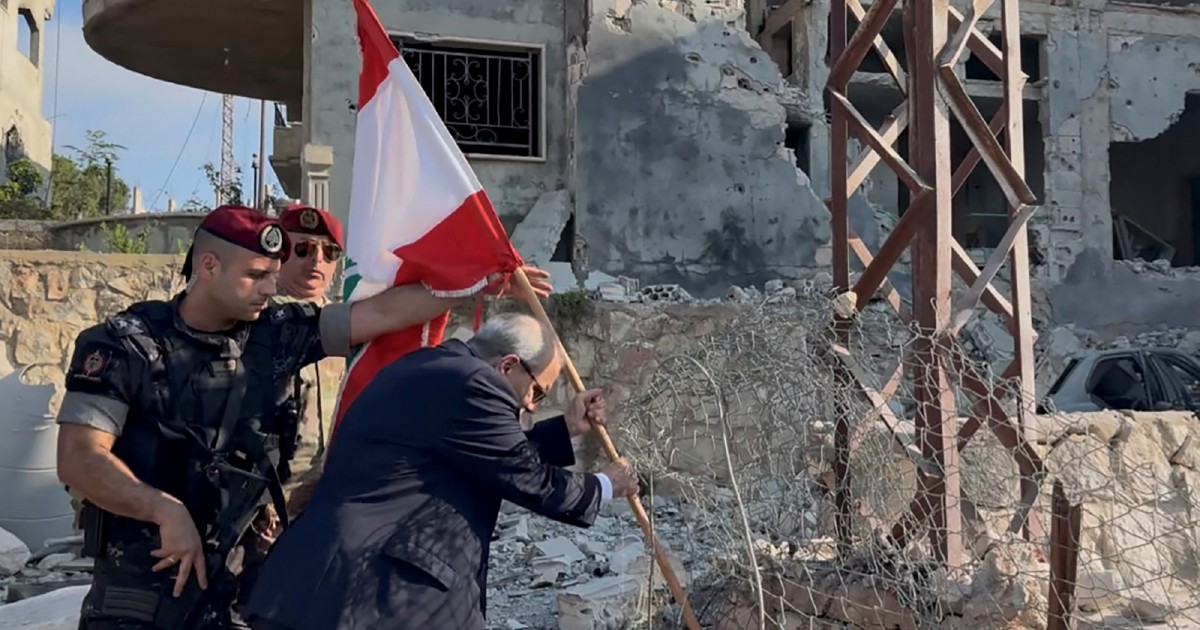
Lebanese Prime Minister Nawaf Salam has reiterated his government's commitment to securing a comprehensive Israeli withdrawal from all territories under occupation, marking a significant assertion of Beirut's negotiating position as efforts to stabilise the volatile Israel-Lebanon border continue. Speaking during a visit to Zawtar al-Gharbiyah, a village in southern Lebanon where government troops have recently established a military presence, Salam underscored that achieving this goal remains a central objective of Lebanese policy.
The visit itself carries considerable symbolic weight, representing a visible reassertion of Lebanese state authority in border areas that have long been contested or inadequately controlled by central government forces. The deployment of the Lebanese army to villages in these strategically sensitive zones signals Beirut's determination to consolidate sovereignty and extend its administrative reach into regions where non-state actors have historically wielded significant influence. Such moves are essential to Lebanon's broader efforts to rebuild institutional capacity and demonstrate to both regional and international observers that the state retains viable control over its territory.
Salam's remarks reflect the delicate balancing act that Lebanese political leadership must maintain when addressing the question of occupied territories. The statement serves multiple audiences simultaneously: domestically, it reassures Lebanese citizens and political factions that the government remains committed to national sovereignty and territorial integrity; regionally, it positions Lebanon as a state unwilling to accept the status quo of Israeli presence; and internationally, it frames Beirut as a reasonable actor pursuing legitimate grievances through political channels rather than military confrontation.
The question of Israeli-occupied Lebanese land has been a persistent source of tension between the two countries, with previous agreements and ceasefire arrangements establishing frameworks that have often proven inadequate or subject to dispute. The Shebaa Farms area, along with sections of the Golan Heights, represent territorial disputes that have simmered for decades and occasionally flared into armed conflict. These territorial questions intersect with broader questions of sovereignty, refugee repatriation, and the terms under which international peacekeeping mechanisms operate along the border.
Salam's emphasis on complete withdrawal, rather than partial agreements or compromises, suggests that Lebanese negotiators are seeking to establish clear red lines in any future diplomatic engagement. This positioning may reflect either genuine confidence in Lebanon's bargaining position or a necessary rhetorical stance required by domestic political realities, where public opinion strongly supports maximalist demands regarding territorial integrity. The distinction between stated objectives and realistic negotiating outcomes remains significant, however, as actual diplomatic processes typically involve compromise.
The timing of such statements warrants attention given the broader regional context. Lebanon faces multiple concurrent challenges, including economic collapse, political fragmentation, and the humanitarian crisis created by hosting over a million Syrian refugees. Against this backdrop, assertions about securing territorial concessions can serve as a unifying national narrative that transcends Lebanon's deep sectarian and political divisions, at least temporarily. When the state emphasises foreign policy objectives like territorial recovery, it potentially creates psychological space for addressing domestic reconstruction priorities.
For Malaysia and other Southeast Asian observers, Lebanon's situation illustrates the complex dynamics that govern territorial disputes in regions experiencing protracted geopolitical tensions. The Lebanese case demonstrates how territorial questions become interwoven with questions of state legitimacy, military capacity, and international alignment. Like certain Southeast Asian states navigating their own maritime boundary disputes or territorial claims, Lebanon must balance the rhetorical commitment to maximalist positions with pragmatic assessment of what diplomatic engagement and military capacity can realistically achieve.
The presence of Lebanese armed forces in border villages also raises questions about the sustainability of such deployments and their protection against various security threats. International observers, particularly those monitoring compliance with UN Security Council resolutions related to Lebanese arms and military capabilities, will be watching closely to assess whether these deployments represent genuine structural changes in state capacity or temporary political positioning. The ability to maintain security and prevent infiltration or cross-border incidents depends not merely on military presence but on adequate training, equipment, and international support.
Salam's government faces the challenge of translating political declarations into tangible results that improve Lebanon's strategic position. This requires calibrating diplomatic engagement carefully, maintaining coalition-building with regional powers and international actors, and demonstrating that Lebanon itself is a reliable and responsible partner in any negotiated framework. The Lebanese government's capacity to deliver on territorial security and sovereignty depends partly on resources and capabilities that currently lie beyond its immediate reach, necessitating continued international engagement and potential mediation by actors with leverage over all parties.
Moving forward, Lebanese policymakers must navigate between maintaining principled negotiating positions on territorial issues while simultaneously addressing the urgent humanitarian and economic crises affecting Lebanese citizens. The balance between external security concerns and internal state collapse represents one of Lebanon's most pressing dilemmas, and the sustainability of assertions about territorial recovery depends ultimately on whether the Lebanese state can restore functional governance and institutional capacity.

