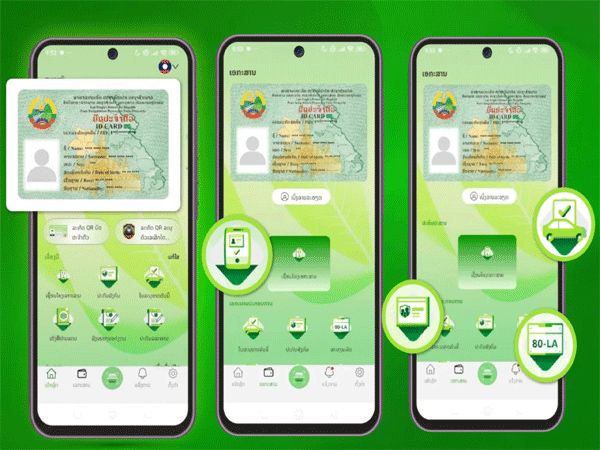
Laos has completed a significant milestone in its digital transformation agenda by formally decommissioning its decades-old paper identity document system and introducing the LAeID application, a mobile-based digital identity platform. The Ministry of Public Security announced the nationwide rollout after issuing formal directives to all government ministries, agencies, and the general public. From 18 July, the familiar white and green identity cards that have been in circulation throughout the country are no longer accepted for any official government transactions, marking a decisive shift toward a paperless administrative system.
The transition represents a fundamental change in how Laotian citizens interact with government services and manage their personal documentation. Rather than maintaining stacks of paper documents—identity cards, household registration books, birth certificates, and various permits—residents can now consolidate their official records onto a single smartphone application. This consolidation addresses long-standing inefficiencies in government service delivery, where citizens previously needed to visit multiple offices, wait in queues, and present numerous documents to complete routine administrative tasks.
The LAeID platform operates as a digital wallet designed to eventually incorporate a comprehensive suite of official documents. While the initial rollout focuses exclusively on digital identity card functionality, the system's architecture allows for gradual integration with other government databases. The Ministry of Public Security has outlined plans to progressively add birth certificates, marriage records, health insurance documentation, social security information, vehicle registration papers, driving licences, and passport data to the platform. This phased approach reflects practical implementation realities, acknowledging that connecting fragmented government databases requires substantial technical coordination and cybersecurity preparations.
Registration procedures have been deliberately streamlined to encourage rapid public adoption. Citizens can register at district and provincial public security offices throughout the country, where officials assist with the digital identity card application process. The system uses each citizen's identity number as a default username, with passwords transmitted via SMS following account approval or created during initial registration. This straightforward authentication mechanism was designed to accommodate users with varying levels of digital literacy, a critical consideration in a nation where smartphone penetration has expanded rapidly but digital service familiarity remains developing.
The practical benefits for ordinary citizens are substantial and immediately apparent. The elimination of physical documents reduces daily inconvenience—individuals no longer need to carry multiple cards and papers or worry about loss or damage. More significantly, the shift addresses systemic inefficiencies that have long plagued government service delivery. Administrative procedures that previously consumed hours of citizen time, involving visits to various offices and repeated document verification, can potentially be compressed into minutes through the LAeID application. For government agencies, the digital transition promises operational cost reductions through decreased paperwork handling, reduced document storage requirements, and streamlined inter-agency information sharing.
This modernisation initiative positions Laos within a broader Southeast Asian trend toward digital governance. Regional neighbours including Thailand, Vietnam, and Indonesia have pursued similar digital identity and e-government initiatives, though with varying implementation timelines and technological sophistication levels. Laos' relatively accelerated rollout, despite the nation's developing infrastructure status, reflects international pressure and regional competitive dynamics to modernise public administration systems. The move also aligns with the country's participation in ASEAN frameworks that increasingly emphasise digital connectivity and cross-border digital services integration.
The data management implications deserve careful consideration. Centralising personal information within the LAeID system creates both administrative efficiencies and cybersecurity vulnerabilities. The Ministry of Public Security's management of the unified digital database means that government data protection protocols become critically important. Citizen information—identity numbers, household composition, health records, vehicle ownership, and eventually passport details—concentrates within a single digital ecosystem. Any security breach could expose sensitive information at scale. The government's cybersecurity preparedness and data protection standards will likely face scrutiny as the system expands and integrates with additional databases.
The transition also reshapes government-citizen relationships in subtle but significant ways. When citizens previously visited government offices in person to conduct transactions, they encountered bureaucrats face-to-face and had opportunities to negotiate, explain circumstances, or appeal decisions directly. Digital systems, by contrast, enforce standardised procedures and algorithmic processing with limited human discretion. This shift toward automated transactions may improve consistency and reduce corruption opportunities, but it could also create barriers for vulnerable populations—elderly citizens, rural residents with limited digital access, or those unfamiliar with smartphone applications. Laos will need to maintain parallel support systems and offline alternatives during this transition period to ensure inclusive access.
The government's phased implementation strategy reflects lessons learned from digital transformation projects elsewhere. Rather than attempting to integrate all services simultaneously, which could overwhelm technical infrastructure and confuse users, the LAeID platform begins with basic identity verification and progressively adds functionality. This approach allows technical teams to identify and resolve system vulnerabilities, permits public adoption curves to stabilise, and enables feedback mechanisms to inform subsequent feature additions. However, the timeline for achieving full integration across all government databases remains unspecified, leaving uncertainty about when citizens can expect the complete range of digital services.
For Malaysian observers, Laos' digital identity initiative offers instructive parallels and contrasts with regional developments. Malaysia's MyKad system and emerging digital identity initiatives demonstrate that Southeast Asian governments increasingly recognise digital identity infrastructure as fundamental to modern governance. However, each nation's implementation reflects distinct technological capabilities, administrative cultures, and citizen expectations. Laos' emphasis on phasing out paper documents entirely, rather than maintaining dual systems, suggests a more decisive administrative approach than some regional counterparts have adopted.
The LAeID rollout ultimately reveals Laos' determination to modernise its governance infrastructure despite economic and developmental constraints. By consolidating personal documentation onto mobile platforms and connecting government databases, the nation aims to deliver faster, more efficient public services while reducing administrative burden on both citizens and agencies. However, success depends substantially on sustained investment in cybersecurity, inclusive design for diverse user populations, and maintaining public trust in the digital system. As other Southeast Asian nations observe Laos' implementation, the LAeID platform's effectiveness in practice will inform regional discussions about balancing digital efficiency with citizen accessibility and data protection standards.

