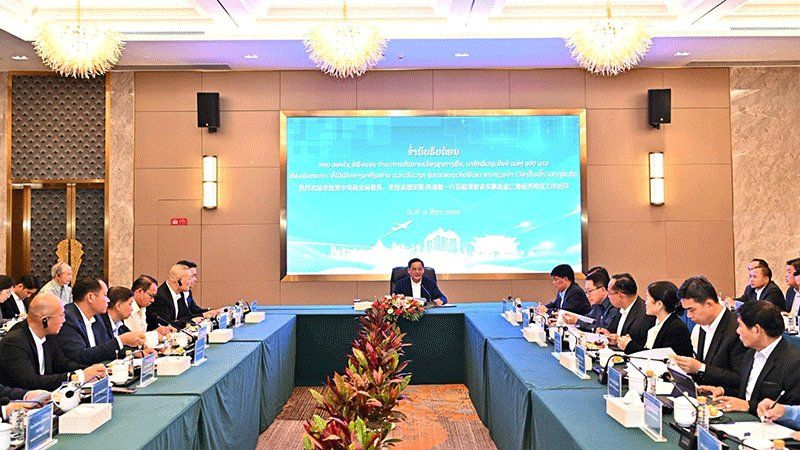
Laos Prime Minister Sonexay Siphandone has signalled growing concerns about the management and performance of the Golden Triangle Special Economic Zone, announcing a push for tighter oversight and more sustainable development practices during a working visit to the strategically important zone this week. The call reflects mounting pressure on authorities to improve returns on foreign investment and ensure that economic activity in the 10,000-hectare zone, located in Bokeo province's Tonpheung district, delivers tangible benefits to the nation and its people.
Over nearly two decades since its establishment in 2007, the Golden Triangle SEZ has attracted approximately US$10 billion in cumulative investment, drawing companies across manufacturing, real estate, hospitality, banking, tourism and numerous service sectors. Yet despite this substantial capital inflow, the zone has underperformed relative to its potential. Officials acknowledge that only 60 per cent of activities outlined in investor contracts have materialised, revealing significant gaps between planned and actual economic development and suggesting systemic challenges in governance, enforcement and project delivery.
The Prime Minister's Tuesday visit carried unmistakable signals that Vientiane is reconsidering its approach to the zone's administration. Dr Sonexay instructed zone authorities to strengthen management systems and enforce existing regulations more rigorously, particularly concerning cross-border operations and financial flows. He emphasised that all transactions—whether related to trade, investment, wages or services—must be processed through Laos's banking system, a measure designed to increase transparency and prevent unaccounted capital movements in what remains a porous borderland.
Among his specific directives was a call to tighten border management at the zone's entry and exit points, addressing a persistent challenge in an area where Laos, Myanmar and Thailand converge and where the Chinese border lies nearby. The zone's geographical position offers obvious commercial advantages, providing investors with access to vast consumer and labour markets across Southeast Asia and southwestern China. However, this same location creates vulnerability to irregular cross-border flows, smuggling and labour trafficking—issues that stronger regulatory enforcement could help mitigate.
Dr Sonexay identified several sectors as deserving heightened investment focus to drive sustainable expansion: tourism, manufacturing, processing, transport, education and public health. This sectoral prioritisation suggests official thinking has shifted toward development that generates broader social benefits rather than purely extractive or speculative activities. The emphasis on tourism and transport reflects recognition that the zone's unique geographic position at the tri-border confluence could anchor a regional economic corridor linking Southeast Asia with China's southwestern frontier.
The zone currently hosts more than 10,000 registered workers, with an additional 10,000-plus investors, business operators, residents and tourists present at any given time. More than 400 government officials representing various state agencies work within the zone's administration. These figures underscore the zone's significance as an economic hub and its complexity as a governance challenge, requiring coordination across multiple ministries and border management bodies.
A critical element of the Prime Minister's reform agenda concerns the zone's concession agreements and the role of its Management and Administration Committee. Dr Sonexay instructed officials to update these documents to align with relevant legislation and strengthen the Committee's operational effectiveness. This reflects awareness that contractual arrangements and institutional frameworks established years ago may no longer reflect current legal standards or operational realities, creating ambiguities that complicate enforcement and encourage circumvention.
Cross-border labour mobility presents another dimension of the zone's complexity. Dr Sonexay called for enhanced cooperation with Myanmar and Thailand regarding worker movements, including improved airline connections and effective mechanisms to manage the influx of migrant labourers from neighbouring countries. This signals recognition that while the zone's competitiveness depends partly on access to regional labour markets, unregulated migration creates social and security challenges requiring bilateral coordination.
The Golden Triangle SEZ's underperformance—with only 60 per cent of contracted activities realised—reflects broader challenges affecting special economic zones across the Mekong region. These include weak enforcement capacity, corruption, political instability in neighbouring countries, incomplete infrastructure development and difficulty attracting higher-value investments. For Malaysia and other ASEAN economies, Laos's experience offers instructive lessons about the necessity of robust institutional frameworks, transparent regulatory environments and genuine political commitment to enforcing rules consistently.
For Malaysian investors and businesses operating in Southeast Asia, the Prime Minister's emphasis on banking-system transactions and stricter financial controls suggests Laos intends to professionalise its economic zone operations. This could eventually improve the zone's credibility as an investment destination, though it may initially impose compliance burdens. Regional observers will watch whether these announced reforms translate into sustained enforcement or remain largely rhetorical.
The zone's location within the broader Mekong region—and proximity to China's Yunnan province—positions it as a potential anchor for Belt and Road Initiative connectivity projects. However, realising this potential requires precisely the kind of regulatory strengthening and institutional capacity-building that Dr Sonexay's directives now emphasise. Success depends on whether Vientiane can maintain political will for reform despite competing pressures and corruption risks inherent to borderland economies.
Moving forward, the litmus test for Laos's commitment will be implementation. The one-stop service system for investors requires genuine streamlining rather than merely shifting bureaucratic bottlenecks. Enhanced border controls must balance legitimate commerce against overreach that stifles business. Regional cooperation on labour standards and cross-border management requires sustained diplomatic engagement and institutional capacity that remains underdeveloped. If successfully executed, these reforms could position the Golden Triangle SEZ as a more credible and sustainable investment platform; if neglected, the zone risks becoming another example of unrealised potential in Southeast Asia's complex economic landscape.

