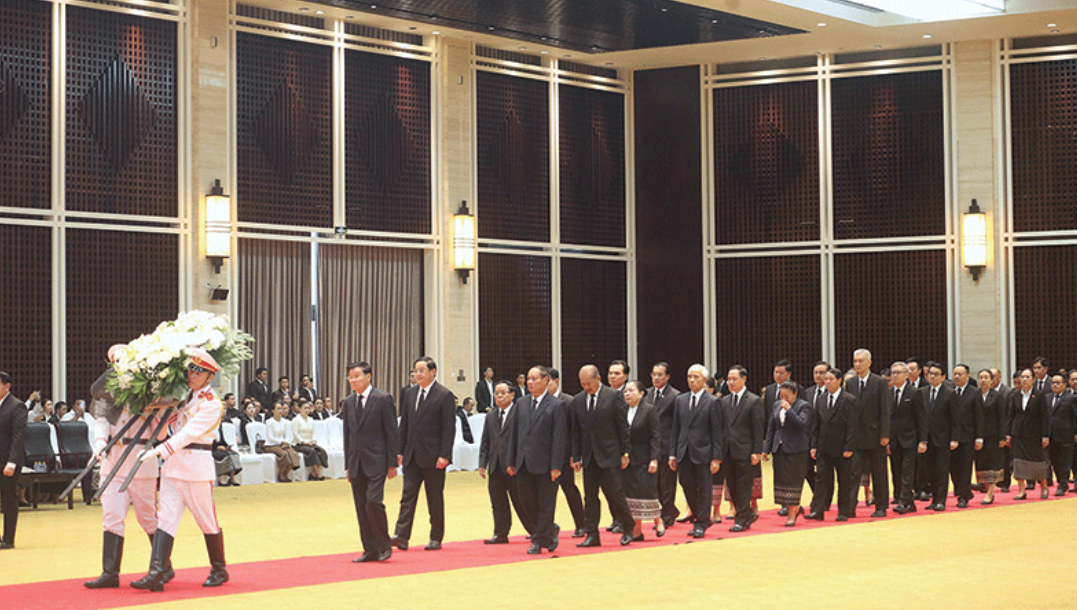
Laos observed a solemn state tribute on Sunday for National Assembly President Xaysomphone Phomvihane, who died on Saturday, as the country's top political leadership assembled at the National Convention Hall in Vientiane to honour the deceased dignitary. Party Secretary General and President Thongloun Sisoulith led the procession of high-ranking officials, National Assembly members, government ministers, and representatives from civil society organisations who came to pay their final respects through wreath-laying ceremonies. The gathering reflected the significance accorded to Xaysomphone's role within Laos's political establishment and the esteem in which he was held across governmental and non-governmental sectors.
Xaysomphone's death represents a substantial loss within Laos's leadership echelon. As a member of the Politburo of the Lao People's Revolutionary Party Central Committee and president of the legislative chamber, he held one of the nation's most influential positions. His contribution to strengthening the National Assembly as an institution, coupled with his involvement in shaping national defence, economic development, and the country's broader political trajectory, underscores the depth of his impact on contemporary Lao governance. The extended mourning period—declared by the Party Central Committee, National Assembly, Government and Lao Front for National Development from 8 to 12 August—signals recognition of his standing within the political hierarchy.
The ceremonial response demonstrated the hierarchical nature of Lao governance, with delegations representing each pillar of the state structure participating in formal tributes. Prime Minister Dr Sonexay Siphandone led the Government's delegation, while the Party Central Committee's representation was headed by President Thongloun himself. Deputy Prime Minister and Finance Minister Santiphab Phomvihane, who shares family ties with the deceased, represented the Phomvihane family at the proceedings. This layered representation—encompassing family, governmental apparatus, and party machinery—illustrated how Lao political culture interweaves personal relationships with institutional responsibilities, a characteristic feature of governance across the region.
The participation of Vietnamese leaders at the tribute ceremony underscores the profound strategic partnership between Laos and Vietnam, a relationship that extends through security, economic, and diplomatic channels. A delegation led by Tran Thanh Man, a member of the Vietnamese Communist Party's Politburo and chairman of Vietnam's National Assembly, travelled to Vientiane to lay wreaths. Additionally, representatives from Vietnam's Ministry of Public Security and Ministry of National Defence attended, reflecting how bilateral ties transcend typical diplomatic courtesy. This show of respect from Hanoi carries particular significance given the historical interconnections between the two countries' revolutionary movements and ongoing defence collaboration.
Vietnam's declaration of two days of national mourning on 10-11 August further illustrates the exceptional regard accorded to Xaysomphone within Vietnamese leadership circles. Such bilateral mourning protocols are typically reserved for senior figures whose contributions extend beyond their national boundaries or whose relationships with neighbouring states are historically significant. The gesture implies that Vietnamese officials recognised Xaysomphone's role not merely as a Lao leader but as someone whose work contributed to the regional balance and the two countries' joint strategic interests.
Xaysomphone's biographical details reveal his connections to Laos's revolutionary heritage. Born on 12 December 1956, he was one of six sons of President Kaysone Phomvihane, the founding figure of the Lao People's Democratic Republic and architect of the contemporary Lao state. His siblings occupy or have occupied prominent positions within the political establishment—among them Santiphab Phomvihane, currently Deputy Prime Minister and Finance Minister. This familial concentration of power within the upper echelons of Lao governance reflects patterns common to other one-party socialist states in Southeast Asia, where revolutionary families often maintain multi-generational influence across state institutions.
The wreath-laying ceremonies at the National Convention Hall extended across multiple days, with Monday witnessing additional tributes from line ministry officials, Vientiane municipal authorities, and retired party and governmental figures. Foreign diplomatic representatives stationed in Laos also visited to express condolences, indicating that Xaysomphone's standing extended into the international community beyond regional peers. This sustained ceremonial process, permitted to continue through 11 August, provided institutional channels for various constituencies—from active officials to retired cadres to business sector representatives—to mark their acknowledgment of his passing and his contributions to national development.
The state funeral arrangements scheduled for 12 August at the That Luang esplanade, Vientiane's most significant religious and national landmark, emphasised the ceremonial weight attributed to Xaysomphone's departure. Cremation at That Luang with full state honours represents the highest funeral protocol within Lao practice, typically reserved for founding leaders or those deemed to have fundamentally shaped the nation. The timing and location of the ceremony, combined with the extended mourning period, signal that Lao authorities considered Xaysomphone's life and work as integral to the republic's institutional continuity and symbolic identity.
For Malaysian and Southeast Asian observers, Xaysomphone's death and the regional response it generated offer insights into how power transitions occur within communist-party states in the region. The participation of Vietnamese leaders and the bilateral mourning protocols demonstrate that leadership succession in Laos involves consultation and coordination with Vietnam, reflecting the asymmetric but institutionalised relationship between these two nations. Within ASEAN, Laos occupies a particular position as the smallest member by population and economy; developments within its top tier of governance carry implications for regional stability and the functioning of ASEAN consensus-building mechanisms, particularly within forums where Lao representatives participate.
The centrality of family connections in the succession architecture highlighted by Xaysomphone's death—his brothers holding ministerial positions, their families participating in official ceremonies—suggests that leadership transitions within Laos may follow patterns where institutional roles and family networks remain intertwined. This observation holds relevance for understanding how power may transition following other senior departures and whether established families will maintain or adjust their institutional presence in coming years. The international community's measured response, reflected in Vietnamese attendance and foreign diplomats' participation, indicates external actors are monitoring these transitions carefully to assess continuity or potential shifts in Lao policy orientation.
Xaysomphone's decades of service within the National Assembly and his contribution to legislative institutional development represent a particular focus of the commemorations. The National Assembly, while formally holding legislative authority, functions within constraints common to single-party systems where executive and party structures retain predominant power. Yet Xaysomphone's long tenure in this role and the emphasis placed on his institutional contributions in tributes suggest he may have worked toward strengthening the legislature's advisory and representational functions within those structural parameters. His passing leaves a gap in the institutional memory of the Assembly and raises questions about succession within that body and how Lao governance might evolve if future National Assembly leaders prioritise similar institutional development.

