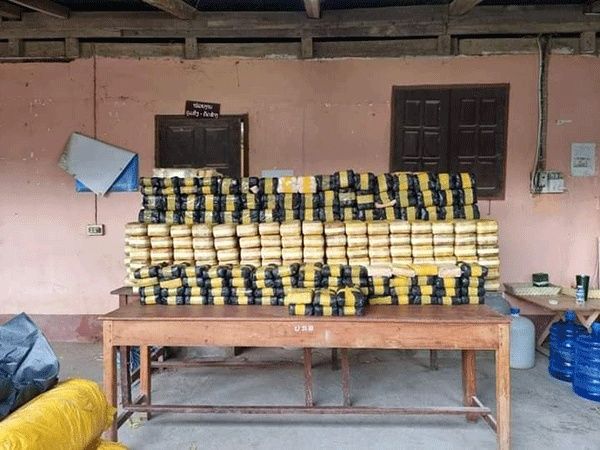
Central Laos is facing an escalating drug crisis that has prompted senior security officials to call for significantly stricter enforcement action. In Xaysomboun province, narcotic-related offences have emerged as the dominant criminal concern, accounting for nearly half of all recorded crimes during the first half of 2024. The revelation comes as the Lao government intensifies a long-standing campaign against drug trafficking that was elevated to national priority status five years ago, signalling a sustained commitment to combating what authorities view as a destabilising threat to regional stability.
The scale of the problem in Xaysomboun is striking. Between January and June this year, authorities documented 24 drug-related cases out of 54 total offences—a proportion that underscores how thoroughly narcotics trafficking has penetrated the province's criminal landscape. Only two of these cases have progressed to prosecution, with the remaining 22 still under investigation, suggesting that police resources remain stretched and case resolution moves slowly through the judicial system. This backlog raises questions about the effectiveness of current enforcement strategies and the capacity of local law enforcement to handle the volume of drug-related crime.
The meeting between Police Brigadier General Ouday Insouvanh and visiting Minister of Public Security Police Lieutenant General Vanthong Kongmany on August 7 underscored the gravity with which Vientiane treats the situation. The minister's presence in the province signalled high-level concern and provided a platform for officials to articulate the need for systemic changes in how security forces approach crime prevention. Rather than accept existing enforcement levels, the minister explicitly instructed provincial commanders to strengthen their efforts against drug trafficking and emerging drug variants—a directive that suggests current tactics are deemed insufficient.
National figures reveal the scope of Laos's broader drug enforcement efforts. Prime Minister Sonexay Siphandone reported that authorities processed 1,786 drug-related cases nationwide during the same six-month period, resulting in 4,025 arrests including 93 foreign nationals. This scale of activity demonstrates that drug enforcement consumes substantial police resources across the country. The confiscation of large quantities of drugs, drug manufacturing equipment, and vehicles associated with trafficking operations indicates that enforcement agencies are identifying significant supply-chain operations, yet the continuing prevalence of cases suggests they remain unable to stem the trade's expansion.
Beyond narcotics, Xaysomboun's security challenges reflect broader regional vulnerabilities. The province sits in central Laos with geographic proximity to both Thailand and Vietnam, positioning it as a potential transit corridor for illicit goods and a focal point for transnational crime. The minister's instructions to strengthen action against smuggling, human trafficking, illegal mining, and gambling operations acknowledge this reality. Each of these offences carries cross-border dimensions that complicate enforcement and require coordination beyond provincial boundaries—a logistical challenge that many Southeast Asian law enforcement agencies struggle to manage effectively.
Cybercrime and digital-based offences now occupy an elevated place within Xaysomboun's security priorities, reflecting a recognition that criminal activity has migrated online. Minister Vanthong's directive to strengthen oversight of social media use and tackle cybercrime represents an acknowledgment that traditional policing approaches are insufficient in an increasingly digitised environment. For Malaysia and other regional nations, this shift in Lao security thinking carries implications. As digital infrastructure expands across Southeast Asia, criminal networks exploit online platforms for drug trafficking coordination, money laundering, and recruitment—activities that provincial police forces often lack specialised training to investigate effectively.
Road safety emerged as another significant concern during the security review. Xaysomboun recorded 60 traffic accidents in the first half of 2024, resulting in four fatalities, 80 injuries, and approximately 2.56 billion kip in vehicle damage. While these figures may seem modest in isolation, they underscore how public safety extends beyond traditional crime categories. Poor road conditions, inadequate enforcement of traffic regulations, and vehicle safety standards contribute to death tolls that could be substantially reduced through targeted interventions. The substantial financial losses highlight how preventable accidents create economic drag on communities and divert resources from productive activities.
Tourism and foreign national monitoring constitute another dimension of Xaysomboun's security mandate. During the six-month period, officers inspected 1,698 tourists, of whom 396 were foreign nationals. This oversight function reflects concerns about visitor involvement in drug consumption, trafficking, or other illicit activities. For regional tourism industries, the implication is that Laos and neighbouring countries are tightening controls on foreign visitors—a development that could affect travel patterns and require tourists to navigate stricter documentation and monitoring procedures.
The minister's emphasis on strengthening political and ideological education among security personnel reveals underlying concerns about officer conduct and morale. His call for personnel to acknowledge weaknesses and take direct responsibility for work outcomes suggests that passive compliance and hierarchical deference have contributed to enforcement gaps. In Southeast Asian security contexts, corruption, inadequate training, and unclear accountability structures frequently undermine law enforcement effectiveness. Vanthong's instruction that immigration management and foreign national oversight be conducted professionally, with personnel assigned according to expertise, indicates that Vientiane recognises merit-based assignment and specialist training as prerequisites for effective security work.
For Malaysia and other Southeast Asian nations, Xaysomboun's experience carries cautionary lessons. Drug trafficking networks operate across borders, exploiting weak enforcement in transit countries to move narcotics between production zones in the Golden Triangle and consumption markets in Thailand, Malaysia, and beyond. Laos's struggle to contain drug-related offences at 44 percent of provincial crime suggests that regional coordination mechanisms remain insufficient. Malaysian law enforcement agencies monitoring drug flow patterns should consider whether Xaysomboun's enforcement gaps create vulnerabilities that traffickers exploit for onward shipment. The province's geographic position and reported trafficking volumes make it a critical node in regional drug supply chains.
The Lao government's sustained focus on drugs as a national priority, coupled with Xaysomboun's escalating case volumes, indicates that enforcement pressure has not yet achieved deterrent or interdict effects at scale. Whether the intensified measures announced during Minister Vanthong's visit will alter this trajectory remains uncertain. Effective drug enforcement typically requires sustained investment in training, intelligence gathering, cross-border coordination, and judicial capacity—areas where resource constraints often limit Southeast Asian law enforcement agencies. Xaysomboun's experience suggests that Laos recognises these challenges and is attempting to address them through centralised policy direction, though translating ministerial directives into field-level operational changes poses significant implementation challenges.

