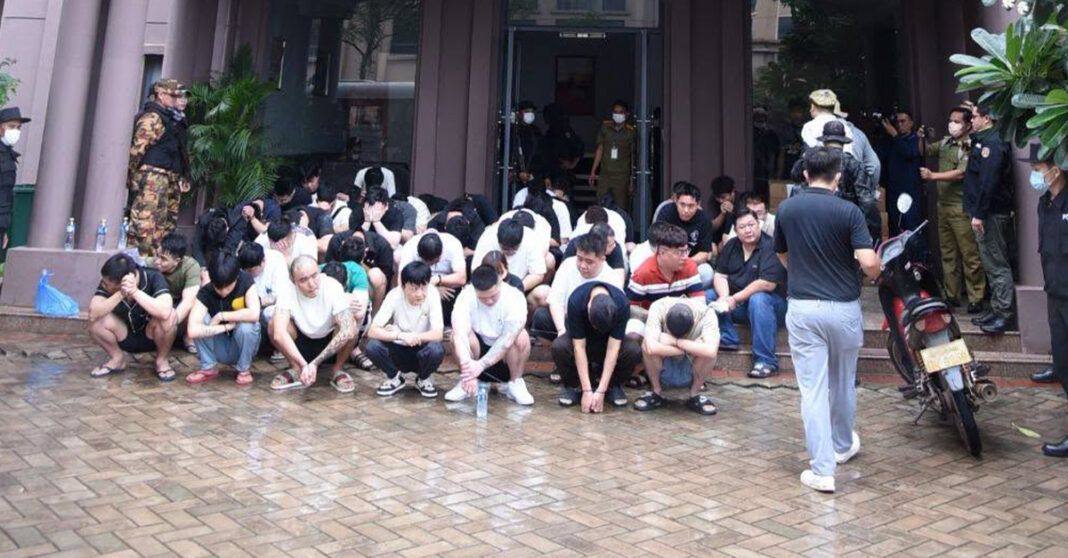
Vientiane's police force executed a significant raid on 8 August targeting a sprawling telecommunications fraud and online gambling enterprise housed within the Thatluang Lake Special Economic Zone, securing 261 detainees in what represents an escalating enforcement effort against cross-border criminal networks operating within Laos. The operation has underscored the growing sophistication and international scale of scam operations leveraging Southeast Asia as a operational hub, raising concerns for regional cybersecurity and law enforcement coordination.
The arrested suspects represented a diverse geographic footprint reflecting the transnational nature of modern fraud syndicates. Chinese nationals dominated the detainee population with 153 individuals, a figure that aligns with broader regional patterns of Chinese-led organised crime groups establishing telecommunications fraud bases across Southeast Asia. Vietnamese nationals followed as the second-largest contingent at 61 persons, while Thai detainees numbered 36. The remaining nationalities included five Taiwanese, two Malaysians, two South Koreans, and two Myanmar nationals, revealing how these operations recruit operatives from across the region's economic networks and diaspora communities.
Law enforcement officers catalogued substantial quantities of equipment seized during the operation, recovering nearly 500 desktop computers and laptops along with 2,355 mobile phones functioning as the technological infrastructure for the scam network. This infrastructure scale indicates the operation's systematic approach to conducting large-volume fraud campaigns, likely targeting victims across multiple countries simultaneously through coordinated telecommunications channels and digital payment systems. The building itself was identified as property controlled by Lao Thatluang Investment Development Co., Ltd., suggesting potential complexity regarding corporate complicity or shell company arrangements frequently exploited by organised criminal elements.
Laotian authorities have signalled that the investigation remains ongoing, with particular emphasis on identifying the operation's senior figures and broader criminal network. Officials indicated they are pursuing prosecutions against identified masterminds and accomplices under applicable domestic legislation. This investigative posture reflects a recognition that street-level operatives detained in such raids typically execute directives from more sophisticated organisational hierarchies located elsewhere or insulated through intermediaries. The willingness to continue investigation signals potential coordination with international partners, particularly given the multinational composition of the detained group.
The Thatluang Lake raid forms part of a demonstrably intensified campaign by Vientiane authorities targeting scam operations nationwide. The enforcement action comes amid mounting international pressure on Southeast Asian governments, including Laos, to address the regional scam epidemic that has generated billions of dollars in losses for victims globally, particularly affecting Malaysian, Thai, Singaporean and other neighbouring populations. Laos specifically has faced criticism from regional partners for allegedly tolerating scam operations on its territory, a concern that the recent enforcement activities appear designed to address through visible high-profile operations.
Demonstrating the coordinated nature of these enforcement efforts, Laotian authorities proceeded to deport 41 Thai suspects merely two days after the initial raid, transferring them to Thai counterparts via the 1st Lao-Thai Friendship Bridge on 10 August. This handover followed an earlier transfer of 32 Thai nationals through the same crossing on 6 August, bringing the total number of Thai nationals repatriated from Laos to at least 73 individuals in a concentrated two-week period. The bilateral cooperation mechanism reflects established judicial frameworks between the two countries and demonstrates functional transnational law enforcement capacity when political will aligns.
These deportations connected directly to an earlier enforcement operation conducted on 18 July targeting the ST Vegas complex situated in Dongphosy village, Hatsayfong district, Vientiane. That raid resulted in the detention of 589 suspected scammers representing diverse nationalities, with Thai nationals constituting the largest group, accompanied by Lao, Vietnamese and Cambodian detainees. The ST Vegas operation's scale and composition suggest the complex functioned as a significant regional node within broader scam networks, warranting its designation as a priority enforcement target.
The consecutive nature of these raids indicates Vientiane authorities possess intelligence regarding multiple interconnected scam facilities and are capitalising on momentum to dismantle operational capacity. The two-week window spanning from the ST Vegas operation through the Thatluang Lake raid and subsequent deportations suggests coordinated planning rather than isolated enforcement actions. This approach maximises disruption by preventing network reconstitution, as operatives are systematically removed from the operational environment through detention or deportation before managers can reorganise resources.
For Malaysia and other Southeast Asian nations whose citizens represent significant victim populations for these scam operations, the enforcement actions carry complicated implications. While the raids demonstrate apparent willingness by Laotian authorities to act against these criminal enterprises, the sheer number of detainees—over 850 individuals across the two major raids within weeks—indicates substantial ongoing operational capacity despite enforcement pressure. This suggests scam networks maintain sufficient recruitment pipelines and financial resources to quickly regenerate operational capability unless accompanied by disruption of their underlying organisational structures and financial flows.
The international composition of detained suspects highlights how these criminal networks deliberately recruit across national boundaries to complicate attribution and prosecution. The presence of Malaysian nationals among the detainees raises questions regarding recruitment mechanisms and whether individuals were trafficked or voluntarily participated, a distinction with significant implications for victim assistance and criminal liability frameworks. Malaysian authorities likely face a backlog of investigations into individuals conscripted into these operations, requiring effective information-sharing with Laotian counterparts.
Regional security analysts have observed that while individual raids generate headlines and temporarily disrupt operations, sustained elimination of scam networks requires comprehensive strategies addressing financial enablement, organisational management, recruitment systems and demand-side factors driving victim targeting. The sophistication evident in the Thatluang Lake operation—involving hundreds of workers, thousands of devices, and cross-border personnel coordination—suggests that law enforcement actions alone, without complementary financial intelligence and disruption of money laundering channels, may produce temporary rather than structural solutions to these networks' operational continuity. Laotian policymakers face pressure to demonstrate that enforcement intensity will persist rather than fluctuate cyclically based on international attention patterns.

