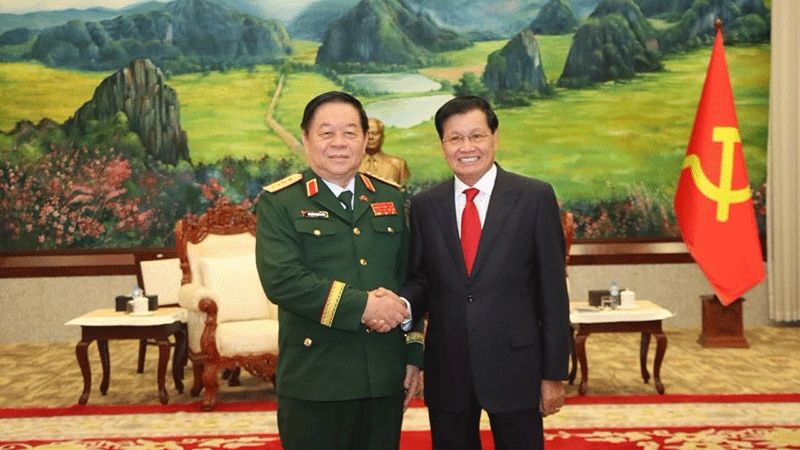
Vietnam's General Nguyen Trong Nghia, Chairman of the General Department of Politics of the Vietnam People's Army, concluded a significant three-day official visit to Laos this week, marking another chapter in the deepening defence relationship between the two Southeast Asian neighbours. During his stay from August 5 to 7, the general held high-level talks aimed at reinforcing military cooperation and cementing the strategic partnership that has defined Laos-Vietnam relations for decades.
President Thongloun Sisoulith of Laos, who also serves as Secretary General of the Lao People's Revolutionary Party Central Committee, received General Nguyen Trong Nghia on Thursday, August 6, and expressed strong approval of the outcomes emerging from parallel military discussions. The Lao leader characterised the visit as a meaningful continuation of efforts to strengthen the historic friendship and strategic cohesion binding the two nations together at institutional, governmental, and popular levels.
The bilateral relationship between Laos and Vietnam carries profound historical significance for the region. Both countries share a communist political heritage, intertwined revolutionary histories, and geographical proximity that has shaped their foreign policy priorities for generations. The consistency with which both nations emphasise their "special solidarity" and "comprehensive cooperation" reflects the depth of institutional ties that extend across party structures, state apparatus, and military establishments. For Malaysian and broader Southeast Asian observers, these exchanges underscore how regional powers maintain and revitalise their core strategic partnerships through regular high-level engagement.
General Khamlieng Outhakaisone, Laos's Deputy Prime Minister and Minister of National Defence, also received the Vietnamese delegation, signalling the importance placed on defence matters within Vientiane's governance hierarchy. The participation of such senior officials indicates that military cooperation ranks among the foremost priorities in the bilateral agenda, reflecting shared security concerns and the role defence collaboration plays in anchoring the comprehensive strategic partnership.
During technical-level discussions with Lieutenant General Vongsone Inpanphim, Deputy Minister of National Defence and Director General of the General Department of Politics of the Lao People's Army, the two sides identified specific areas for expanded cooperation. Border management emerged as a particularly critical focus, given the shared frontier and the need for coordinated approaches to transnational challenges including drug trafficking, human smuggling, and irregular migration. Both militaries recognised that effective border administration requires ongoing military-to-military coordination, intelligence sharing, and joint operational protocols.
Military-to-military exchanges constitute another pillar of the expanding relationship. Such exchanges facilitate professional development, standardisation of procedures, and the building of personal relationships among officers that often prove invaluable during crises. The emphasis on defence cooperation as a "key pillar" of the comprehensive strategic partnership reflects the conviction that military strength and institutional coordination underpin political stability and economic development in the region.
A particularly notable element of the discussions involved commitment to educating younger generations about the historical foundations and enduring relevance of Laos-Vietnam solidarity. This pedagogical emphasis suggests both nations view their relationship not merely as a contemporary strategic alignment but as a civilisational and historical bond requiring active transmission to successor generations. For militaries, this educational component means cultivating officer corps and enlisted personnel who understand and respect the historical context of bilateral relations, fostering institutional continuity in defence cooperation.
Political education and party-to-party work also featured prominently in the agreed cooperation framework. This reflects the fact that both Laos and Vietnam remain one-party communist states where the ruling party maintains comprehensive oversight of state institutions, including the military. Party-to-party exchanges and political education initiatives therefore carry institutional weight comparable to formal state-level diplomacy, reinforcing ideological alignment and coordination on strategic matters.
The timing and tenor of General Nguyen Trong Nghia's visit carries broader implications for Southeast Asia's evolving geopolitical landscape. As regional powers navigate complex great-power competition and shifting security dynamics, bilateral relationships like the Laos-Vietnam partnership gain strategic salience. Vietnam's efforts to strengthen military ties with Laos reflect Hanoi's interest in maintaining close coordination with a neighbour whose territory and airspace hold significant strategic value. Conversely, Laos benefits from Vietnamese support in addressing internal security challenges and development needs, creating mutual interest in the relationship's sustainability.
For Malaysia and other ASEAN members, the Laos-Vietnam dynamic illustrates how bilateral partnerships operate within the regional multilateral framework. The Association of Southeast Asian Nations emphasises non-interference and bilateral dispute resolution, yet member states maintain discrete strategic relationships that coexist with collective ASEAN identity. Understanding how individual member states cultivate strategic partnerships provides insight into ASEAN's internal dynamics and the varied security architectures competing for influence across the region.
General Nguyen Trong Nghia's departure from Vientiane concluded a visit that, while conducted in diplomatic language emphasising friendship and solidarity, underscored the practical military dimensions of Laos-Vietnam cooperation. The concrete agreements on border management, personnel training, and military exchanges translate bilateral rhetoric into operational reality. Such engagement mechanisms—formal visits, technical meetings, and institutional frameworks—constitute the infrastructure through which states deepen relationships and coordinate responses to shared challenges.
Looking forward, the framework established during this visit positions both nations to address emerging transnational security threats through coordinated military action and intelligence cooperation. The emphasis on comprehensive cooperation spanning political education, operational coordination, and personnel development suggests both countries view their defence partnership as foundational to broader regional stability and development. For Malaysian policymakers and regional analysts, monitoring such bilateral developments provides essential context for understanding ASEAN's internal balance of power and the strategic calculations shaping Southeast Asian geopolitics.

